

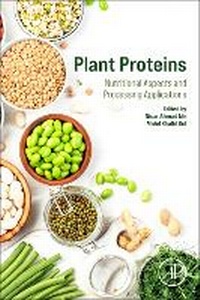
PLANT PROTEINS
Nutritional Aspects and Processing Applications
Published on 26. March 2026
Book
Paperback/Softback
516 pages
978-0-443-32976-0 (ISBN)
Description
Plant Proteins: Nutritional Aspects and Processing Applications covers various methods used to extract and purify plant proteins for nutrition, health, and new product development. The book identifies techniques and modifications such as fermentation, radiation, and ball-milling to characterize plant protein structure and functionality. Readers will learn how each method serves a different purpose in enhancing flavor, texture, and/or shelf-life. A special focus on plant-based meat is discussed, along with insights on how plant-based proteins effect digestive wellness and the microbiome. Additional sections address the nano-reduction of plant-based proteins and their role in the delivery of different bioactive compounds and health benefits.
More details
Language
English
Place of publication
San Diego
United States
Publishing group
Elsevier Science Publishing Co Inc
Target group
Professional and scholarly
Product notice
Paperback (trade)
Unsewn / adhesive bound
Dimensions
Height: 235 mm
Width: 191 mm
Weight
450 gr
ISBN-13
978-0-443-32976-0 (9780443329760)
Copyright in bibliographic data and cover images is held by Nielsen Book Services Limited or by the publishers or by their respective licensors: all rights reserved.
Schweitzer Classification
Other editions
Additional editions
E-Book
03/2026
Elsevier
€139.99
Available for download
Persons
Dr. Nisar Ahmad Mir received his Ph.D. from Department of Food Engineering and Technology, Sant Longowal Institute of Engineering and Technology. Currently, he is an Assistant Professor in the Department of Food Technology, Islamic University of Science and Technology, Awantipora, J & K. He received National Postdoctoral Fellowship (NPDF) from Science and Engineering Research Board (SERB), Department of Science and Technology (DST), Govt. of India. His research interests include cereal and pseudocereal protein characterization, modification and applications in food systems. He has published more than twenty research and review articles in journals of repute. He has also published more than fifteen book chapters with esteemed publishers. He serves as a reviewer to highly reputed journals like Trends in Food Science and Technology, Food Hydrocolloids, Food Chemistry, International Journal of Biological Macromolecules, Heliyon, Journal of Food Processing and Preservation, Journal of Food Process Engineering and International Journal of Food Properties.
Dr. Mohd Khalid Gul, works as an Academic Visiting Researcher at the School of Food Science and Nutrition, University of Leeds, Leeds, United Kingdom. His primary affiliation is with National Institute of Technology, Rourkela, India, where he works as an Assistant Professor in Food Process Engineering. His research interests include investigating different aspects of food colloids, such as their functionalities and modifications, sensory-satiety relationships, interactions between proteins and polysaccharides, encapsulation, and food safety. To date Khalid has published over +62 peer reviewed journal articles and book chapters. He is part of the Editorial Board for Food Packaging and Shelf Life, and Associate Editor for Frontiers in Nutrition - Food Science.
Dr. Mohd Khalid Gul, works as an Academic Visiting Researcher at the School of Food Science and Nutrition, University of Leeds, Leeds, United Kingdom. His primary affiliation is with National Institute of Technology, Rourkela, India, where he works as an Assistant Professor in Food Process Engineering. His research interests include investigating different aspects of food colloids, such as their functionalities and modifications, sensory-satiety relationships, interactions between proteins and polysaccharides, encapsulation, and food safety. To date Khalid has published over +62 peer reviewed journal articles and book chapters. He is part of the Editorial Board for Food Packaging and Shelf Life, and Associate Editor for Frontiers in Nutrition - Food Science.
Content
1. Novel plant-based proteins: Extraction and nutritional, functional, and structural characteristics.
2. Protein modification: Physical methods for protein modification and their impact on protein characteristics
3. Biological (Fermentation and Enzymatic) modification of plant-based proteins and their effect on protein characteristics
4. Chemical methods for protein modification and their impact on protein characteristics
5. Ball milling-based modification of plant protein and its impact on protein characteristics
6. Radiation-induced modification of plant proteins and their impact on protein characteristics
7. Nanoreduction of plant-based proteins and their role for delivery of different bioactive compounds
8. Bioactive peptides from plant- based proteins: Preparation, characterization and health benefits
9. Harnessing the versatility of plant proteins in food applications: A special focus on plant-based meat
10. Role of plant proteins as emulsifiers: Mechanism and potential applications
11. Plant-based antifreeze proteins: Mechanism of action and applications
12. Plant proteins and gut health: Understanding the impact on microbiota and human health
13. Bioactive films and coatings from plant proteins for vegetables, extending the shelf life of fresh-cut fruits and vegetables
14. Impact of processing on different properties and biological activities of plant-based proteins
15. Plant proteins and their role in enhancing nutritional quality and human health
16. Sustainability of novel plant proteins in terms of their cost and other functional properties
2. Protein modification: Physical methods for protein modification and their impact on protein characteristics
3. Biological (Fermentation and Enzymatic) modification of plant-based proteins and their effect on protein characteristics
4. Chemical methods for protein modification and their impact on protein characteristics
5. Ball milling-based modification of plant protein and its impact on protein characteristics
6. Radiation-induced modification of plant proteins and their impact on protein characteristics
7. Nanoreduction of plant-based proteins and their role for delivery of different bioactive compounds
8. Bioactive peptides from plant- based proteins: Preparation, characterization and health benefits
9. Harnessing the versatility of plant proteins in food applications: A special focus on plant-based meat
10. Role of plant proteins as emulsifiers: Mechanism and potential applications
11. Plant-based antifreeze proteins: Mechanism of action and applications
12. Plant proteins and gut health: Understanding the impact on microbiota and human health
13. Bioactive films and coatings from plant proteins for vegetables, extending the shelf life of fresh-cut fruits and vegetables
14. Impact of processing on different properties and biological activities of plant-based proteins
15. Plant proteins and their role in enhancing nutritional quality and human health
16. Sustainability of novel plant proteins in terms of their cost and other functional properties