

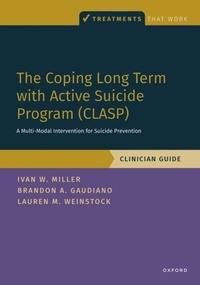
The Coping Long Term with Active Suicide Program (CLASP)
A Multi-Modal Intervention for Suicide Prevention
Published on 27. September 2022
Book
Paperback/Softback
144 pages
978-0-19-009526-0 (ISBN)
Description
Coping Long-Term with Active Suicide Program (CLASP): Clinician Guide is an indispensable resource for clinicians, researchers and mental health practitioners who are interested in implementing a cost-effective and proven suicide prevention intervention, with the newly developed 'Coping Long Term with Active Suicide Program' (CLASP). With a foundation grounded in theoretical models of suicide prevention, as well as in the relevant empirical literature, CLASP is unique among suicide prevention interventions in that it targets multiple risk factors for suicide using a combination of formats and therapeutic strategies. The treatment can be delivered in-person and/or via telehealth to focus on values-goals clarification, problem solving, and significant other support. This book introduces the rationale and empirical support for the CLASP intervention, followed by a session-by-session description of how to implement CLASP in clinical practice and with specific targeted populations at risk.
Reviews / Votes
This book provides a step-by-step guide to implementing the Coping Long-Term with Active Suicide Program (CLASP) for clinicians.I finished reading this book with a sense that I had a comprehensive understanding of this program, when to apply it, and how. * Keri A. Frantell, The Society for the Psychology of Sexual Orientation and Gender Diversity * The CLASP: A Clinician's Guide to a Multi-Modal Intervention for Suicide Prevention is an essential resource for therapists. Driven by scientific research, the treatment model targets key factors for suicide prevention with practical, effective strategies. Beautifully written and filled with detailed examples, this outstanding manual provides crucial tools for clinical care with compassion and competence.Kathryn H. Gordon, Ph.D., Licensed Psychologist and Author of The Suicidal Thoughts Workbook Evidence-based treatments are sorely needed as we aim for zero suicides. Developed through rigorous research, CLASP combines frequent caring contacts with targeted therapy to offer a unique treatment option for clinicians. It can be provided through a variety of platforms and is an ideal approach for today's healthcare settings.
Brian K. Ahmedani, PhD, LMSW, Senior Scientist, Henry Ford Health System This guide for clinicians presents a much-needed evidence-based brief intervention to prevent suicidal behavior. The guide is well-written and easy to follow using a plain
language (non-jargony) step-by-step approach to conducting CLASP. The authors are an accomplished team of clinicians with many years of experience working with
suicidal patients and their vast experience is in evidence throughout the guide.
Barbara Stanley, PhD, Professor of Medical Psychology, Department of Psychiatry, Columbia University and Director, Suicide Prevention Training Implementation & Evaluation Center for Practice Innovations, New York State Psychiatric Institute
More details
Series
Language
English
Place of publication
New York
United States
Dimensions
Height: 178 mm
Width: 254 mm
Thickness: 10 mm
Weight
246 gr
ISBN-13
978-0-19-009526-0 (9780190095260)
Copyright in bibliographic data and cover images is held by Nielsen Book Services Limited or by the publishers or by their respective licensors: all rights reserved.
Schweitzer Classification
Other editions
Additional editions
Ivan Miller | Brandon Gaudiano | Lauren Weinstock
The Coping Long Term with Active Suicide Program (CLASP)
A Multi-Modal Intervention for Suicide Prevention
E-Book
07/2022
OUP eBook
€27.49
Available for download
Ivan Miller | Brandon Gaudiano | Lauren Weinstock
The Coping Long Term with Active Suicide Program (CLASP)
A Multi-Modal Intervention for Suicide Prevention
E-Book
07/2022
OUP eBook
€27.49
Available for download
Persons
Ivan W. Miller, Ph.D., is a clinical psychologist and Professor of Psychiatry and Human Behavior. He also holds the roles of Director of the Consortium for Research Innovation in Suicide Prevention (CRISP) at Brown University, and Director of Psychosocial Research at Butler Hospital. He has published over 300 scientific articles, chapters and books, including over 75 focused on suicide.
Brandon A Gaudiano, Ph.D. is a clinical psychologist and Professor of Psychiatry and Human Behavior at Brown University. He is also the Clinical Director of the Transitional Outpatient Program at Butler Hospital and is a Research Psychologist at the Providence VA Medical Center. He has published over 150 articles and related works.
Lauren M. Weinstock, PhD., is a clinical psychologist and Professor of Psychiatry and Human Behavior. She also holds the role of Associate Director for the Consortium for Research Innovation in Suicide Prevention (CRISP) at Brown University. She has written over 90
scientific articles and book chapters.
Brandon A Gaudiano, Ph.D. is a clinical psychologist and Professor of Psychiatry and Human Behavior at Brown University. He is also the Clinical Director of the Transitional Outpatient Program at Butler Hospital and is a Research Psychologist at the Providence VA Medical Center. He has published over 150 articles and related works.
Lauren M. Weinstock, PhD., is a clinical psychologist and Professor of Psychiatry and Human Behavior. She also holds the role of Associate Director for the Consortium for Research Innovation in Suicide Prevention (CRISP) at Brown University. She has written over 90
scientific articles and book chapters.
Content
- Chapter 1: CLASP Introduction, Development, and Empirical Support
- Chapter 2: Theoretical Rationale and Components of CLASP
- Chapter 3: Treatment Description
- Chapter 4: Detailed Session Outline
- Chapter 5: Adaptations for Specific Populations and Settings
- Chapter 6: Requirements and Training of CLASP Advisors
- Chapter 7: The CLASP Intervention: Questions, Issues, and Concluding Comments
- Appendix
- References