

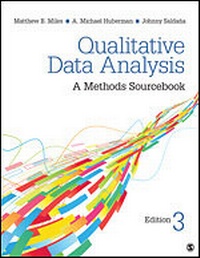
Qualitative Data Analysis
A Methods Sourcebook
3rd Edition
Published on 11. June 2013
Book
Paperback/Softback
408 pages
978-1-4522-5787-7 (ISBN)
Description
The Third Edition of Miles & Huberman's classic research methods text is updated and streamlined by Johnny Saldana, author of The Coding Manual for Qualitative Researchers. Several of the data display strategies from previous editions are now presented in re-envisioned and reorganized formats to enhance reader accessibility and comprehension. The Third Edition's presentation of the fundamentals of research design and data management is followed by five distinct methods of analysis: exploring, describing, ordering, explaining, and predicting. Miles and Huberman's original research studies are profiled and accompanied with new examples from Saldana's recent qualitative work. The book's most celebrated chapter, "Drawing and Verifying Conclusions," is retained and revised, and the chapter on report writing has been greatly expanded, and is now called "Writing About Qualitative Research." Comprehensive and authoritative, Qualitative Data Analysis has been elegantly revised for a new generation of qualitative researchers.
Reviews / Votes
"This book is a wonderful, valuable and truly important contribution to the field of qualitative research. Saldana has updated, innovated and altogether advanced the insights and wisdom of practice of Miles and Huberman in such a way as to amplify the value of their work while making it even more usable and inspiring to researchers concerned with engaging in rigorous, reflective, systematic and reliable empirical research. This book adds great value to the field of qualitative research and I will use it in all of my methods courses with great enthusiasm and appreciation. Thank you for your hard work, I am grateful!" -- Sharon Ravitch "I definitely plan to adopt this edition when it becomes available. In recent years, this has been a text I encourage student to use as a reference. The new edition will be a required textbook for my Advanced Qualitative Research course." -- Mary Madden "The new material is well integrated, it still has the Miles and Huberman content, but the presentation strategy adds new material and "softens" the quantitative edge of the Second Edition. I think the section on coding (Chapter 4) is an excellent presentation and surpasses similar material in Saldana's previous book. This book continues to be the best basic sourcebook available." -- James H. Banning "Yes, this is a much improved 3rd edition and I know my students will find it extremely valuable as a handbook, instructional guide, and day-to-day resource in their qualitative analysis activities." -- Carolyn Garcia "All in all, the updated Sourcebook is an impressive accomplishment in preserving Miles and Huberman's original vision while also moving research approaches forward with the changing demands of the field...Saldana reorganized the Sourcebook with great care and according to Miles and Huberman's five primary purposes of data display: to explore, describe, order, explain, and predict...With all its helpful updates, the new and improved Sourcebook provides an extensive overview and a range of practical applications of possible and 'elusive' qualitative data analysis methods (aimed primarily at textual data)." -- Elmar Hashimov, Ball State University Several of the data display strategies from the previous editions are retained and MHS [Miles, Huberman, and Saldana] presents them in reenvisioned and reorganized formats that will, I believe, enhance reader accessibility and comprehension...The book provides a display (p. 340), taken from the second edition, that illustrates an "overview of qualitative data analysis processes." The display is a concept map, starting with the research question and ending with the dissemination and use of the report. The bulk of MHS (Chapters 5-10) talks about what is in between these points. The concept map is complex and will be valuable for readers, whatever their level of coding experience. -- Molly Engle, American Journal of EvaluationMore details
Edition
3rd Revised edition
Language
English
Place of publication
Thousand Oaks
United States
Target group
College/higher education
Edition type
Revised edition
Dimensions
Height: 279 mm
Width: 216 mm
Weight
944 gr
ISBN-13
978-1-4522-5787-7 (9781452257877)
Copyright in bibliographic data and cover images is held by Nielsen Book Services Limited or by the publishers or by their respective licensors: all rights reserved.
Schweitzer Classification
Other editions
New editions
Matthew B. Miles | A. Michael Huberman | Johnny Saldana
Qualitative Data Analysis - International Student Edition
A Methods Sourcebook
Book
01/2019
4th Edition
SAGE Publications Inc
€66.34
Shipment within 15-20 days
Previous edition
Book
01/1994
2nd Edition
SAGE Publications Inc
€84.38
Article exhausted; check for reprint
Persons
Matthew B. Miles, a social psychologist, had a career-long interest in strategies for educational reform. His work focused on planned change in education, group and organizational studies, and the dissemination and implementation of research findings. His first major research project was a four-year study of six new, innovative public schools. A. Michael Huberman's long-term interests were in scientific epistemology and adult cognition and knowledge use. His work focused on education policy, school reform, and the practical translation of research knowledge into effective school practice. His first extensive project was a four-year study of an experimental elementary school's implementation of Piagetian theories into classroom practice.. Johnny Saldana is Professor Emeritus from Arizona State University's (ASU) School of Film, Dance, and Theatre in the Herberger Institute for Design and the Arts, where he taught from 1981 to 2014. He received his BFA in Drama and English Education in 1976, and MFA in Drama Education in 1979 from the University of Texas at Austin.
Saldana is the author of Longitudinal Qualitative Research: Analyzing Change through Time (AltaMira Press, 2003); Fundamentals of Qualitative Research (Oxford University Press, 2011); Ethnotheatre: Research from Page to Stage (Left Coast Press, 2011); Thinking Qualitatively: Methods of Mind (Sage Publications, 2015); a commissioned title for Routledge's World Library of Educationalists Series, Writing Qualitatively: The Selected Works of Johnny Saldana (Routledge, 2018); co-author with the late Matthew B. Miles and A. Michael Huberman for Qualitative Data Analysis: A Methods Sourcebook (4th ed., Sage Publications, 2020); co-author with Matt Omasta for Qualitative Research: Analyzing Life (Sage Publications, 2018); and the editor of Ethnodrama: An Anthology of Reality Theatre (AltaMira Press, 2005). Previous editions of The Coding Manual for Qualitative Researchers have been translated into Korean, Turkish, and Chinese-Simplified.
Saldana's methods works have been cited and referenced in more than 16,000 research studies conducted in over 130 countries in disciplines such as K-12 and higher education, medicine and health care, technology and social media, business and economics, government and social services, the fine arts, the social sciences, human development, and communication. He has published a wide range of research articles in journals such as Research in Drama Education, The Qualitative Report, Multicultural Perspectives, Youth Theatre Journal, Journal of Curriculum and Pedagogy, Teaching Theatre, Research Studies in Music Education, Cultural Studies ? Critical Methodologies, the International Journal of Qualitative Methods, the International Review of Qualitative Research, and Qualitative Inquiry, and has contributed several chapters to research methods handbooks. His most popular journal article, "Blue-Collar Qualitative Research: A Rant" (Qualitative Inquiry, 2014), has been downloaded by over 3,000 readers, according to ResearchGate.
Saldana's research in qualitative inquiry, data analysis, and performance ethnography has received awards from the American Alliance for Theatre & Education, the National Communication Association-Ethnography Division, the American Educational Research Association's Qualitative Research Special Interest Group, New York University's Program in Educational Theatre, the Children's Theatre Foundation of America, and the ASU Herberger Institute for Design and the Arts.
Saldana is the author of Longitudinal Qualitative Research: Analyzing Change through Time (AltaMira Press, 2003); Fundamentals of Qualitative Research (Oxford University Press, 2011); Ethnotheatre: Research from Page to Stage (Left Coast Press, 2011); Thinking Qualitatively: Methods of Mind (Sage Publications, 2015); a commissioned title for Routledge's World Library of Educationalists Series, Writing Qualitatively: The Selected Works of Johnny Saldana (Routledge, 2018); co-author with the late Matthew B. Miles and A. Michael Huberman for Qualitative Data Analysis: A Methods Sourcebook (4th ed., Sage Publications, 2020); co-author with Matt Omasta for Qualitative Research: Analyzing Life (Sage Publications, 2018); and the editor of Ethnodrama: An Anthology of Reality Theatre (AltaMira Press, 2005). Previous editions of The Coding Manual for Qualitative Researchers have been translated into Korean, Turkish, and Chinese-Simplified.
Saldana's methods works have been cited and referenced in more than 16,000 research studies conducted in over 130 countries in disciplines such as K-12 and higher education, medicine and health care, technology and social media, business and economics, government and social services, the fine arts, the social sciences, human development, and communication. He has published a wide range of research articles in journals such as Research in Drama Education, The Qualitative Report, Multicultural Perspectives, Youth Theatre Journal, Journal of Curriculum and Pedagogy, Teaching Theatre, Research Studies in Music Education, Cultural Studies ? Critical Methodologies, the International Journal of Qualitative Methods, the International Review of Qualitative Research, and Qualitative Inquiry, and has contributed several chapters to research methods handbooks. His most popular journal article, "Blue-Collar Qualitative Research: A Rant" (Qualitative Inquiry, 2014), has been downloaded by over 3,000 readers, according to ResearchGate.
Saldana's research in qualitative inquiry, data analysis, and performance ethnography has received awards from the American Alliance for Theatre & Education, the National Communication Association-Ethnography Division, the American Educational Research Association's Qualitative Research Special Interest Group, New York University's Program in Educational Theatre, the Children's Theatre Foundation of America, and the ASU Herberger Institute for Design and the Arts.
Content
Contents
List of Displays
Preface to the Third Edition by Johnny Saldana
Acknowledgements from the Second Edition by Matthew B. Miles and A. Michael Huberman
About the Authors
PART I. THE SUBSTANTIVE START
1. Introduction
2. Research Design and Management
3. Ethical Issues in Analysis
4. Fundamentals of Qualitative Data Analysis
PART II. DISPLAYING THE DATA
5. Designing Matrix and Network Displays
6. Methods of Exploring
7. Methods of Describing
8. Methods of Ordering
9. Methods of Explaining
10. Methods of Predicting
PART III: MAKING GOOD SENSE
11. Drawing and Verifying Conclusions
12. Writing About Qualitative Research
13. Closure
Appendix - An Annotated Bibliography of Qualitative Research Resources
References
Index
List of Displays
Preface to the Third Edition by Johnny Saldana
Acknowledgements from the Second Edition by Matthew B. Miles and A. Michael Huberman
About the Authors
PART I. THE SUBSTANTIVE START
1. Introduction
2. Research Design and Management
3. Ethical Issues in Analysis
4. Fundamentals of Qualitative Data Analysis
PART II. DISPLAYING THE DATA
5. Designing Matrix and Network Displays
6. Methods of Exploring
7. Methods of Describing
8. Methods of Ordering
9. Methods of Explaining
10. Methods of Predicting
PART III: MAKING GOOD SENSE
11. Drawing and Verifying Conclusions
12. Writing About Qualitative Research
13. Closure
Appendix - An Annotated Bibliography of Qualitative Research Resources
References
Index