

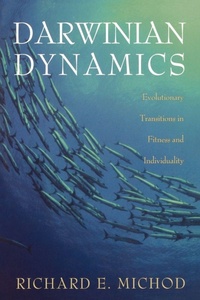
Darwinian Dynamics
Evolutionary Transitions in Fitness and Individuality
Published on 30. January 2000
Book
Paperback/Softback
280 pages
978-0-691-05011-9 (ISBN)
Description
The concept of fitness has long been a topic of intense debate among evolutionary biologists and their critics, with its definition and explanatory power coming under attack. In this book, Richard Michod offers a fresh, dynamical interpretation of evolution and fitness concepts. He argues that evolution has no enduring products; what matters is the process of genetic change. Whereas many biologists have focused on competition and aggression as determining factors in survival, Michod, by concentrating on the emergence of individuality at new and more complex levels, finds that cooperation plays even a greater role. Michod first considers the principles behind the hierarchically nested levels of organization that constitute life: genes, chromosomes, genomes, cells, multicellular organisms, and societies. By examining the evolutionary transitions from the molecular level up to the whole organism, the author explains how cooperation and conflict in a multilevel setting leads to new levels of fitness. He builds a model of fitness drawing on recent developments in ecology and multilevel selection theory and on new explanations of the origin of life.
Michod concludes with a discussion of the philosophical implications of his theory of fitness, a theory that addresses the most fundamental and unique concept in all of biology.
Michod concludes with a discussion of the philosophical implications of his theory of fitness, a theory that addresses the most fundamental and unique concept in all of biology.
Reviews / Votes
"Darwinian Dynamics is an excellent and masterful synthesis of the current understanding about how evolutionary principles work at the various levels of biological organization... Much like Einstein's theories of relativity extended classical mechanics, Michod's multi-selection theory is an extension of classical selection theory... Well produced and current... Michod has written what should be a classic for decades to come."--Norman A. Johnson, Bioscience "Individuality and fitness, two of the most fundamental concepts in evolutionary theory, are anything but simple. Theoretical biologist Richard Michod reviews and extends the state of the art for these subjects in Darwinian Dynamics... [These are] some of the most exciting advances in modern biology from one of its most able practitioners."--David Sloan Wilson, Human BiologyMore details
Language
English
Place of publication
New Jersey
United States
Target group
Professional and scholarly
College/higher education
Product notice
Paperback (trade)
Illustrations
25 tables, 24 line illus.
Dimensions
Height: 234 mm
Width: 156 mm
Thickness: 15 mm
Weight
430 gr
ISBN-13
978-0-691-05011-9 (9780691050119)
Copyright in bibliographic data and cover images is held by Nielsen Book Services Limited or by the publishers or by their respective licensors: all rights reserved.
Schweitzer Classification
Other editions
Additional editions
E-Book
07/2022
1st Edition
Princeton University Press
€66.49
Available for download
Person
Richard E. Michod is Professor of Ecology and Evolutionary Biology at the University of Arizona. He is the author of Eros and Evolution: A Natural Philosophy of Sex. Among the volumes he has coedited are Evolution of Sex: An Examination of Current Ideas and The Origin of Values.
Content
Preface Acknowledgments CHAPTER 1 The Language of Selection Plan of the Book Darwinian Dynamics Major Evolutionary Transitions Cooperation and Conflict Fisherian Fitness Deconstructing Fitness Selection as Fitness Covariance Mathematical Models Adequacy Criterion for Understanding Fitness Definitions of Basic Concepts CHAPTER 2 Origin of Fitness Complementarity Spontaneous Creation Self-Replication and the Origin of Fitness Replicator Dynamics Design Analysis of Molecular Replicator Life History Evolution Survival of the Fittest Survival of Anybody Overview of the Origin of Fitness CHAPTER 3 The First Individuals Origin of Gene Networks Cooperation and Conflict Survival of the First Evolutionary Transitions Are Inherently Nonlinear Origin of Hypercycles Quasispecies Population Structure Kin Selection in Evolutionary Transitions Conflict Mediation through Individuality Further Evolution of the Cell Heritable Capacities of Single Cells Reconsidering Adaptedness and Fitness Early Transitions in Evolution CHAPTER 4 Evolution of Interactions Gene Frequency Change Population Growth Frequency-Dependent Selection Constant Selection Adaptive Topography Frequency Dependence Decouples Fitness in a Selection Hierarchy Selection as Covariance Fisher's Fundamental Theorem Evolution in Hierarchically Structured Populations Evolution of Multicellular Organisms Kin Selection Game Theory Modification of Genetic Constraints Population Dynamics and Natural Selection Fitness Minima Prisoner's Dilemma Spatial Structure and the Evolution of Cooperation The Problem of Frequency Dependence CHAPTER 5 Multilevel Selection of the Organism A Scenario A Model for the Emergence of Organisms Recurrence Equations Within-Organism Mutation Selection Model Mutation Rate Covariance Methods The Risk of Development Increase of Cooperation Level of Cooperation among Cells within Organisms Fitness of Organisms Effect of Sex and Diploidy on the Emerging Organism Strengths and Weaknesses of the Model CHAPTER 6 Rediscovering Individuality Evolutionary Individuals Two-Locus Modifier Model Model Parameters Equilibria of the System Evolution of the Germ Line Evolution of the Mutation Rate Evolution of Self-Policing Evolution of Adult Size Effect of Transition on the Level of Cooperation Increase of Fitness Covariance at Organism Level Heritability of Fitness and the Evolution of Individuality Sex and Individuality Origin of Multicellular Life Transitions in Individuality CHAPTER 7 Fitness Explanations Overview of Fitness and Natural Selection Trading Fitness through Cooperation Kinship and Population Structure Conflict Mediation Reconsidering Fitness The "Tautology Problem" Surrogates for Natural Selection Evolution of Selfing Cost of Sex Immortality, Death, and the Life Cycle Kin Selection of Altruism Heterozygote Superiority Sickle Cell Anemia Darwin's Dilemmas CHAPTER 8 A Philosophy of Fitness Dynamics of Design What Makes Biology Different? Success and Design Long-Term versus Short-Term Measures of Fitness Darwinian Dynamics Natural Selection as a Biological Law Paradigms for Natural Selection Fitness in Darwinian Dynamics The Insufficiency of Individual Fitness Heritability and Natural Selection Schema for Natural Selection The Propensity Interpretation of Fitness Brandon's Approach Heritable Capacities as Components of Design Overall Adaptedness of Organisms Masking of Adaptiveness Are Adaptation Concepts Necessary? F-Fitness and Evolutionary Explanations Explaining Fitness APPENDIX A Supporting Analyses Statistics of Fitness and Selection Equilibria for Modifier Model (G = 0) Cost of Sex in Diploids APPENDIX B Fitness Phrases APPENDIX C Notation Notes References Index