

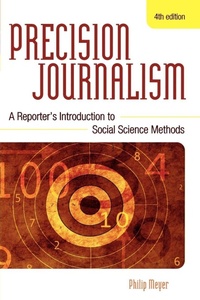
Precision Journalism
A Reporter's Introduction to Social Science Methods
4th Edition
Published on 25. February 2002
Book
Paperback/Softback
304 pages
978-0-7425-1088-3 (ISBN)
Description
Philip Meyer's work in precision journalism established a new and ongoing trend-the use by reporters of social science research techniques to increase the depth and accuracy of major stories. In this fully updated, fourth edition of the classic Precision Journalism (known as The New Precision Journalism in its third edition), Meyer shows journalists and students of journalism how to use new technology to analyze data and provide more precise information in easier-to-understand forms. New to this edition are an overview of the use of theory and science in journalism; game theory applications; introductions to lurking variables and multiple and logistic regression; and developments in election surveys. Key topics retained and updated include elements of data analysis; the use of statistics, computers, surveys, and experiments; database applications; and the politics of precision journalism. This accessible book is an important resource for working journalists and an indispensable text for all journalism majors.
Reviews / Votes
Precision Journalism is a must-read for journalists intending to do in-depth reporting in the 21st century-whether it involves polling, data analysis, or understanding complex reports. This updated edition clearly explains social science methods and how to effectively use them to increase the accuracy and credibility of news stories. -- Brant Houston, University of Missouri, Columbia Precision Journalism is the mother ship from which most other books on computer-assisted journalism were launched. Philip Meyer not only encouraged journalists to learn social science methods three decades ago, but he also provided a clear, user-friendly book to get them started. Now in its fourth edition, Precision Journalism continues to be an important resource in the arsenal of tools available to journalism educators, students, and practitioners. -- Kevin Kawamoto, University of Washington In his professional mode, Meyer leads readers into becoming as comfortable with numbers as with words-data analysis, basic statistical procedures, constructing and interpreting surveys, using databases, and much more. At the same time he warns working journalists not to get too comfortable with numbers. * Columbia Journalism Review * Philip Meyer's vision of 'precision journalism' as a standard of excellence for our profession is sharper than ever in this thoroughly updated and expanded edition of his classic book. -- Stephen K. Doig, Arizona State UniversityMore details
Edition
4th edition
Language
English
Place of publication
United States
Publishing group
Bloomsbury Publishing Plc
Target group
College/higher education
Professional and scholarly
Dimensions
Height: 229 mm
Width: 152 mm
Thickness: 16 mm
Weight
446 gr
ISBN-13
978-0-7425-1088-3 (9780742510883)
Copyright in bibliographic data and cover images is held by Nielsen Book Services Limited or by the publishers or by their respective licensors: all rights reserved.
Schweitzer Classification
Other editions
Additional editions
E-Book
02/2002
4th Edition
Rowman & Littlefield Publishers
€44.99
Available for download
Person
Philip Meyer is the Knight Chair in Journalism at the University of North Carolina at Chapel Hill.
Content
Chapter 1 The Journalism We Need
Chapter 2 Using Numbers Rationally
Chapter 3 Some Elements of Data Analysis
Chapter 4 Harnessing the Power of Statistics
Chapter 5 Computers
Chapter 6 Surveys
Chapter 7 Lurking Variables, Part I
Chapter 8 Lurking Variables, Part II
Chapter 9 Experiments: In the Lab, in the Field, and in Nature
Chapter 10 Databases
Chapter 11 How to Analyze an Election
Chapter 12 The Politics of Precision Journalism
Chapter 13 Appendix: Three Things to Measure with Census Data
Chapter 2 Using Numbers Rationally
Chapter 3 Some Elements of Data Analysis
Chapter 4 Harnessing the Power of Statistics
Chapter 5 Computers
Chapter 6 Surveys
Chapter 7 Lurking Variables, Part I
Chapter 8 Lurking Variables, Part II
Chapter 9 Experiments: In the Lab, in the Field, and in Nature
Chapter 10 Databases
Chapter 11 How to Analyze an Election
Chapter 12 The Politics of Precision Journalism
Chapter 13 Appendix: Three Things to Measure with Census Data