

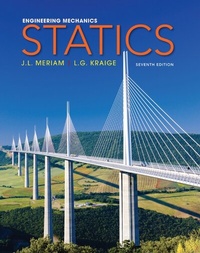
Engineering Mechanics - Statics
Statics
7th Edition
Published on 5. December 2013
Book
Hardback
544 pages
978-0-470-61473-0 (ISBN)
Description
In the latest edition of Engineering Mechanics, Meriam and Kraige deliver a uniquely powerful learning solution: a sound conceptual foundation for solving mechanics problems that is the hallmark of the Meriam text. The new edition offers easy-to-use tools and resources to drive positive outcomes/success. Most notably, it retains the hallmark of the Meriam texts by teaching realistic engineering problem solving without sacrificing rigor.
Other features include easy-to-use assessment tools to create effective learning pathways through the text, immediate feedback and remediation, along with problem solving practice to help develop confidence and take control. The text seamlessly integrates additional examples and practice exercises that are crafted to bridge the gap between a conceptual grasp from lectures and the textbook to the solution of homework and exam problems. Presentation resources, automated scoring, diagnostic reporting and tools enable consistent delivery.
More details
Edition
7., Auflage
Language
English
Place of publication
Chichester
United Kingdom
Publishing group
John Wiley and Sons Ltd
Target group
College/higher education
Dimensions
Height: 25.4 cm
Width: 20.9 cm
Thickness: 24 mm
Weight
1111 gr
ISBN-13
978-0-470-61473-0 (9780470614730)
Schweitzer Classification
Other editions
New editions
Book
05/2016
8th Edition
Wiley
€57.90
Article is exhausted; no reprint
Book
07/2014
8th Edition
Wiley
€277.80
Article is exhausted; no reprint
Previous edition
J. L. Meriam | L. G. Kraige
Engineering Mechanics - Statics
Book
03/2006
6th Edition
Wiley
€179.00
Article exhausted; check for reprint
Content
CHAPTER 1 INTRODUCTION TO STATICS.
1.1 Mechanics.
1.2 Basic Concepts.
1.3 Scalars and Vectors.
1.4 Newton's Laws.
1.5 Units.
1.6 Law of Gravitation.
1.7 Accuracy, Limits and Approximations.
1.8 Problem Solving in Statics.
1.9 Chapter Review.
CHAPTER 2 FORCE SYSTEMS.
2.1 Introduction.
2.2 Force.
SECTION A TWO-DIMENSIONAL FORCE SYSTEMS.
2.3 Rectangular Components.
2.4 Moment.
2.5 Couple.
2.6 Resultants.
SECTION B THREE-DIMENSIONAL FORCE SYSTEMS.
2.7 Rectangular Components.
2.8 Moment and Couple.
2.9 Resultants.
2.10 Chapter Review.
CHAPTER 3 EQUILIBRIUM.
3.1 Introduction.
SECTION A EQUILIBRIUM IN TWO DIMENSIONS.
3.2 System Isolation and the Free-Body Diagram.
3.3 Equilibrium Conditions.
SECTION B EQUILIBRIUM IN THREE DIMENSIONS.
3.4 Equilibrium Conditions.
3.5 Chapter Review.
CHAPTER 4 STRUCTURES.
4.1 Introduction.
4.2 Plane Trusses.
4.3 Method of Joints.
4.4 Method of Sections.
4.5 Space Trusses.
4.6 Frames and Machines.
4.7 Chapter Review.
CHAPTER 5 DISTRIBUTED FORCES.
5.1 Introduction.
SECTION A CENTERS OF MASS AND CENTROIDS.
5.2 Center of Mass.
5.3 Centroids of Lines, Areas, and Volumes.
5.4 Composite Bodies and Figures; Approximations.
5.5 Theorems of Pappus.
SECTION B SPECIAL TOPICS.
5.6 Beams - External Effects.
5.7 Beams - Internal Effects.
5.8 Flexible Cables.
5.9 Fluid Statics.
5.10 Chapter Review.
CHAPTER 6 FRICTION.
6.1 Introduction.
SECTION A FRICTIONAL PHENOMENA.
6.2 Types of Friction.
6.3 Dry Friction.
SECTION B APPLICATIONS OF FRICTION IN MACHINES.
6.4 Wedges.
6.5 Screws.
6.6 Journal Bearings.
6.7 Thrust Bearings; Disk Friction.
6.8 Flexible Belts.
6.9 Rolling Resistance.
6.10 Chapter Review.
CHAPTER 7 VIRTUAL WORK.
7.1 Introduction.
7.2 Work.
7.3 Equilibrium.
7.4 Potential Energy and Stability.
7.5 Chapter Review.
APPENDICES.
APPENDIX A AREA MOMENTS OF INERTIA.
A.1 Introduction.
A.2 Definitions.
A.3 Composite Areas.
A.4 Products of Inertia and Rotation of Axes.
APPENDIX B MASS MOMENTS OF INERTIA.
APPENDIX C SELECTED TOPICS OF MATHEMATICS.
C.1 Introduction.
C.2 Plane Geometry.
C.3 Solid Geometry.
C.4 Algebra.
C.5 Analytic Geometry.
C.6 Trigonometry
C.7 Vector Operations
C.8 Series.
C.9 Derivatives.
C.10 Integrals.
C.11 Newton's Method for Solving Intractable Equations.
C.12 Selected Techniques for Numerical Integration.
APPENDIX D USEFUL TABLES.
Table D.1 Physical Properties.
Table D.2 Solar System Constants.
Table D.3 Properties of Plane Figures.
Table D.4 Properties of Homogeneous Solids.
1.1 Mechanics.
1.2 Basic Concepts.
1.3 Scalars and Vectors.
1.4 Newton's Laws.
1.5 Units.
1.6 Law of Gravitation.
1.7 Accuracy, Limits and Approximations.
1.8 Problem Solving in Statics.
1.9 Chapter Review.
CHAPTER 2 FORCE SYSTEMS.
2.1 Introduction.
2.2 Force.
SECTION A TWO-DIMENSIONAL FORCE SYSTEMS.
2.3 Rectangular Components.
2.4 Moment.
2.5 Couple.
2.6 Resultants.
SECTION B THREE-DIMENSIONAL FORCE SYSTEMS.
2.7 Rectangular Components.
2.8 Moment and Couple.
2.9 Resultants.
2.10 Chapter Review.
CHAPTER 3 EQUILIBRIUM.
3.1 Introduction.
SECTION A EQUILIBRIUM IN TWO DIMENSIONS.
3.2 System Isolation and the Free-Body Diagram.
3.3 Equilibrium Conditions.
SECTION B EQUILIBRIUM IN THREE DIMENSIONS.
3.4 Equilibrium Conditions.
3.5 Chapter Review.
CHAPTER 4 STRUCTURES.
4.1 Introduction.
4.2 Plane Trusses.
4.3 Method of Joints.
4.4 Method of Sections.
4.5 Space Trusses.
4.6 Frames and Machines.
4.7 Chapter Review.
CHAPTER 5 DISTRIBUTED FORCES.
5.1 Introduction.
SECTION A CENTERS OF MASS AND CENTROIDS.
5.2 Center of Mass.
5.3 Centroids of Lines, Areas, and Volumes.
5.4 Composite Bodies and Figures; Approximations.
5.5 Theorems of Pappus.
SECTION B SPECIAL TOPICS.
5.6 Beams - External Effects.
5.7 Beams - Internal Effects.
5.8 Flexible Cables.
5.9 Fluid Statics.
5.10 Chapter Review.
CHAPTER 6 FRICTION.
6.1 Introduction.
SECTION A FRICTIONAL PHENOMENA.
6.2 Types of Friction.
6.3 Dry Friction.
SECTION B APPLICATIONS OF FRICTION IN MACHINES.
6.4 Wedges.
6.5 Screws.
6.6 Journal Bearings.
6.7 Thrust Bearings; Disk Friction.
6.8 Flexible Belts.
6.9 Rolling Resistance.
6.10 Chapter Review.
CHAPTER 7 VIRTUAL WORK.
7.1 Introduction.
7.2 Work.
7.3 Equilibrium.
7.4 Potential Energy and Stability.
7.5 Chapter Review.
APPENDICES.
APPENDIX A AREA MOMENTS OF INERTIA.
A.1 Introduction.
A.2 Definitions.
A.3 Composite Areas.
A.4 Products of Inertia and Rotation of Axes.
APPENDIX B MASS MOMENTS OF INERTIA.
APPENDIX C SELECTED TOPICS OF MATHEMATICS.
C.1 Introduction.
C.2 Plane Geometry.
C.3 Solid Geometry.
C.4 Algebra.
C.5 Analytic Geometry.
C.6 Trigonometry
C.7 Vector Operations
C.8 Series.
C.9 Derivatives.
C.10 Integrals.
C.11 Newton's Method for Solving Intractable Equations.
C.12 Selected Techniques for Numerical Integration.
APPENDIX D USEFUL TABLES.
Table D.1 Physical Properties.
Table D.2 Solar System Constants.
Table D.3 Properties of Plane Figures.
Table D.4 Properties of Homogeneous Solids.