

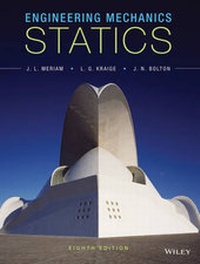
Engineering Mechanics
Statics
8th Edition
Published on 28. July 2014
Book
Hardback
528 pages
978-1-118-80733-0 (ISBN)
Description
Known for its accuracy, clarity, and dependability, Meriam, Kraige, and Bolton's Engineering Mechanics: Statics, 8th Edition has provided a solid foundation of mechanics principles for more than 60 years. This text continues to help students develop their problem-solving skills with an extensive variety of engaging problems related to engineering design. In addition to new homework problems, the text includes a number of helpful sample problems. To help students build necessary visualization and problem-solving skills, the text strongly emphasizes drawing free-body diagrams, one of the most important skills needed to solve mechanics problems.
More details
Edition
8th edition
Language
English
Place of publication
New York
United States
Target group
College/higher education
Dimensions
Height: 257 mm
Width: 201 mm
Thickness: 23 mm
Weight
1089 gr
ISBN-13
978-1-118-80733-0 (9781118807330)
Copyright in bibliographic data and cover images is held by Nielsen Book Services Limited or by the publishers or by their respective licensors: all rights reserved.
Schweitzer Classification
Other editions
Previous edition

Book
12/2013
7th Edition
Wiley
€189.00
Article exhausted; check for reprint
Persons
Dr. James L. Meriam has contributed to the field of engineering mechanics as one of the premier engineering educators during the second half of the twentieth century. Dr. Meriam earned his B.E., M. Eng., and Ph.D. degrees from Yale University. He had early industrial experience with Pratt and Whitney Aircraft and the General Electric Company. During the Second World War, he served in the U.S. Coast Guard. He was a member of the faculty of the University of California-Berkeley, Dean of Engineering at Duke University, a faculty member at the California Polytechnic State University, and visiting professor at the University of California-Santa Barbara. He retired in 1990. Professor Meriam always placed great emphasis on teaching, and this trait was recognized by his students wherever he taught. At Berkeley in 1963, he was the first recipient of the Outstanding Faculty Award of Tau Beta Pi, given primarily for excellence in teaching. In 1978, he received the Distinguished Educator Award for Outstanding Service to Engineering Mechanics Education from the American Society for Engineering Education, and in 1992 was the Society's recipient of the Benjamin Garver Lamme Award, which is ASEE's highest annual national award.
Dr. L. G. Kraige, coauthor of the Engineering Mechanics series since the early 1980s, has also made significant contributions to mechanics education. Dr. Kraige earned his B.S., M.S., and Ph.D. degrees at the University of Virginia, principally in aerospace engineering, and he currently serves as Professor of Engineering Science and Mechanics at Virginia Polytechnic Institute and State University. In addition to his widely recognized research and publications in the field of spacecraft dynamics. Professor Kraige has devoted his attention to the teaching of mechanics at both introductory and advanced levels. His outstanding teaching has been widely recognized and has earned him teaching awards at the departmental, college, university, state, regional, and national levels.
Dr. L. G. Kraige, coauthor of the Engineering Mechanics series since the early 1980s, has also made significant contributions to mechanics education. Dr. Kraige earned his B.S., M.S., and Ph.D. degrees at the University of Virginia, principally in aerospace engineering, and he currently serves as Professor of Engineering Science and Mechanics at Virginia Polytechnic Institute and State University. In addition to his widely recognized research and publications in the field of spacecraft dynamics. Professor Kraige has devoted his attention to the teaching of mechanics at both introductory and advanced levels. His outstanding teaching has been widely recognized and has earned him teaching awards at the departmental, college, university, state, regional, and national levels.
Content
CHAPTER 1 INTRODUCTION TO STATICS 3
1.1 Mechanics 3
1.2 Basic Concepts 4
1.3 Scalars and Vectors 5
1.4 Newton's Laws 7
1.5 Units 8
1.6 Law of Gravitation 12
1.7 Accuracy, Limits, and Approximations 13
1.8 Problem Solving in Statics 14
1.9 Chapter Review 18
CHAPTER 2 FORCE SYSTEMS 23
2.1 Introduction 23
2.2 Force 23
SECTION A TWO-DIMENSIONAL FORCE SYSTEMS 26
2.3 Rectangular Components 26
2.4 Moment 39
2.5 Couple 50
2.6 Resultants 58
SECTION B THREE-DIMENSIONAL FORCE SYSTEMS 66
2.7 Rectangular Components 66
2.8 Moment and Couple 75
2.9 Resultants 89
2.10 Chapter Review 100
CHAPTER 3 EQUILIBRIUM 109
3.1 Introduction 109
SECTION A EQUILIBRIUM IN TWO DIMENSIONS 110
3.2 System Isolation and the Free-Body Diagram 110
3.3 Equilibrium Conditions 121
SECTION B EQUILIBRIUM IN THREE DIMENSIONS 143
3.4 Equilibrium Conditions 143
3.5 Chapter Review 160
CHAPTER 4 STRUCTURES 169
4.1 Introduction 169
4.2 Plane Trusses 171
4.3 Method of Joints 172
4.4 Method of Sections 184
4.5 Space Trusses 193
4.6 Frames and Machines 200
4.7 Chapter Review 220
CHAPTER 5 DISTRIBUTED FORCES 229
5.1 Introduction 229
SECTION A CENTERS OF MASS AND CENTROIDS 231
5.2 Center of Mass 231
5.3 Centroids of Lines, Areas, and Volumes 234
5.4 Composite Bodies and Figures; Approximations 250
5.5 Theorems of Pappus 261
SECTION B SPECIAL TOPICS 269
5.6 Beams-External Effects 269
5.7 Beams-Internal Effects 276
5.8 Flexible Cables 288
5.9 Fluid Statics 303
5.10 Chapter Review 321
CHAPTER 6 FRICTION 331
6.1 Introduction 331
SECTION A FRICTIONAL PHENOMENA 332
6.2 Types of Friction 332
6.3 Dry Friction 333
SECTION B APPLICATIONS OF FRICTION IN MACHINES 353
6.4 Wedges 353
6.5 Screws 354
6.6 Journal Bearings 364
6.7 Thrust Bearings; Disk Friction 365
6.8 Flexible Belts 372
6.9 Rolling Resistance 373
6.10 Chapter Review 381
CHAPTER 7 VIRTUAL WORK 391
7.1 Introduction 391
7.2 Work 391
7.3 Equilibrium 395
7.4 Potential Energy and Stability 411
7.5 Chapter Review 427
APPENDICES
APPENDIX A AREA MOMENTS OF INERTIA 434
A.1 Introduction 434
A.2 Defi nitions 435
A.3 Composite Areas 449
A.4 Products of Inertia and Rotation of Axes 457
APPENDIX B MASS MOMENTS OF INERTIA 469
APPENDIX C SELECTED TOPICS OF MATHEMATICS 470
C.1 Introduction 470
C.2 Plane Geometry 470
C.3 Solid Geometry 471
C.4 Algebra 471
C.5 Analytic Geometry 472
C.6 Trigonometry 472
C.7 Vector Operations 473
C.8 Series 476
C.9 Derivatives 476
C.10 Integrals 477
C.11 Newton's Method for Solving Intractable Equations 479
C.12 Selected Techniques for Numerical Integration 481
APPENDIX D USEFUL TABLES 485
Table D.1 Physical Properties 485
Table D.2 Solar System Constants 486
Table D.3 Properties of Plane Figures 487
Table D.4 Properties of Homogeneous Solids 489
INDEX 493
PROBLEM ANSWERS 497
1.1 Mechanics 3
1.2 Basic Concepts 4
1.3 Scalars and Vectors 5
1.4 Newton's Laws 7
1.5 Units 8
1.6 Law of Gravitation 12
1.7 Accuracy, Limits, and Approximations 13
1.8 Problem Solving in Statics 14
1.9 Chapter Review 18
CHAPTER 2 FORCE SYSTEMS 23
2.1 Introduction 23
2.2 Force 23
SECTION A TWO-DIMENSIONAL FORCE SYSTEMS 26
2.3 Rectangular Components 26
2.4 Moment 39
2.5 Couple 50
2.6 Resultants 58
SECTION B THREE-DIMENSIONAL FORCE SYSTEMS 66
2.7 Rectangular Components 66
2.8 Moment and Couple 75
2.9 Resultants 89
2.10 Chapter Review 100
CHAPTER 3 EQUILIBRIUM 109
3.1 Introduction 109
SECTION A EQUILIBRIUM IN TWO DIMENSIONS 110
3.2 System Isolation and the Free-Body Diagram 110
3.3 Equilibrium Conditions 121
SECTION B EQUILIBRIUM IN THREE DIMENSIONS 143
3.4 Equilibrium Conditions 143
3.5 Chapter Review 160
CHAPTER 4 STRUCTURES 169
4.1 Introduction 169
4.2 Plane Trusses 171
4.3 Method of Joints 172
4.4 Method of Sections 184
4.5 Space Trusses 193
4.6 Frames and Machines 200
4.7 Chapter Review 220
CHAPTER 5 DISTRIBUTED FORCES 229
5.1 Introduction 229
SECTION A CENTERS OF MASS AND CENTROIDS 231
5.2 Center of Mass 231
5.3 Centroids of Lines, Areas, and Volumes 234
5.4 Composite Bodies and Figures; Approximations 250
5.5 Theorems of Pappus 261
SECTION B SPECIAL TOPICS 269
5.6 Beams-External Effects 269
5.7 Beams-Internal Effects 276
5.8 Flexible Cables 288
5.9 Fluid Statics 303
5.10 Chapter Review 321
CHAPTER 6 FRICTION 331
6.1 Introduction 331
SECTION A FRICTIONAL PHENOMENA 332
6.2 Types of Friction 332
6.3 Dry Friction 333
SECTION B APPLICATIONS OF FRICTION IN MACHINES 353
6.4 Wedges 353
6.5 Screws 354
6.6 Journal Bearings 364
6.7 Thrust Bearings; Disk Friction 365
6.8 Flexible Belts 372
6.9 Rolling Resistance 373
6.10 Chapter Review 381
CHAPTER 7 VIRTUAL WORK 391
7.1 Introduction 391
7.2 Work 391
7.3 Equilibrium 395
7.4 Potential Energy and Stability 411
7.5 Chapter Review 427
APPENDICES
APPENDIX A AREA MOMENTS OF INERTIA 434
A.1 Introduction 434
A.2 Defi nitions 435
A.3 Composite Areas 449
A.4 Products of Inertia and Rotation of Axes 457
APPENDIX B MASS MOMENTS OF INERTIA 469
APPENDIX C SELECTED TOPICS OF MATHEMATICS 470
C.1 Introduction 470
C.2 Plane Geometry 470
C.3 Solid Geometry 471
C.4 Algebra 471
C.5 Analytic Geometry 472
C.6 Trigonometry 472
C.7 Vector Operations 473
C.8 Series 476
C.9 Derivatives 476
C.10 Integrals 477
C.11 Newton's Method for Solving Intractable Equations 479
C.12 Selected Techniques for Numerical Integration 481
APPENDIX D USEFUL TABLES 485
Table D.1 Physical Properties 485
Table D.2 Solar System Constants 486
Table D.3 Properties of Plane Figures 487
Table D.4 Properties of Homogeneous Solids 489
INDEX 493
PROBLEM ANSWERS 497