

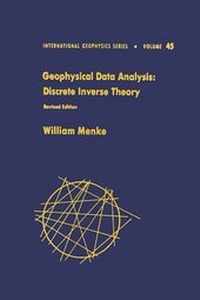
Geophysical Data Analysis: Volume 45
Discrete Inverse Theory
Published on 4. October 1989
Book
Hardback
302 pages
978-0-12-490921-2 (ISBN)
Description
Please use extracts from reviews of first edition
Reviews / Votes
"The author has produced a meaningful guide to the subject; one which a student (or professional unfamiliar with the field) can follow without great difficulty and one in which many motivational guideposts are provided....I think that the value of the book is outstanding....It deserves a prominent place on the shelf of every scientist or engineer who has data to interpret." --GEOPHYSICS"As a meteorologist, I have used least squares, maximum likelihood, maximum entropy, and empirical orthogonal functions during the course of my work, but this book brought together these somewhat disparate techniques into a coherent, unified package....I recommend it to meteorologists involved with data analysis and parameterization." --Roland B. Stull, THE BULLETIN OF THE AMERICAN METEOROLOGICAL SOCIETY
"This book provides an excellent introductory account of inverse theory with geophysical applications....My experience in using this book, along with supplementary material in a course for the first year graduate students, has been very positive. I unhesitatingly recommend it to any student or researcher in the geophysical sciences." --PACEOPH
More details
Series
Language
English
Place of publication
San Diego
United States
Publishing group
Elsevier Science Publishing Co Inc
Target group
College/higher education
Graduate students and researchers in solid earth geophysics, seismology, atmospheric sciences and other areas of applied physics (e.g. image processing) and mathematics.
Dimensions
Height: 229 mm
Width: 152 mm
Weight
490 gr
ISBN-13
978-0-12-490921-2 (9780124909212)
Copyright in bibliographic data and cover images is held by Nielsen Book Services Limited or by the publishers or by their respective licensors: all rights reserved.
Schweitzer Classification
Other editions
New editions
Book
02/2024
5th Edition
Academic Press
€128.50
Shipment within 15-20 days
Additional editions
E-Book
10/1989
2nd Edition
Academic Press
€104.00
Available for download
Person
William Menke is a Professor of Earth and Environmental Sciences at Columbia University. His research focuses on the development of data analysis algorithms for time series analysis and imaging in the earth and environmental sciences and the application of these methods to volcanoes, earthquakes, and other natural hazards. He has thirty years of experience teaching data analysis methods to both undergraduates and graduate students. Relevant courses that he has taught include, at the undergraduate level, Environmental Data Analysis and The Earth System, and at the graduate level, Geophysical Inverse Theory, Quantitative Methods of Data Analysis, Geophysical Theory and Practical Seismology.
Content
Preface.Introduction.DESCRIBING INVERSE PROBLEMSFormulating Inverse Problems.The Linear Inverse Problem.Examples of Formulating Inverse Problems.Solutions to Inverse Problems.SOME COMMENTS ON PROBABILITY THEORYNoise and Random Variables.Correlated Data.Functions of Random Variables.Gaussian Distributions.Testing the Assumption of Gaussian StatisticsConfidence Intervals.SOLUTION OF THE LINEAR, GAUSSIAN INVERSE PROBLEM, VIEWPOINT 1:THE LENGTH METHODThe Lengths of Estimates.Measures of Length.Least Squares for a Straight Line.The Least Squares Solution of the Linear Inverse Problem.Some Examples.The Existence of the Least Squares Solution.The Purely Underdetermined Problem.Mixed*b1Determined Problems.Weighted Measures of Length as a Type of A Priori Information.Other Types of A Priori Information.The Variance of the Model Parameter Estimates.Variance and Prediction Error of the Least Squares Solution.SOLUTION OF THE LINEAR, GAUSSIAN INVERSE PROBLEM, VIEWPOINT 2: GENERALIZED INVERSESSolutions versus Operators.The Data Resolution Matrix.The Model Resolution Matrix.The Unit Covariance Matrix.Resolution and Covariance of Some Generalized Inverses.Measures of Goodness of Resolution and Covariance.Generalized Inverses with Good Resolution and Covariance.Sidelobes and the Backus-Gilbert Spread Function.The Backus-Gilbert Generalized Inverse for the Underdetermined Problem.Including the Covariance Size.The Trade-off of Resolution and Variance.SOLUTION OF THE LINEAR, GAUSSIAN INVERSE PROBLEM, VIEWPOINT 3: MAXIMUM LIKELIHOOD METHODSThe Mean of a Group of Measurements.Maximum Likelihood Solution of the Linear Inverse Problem.A Priori Distributions.Maximum Likelihood for an Exact Theory.Inexact Theories.The Simple Gaussian Case with a Linear Theory.The General Linear, Gaussian Case.Equivalence of the Three Viewpoints.The F Test of Error Improvement Significance.Derivation of the Formulas of Section 5.7.NONUNIQUENESS AND LOCALIZED AVERAGESNull Vectors and Nonuniqueness.Null Vectors of a Simple Inverse Problem.Localized Averages of Model Parameters.Relationship to the Resolution Matrix.Averages versus Estimates.Nonunique Averaging Vectors and A Priori Information.APPLICATIONS OF VECTOR SPACESModel and Data Spaces.Householder Transformations.Designing Householder Transformations.Transformations That Do Not Preserve Length.The Solution of the Mixed-Determined Problem.Singular-Value Decomposition and the Natural Generalized Inverse.Derivation of the Singular-Value Decomposition.Simplifying Linear Equality and Inequality Constraints.Inequality Constraints.LINEAR INVERSE PROBLEMS AND NON-GAUSSIAN DISTRIBUTIONSL1 Norms and Exponential Distributions.