

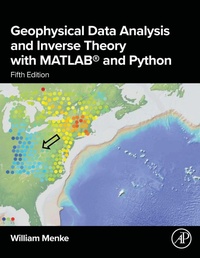
Geophysical Data Analysis and Inverse Theory with MATLAB (R) and Python
5th Edition
Published on 27. February 2024
Book
Paperback/Softback
342 pages
978-0-443-13794-5 (ISBN)
Description
Geophysical Data Analysis and Inverse Theory with MATLAB or Python, Fifth Edition is a revised and expanded introduction to inverse theory and tomography as it is practiced by geophysicists. The book demonstrates the methods needed to analyze a broad spectrum of geophysical datasets, with special attention given to those methods that generate images of the earth. Data analysis can be a mathematically complex activity, but the treatment in this volume is carefully designed to emphasize those mathematical techniques that readers will find the most familiar and to systematically introduce less-familiar ones. A series of "crib sheets" offer step-by-step summaries of methods presented.
Utilizing problems and case studies, along with MATLAB and Python computer code and summaries of methods, the book provides professional geophysicists, students, data scientists and engineers in geophysics with the tools necessary to understand and apply mathematical techniques and inverse theory.
Utilizing problems and case studies, along with MATLAB and Python computer code and summaries of methods, the book provides professional geophysicists, students, data scientists and engineers in geophysics with the tools necessary to understand and apply mathematical techniques and inverse theory.
More details
Edition
5th edition
Language
English
Place of publication
San Diego
United States
Publishing group
Elsevier Science Publishing Co Inc
Target group
College/higher education
Product notice
Paperback (trade)
Dimensions
Height: 272 mm
Width: 209 mm
Thickness: 17 mm
Weight
942 gr
ISBN-13
978-0-443-13794-5 (9780443137945)
Copyright in bibliographic data and cover images is held by Nielsen Book Services Limited or by the publishers or by their respective licensors: all rights reserved.
Schweitzer Classification
Other editions
Additional editions
E-Book
02/2024
5th Edition
Academic Press
€109.00
Available for download
Previous edition
Book
04/2018
4th Edition
Academic Press
€121.31
Shipment within 15-20 days
Person
William Menke is a Professor of Earth and Environmental Sciences at Columbia University. His research focuses on the development of data analysis algorithms for time series analysis and imaging in the earth and environmental sciences and the application of these methods to volcanoes, earthquakes, and other natural hazards. He has thirty years of experience teaching data analysis methods to both undergraduates and graduate students. Relevant courses that he has taught include, at the undergraduate level, Environmental Data Analysis and The Earth System, and at the graduate level, Geophysical Inverse Theory, Quantitative Methods of Data Analysis, Geophysical Theory and Practical Seismology.
Content
1. Getting started with Matlab (R) or python
2. Describing inverse problems
3. Using probabilty to describe random variation
4. Solution of the linear, normal inverse problem, viewpoint 1: the length method
5. Solution of the linear, normal inverse problem, viewpoint 2: generalized inverses
6. Solution of the linear, normal inverse problem, viewpoint 3: maximum likelihood methods
7. Data assimilation methods including gaussian process regression and kalman filtering
8. Nonuniqueness and localized averages
9. Applications of vector spaces
10. Linear inverse problems with non-normal statistics
11. Nonlinear inverse problems
12. Monte carlo methods
13. Factor analysis
14. Continuous inverse theory and tomography
15. Sample inverse problems
16. Applications of inverse theory to solid earth geophysics
17. Important algorithms and method summaries
2. Describing inverse problems
3. Using probabilty to describe random variation
4. Solution of the linear, normal inverse problem, viewpoint 1: the length method
5. Solution of the linear, normal inverse problem, viewpoint 2: generalized inverses
6. Solution of the linear, normal inverse problem, viewpoint 3: maximum likelihood methods
7. Data assimilation methods including gaussian process regression and kalman filtering
8. Nonuniqueness and localized averages
9. Applications of vector spaces
10. Linear inverse problems with non-normal statistics
11. Nonlinear inverse problems
12. Monte carlo methods
13. Factor analysis
14. Continuous inverse theory and tomography
15. Sample inverse problems
16. Applications of inverse theory to solid earth geophysics
17. Important algorithms and method summaries