

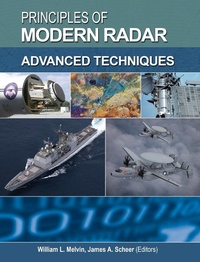
Principles of Modern Radar: Volume 2
Advanced techniques
Published on 16. October 2012
Book
Hardback
872 pages
978-1-891121-53-1 (ISBN)
Description
This second of three volumes in the Principles of Modern Radar series offers a much-needed professional reference for practicing radar engineers. It provides the stepping stones under one cover to advanced practice with overview discussions of the most commonly used techniques for radar design, thereby bridging readers to single-topic advanced books, papers, and presentations. It spans a gamut of exciting radar capabilities from exotic waveforms to ultra-high resolution 2D and 3D imaging methods, complex adaptive interference cancellation, multi-target tracking in dense scenarios, multiple-input, multiple-output (MIMO) and much more. All of this material is presented with the same careful balance of quantitative rigor and qualitative insight of Principles of Modern Radar: Basic Principles. Each chapter is likewise authored by recognized subject experts, with the rigorous editing for consistency and suggestions of numerous volunteer reviewers from the radar community applied throughout. Advanced academic and training courses will appreciate the sets of chapter-end problems for students, as well as worked solutions for instructors. Extensive reference lists show the way for further study.
More details
Series
Language
English
Place of publication
New York
United States
Target group
College/higher education
Product notice
sewn/stitched
Paper over boards
Dimensions
Height: 260 mm
Width: 208 mm
Thickness: 50 mm
Weight
2056 gr
ISBN-13
978-1-891121-53-1 (9781891121531)
Copyright in bibliographic data and cover images is held by Nielsen Book Services Limited or by the publishers or by their respective licensors: all rights reserved.
Schweitzer Classification
Other editions
New editions
Book
05/2026
2nd Edition
Institution of Engineering and Technology
€152.50
Shipment within 3-4 weeks
Additional editions
E-Book
01/2012
1st Edition
The Institution of Engineering and Technology
€191.69
Available for download
Persons
William Melvin is Director of the Sensors and Electromagnetic Applications Laboratory at the Georgia Tech Research Institute and an Adjunct Professor in Georgia Tech's Electrical and Computer Engineering Department. His research interests include systems engineering, advanced signal processing and exploitation, and high-fidelity modeling and simulation. He has authored over 160 publications in his areas of expertise and holds three patents on adaptive radar technology. Among his distinctions, Dr. Melvin is a Fellow of the IEEE, with the follow citation: 'For contributions to adaptive signal processing methods in radar systems.' He received the Ph.D., M.S., and B.S. (with High Honors) degrees in Electrical Engineering from Lehigh University.
Jim Scheer has 40 years of hands-on experience in the design, development, and analysis of radar systems. He currently consults and works part time for GTRI and teaches radar-related short courses. He began his career with the General Electric Company (now Lockheed Martin Corporation), working on the F-111 attack radar system. In 1975 he moved to GTRI, where he worked on radar system applied research until his retirement in 2004. Mr. Scheer is an IEEE Life Fellow and holds a BSEE degree from Clarkson University and the MSEE degree from Syracuse University.
Jim Scheer has 40 years of hands-on experience in the design, development, and analysis of radar systems. He currently consults and works part time for GTRI and teaches radar-related short courses. He began his career with the General Electric Company (now Lockheed Martin Corporation), working on the F-111 attack radar system. In 1975 he moved to GTRI, where he worked on radar system applied research until his retirement in 2004. Mr. Scheer is an IEEE Life Fellow and holds a BSEE degree from Clarkson University and the MSEE degree from Syracuse University.
Content
Chapter 1: Overview
Part I: Waveforms and Spectrum
Chapter 2: Advanced Waveform Techniques
Chapter 3: Optimal and Adaptive Multidimensional Waveform Design
Chapter 4: MIMO Radar
Part II: Synthetic Aperture Radar
Chapter 5: Compressive Sensing
Chapter 6: Stripmap SAR Algorithms
Chapter 7: Spotlight SAR Algorithms
Chapter 8: Interferometric SAR
Part III: Array Processing and Interference Mitigation Techniques
Chapter 9: Adaptive Digital Beamforming
Chapter 10: Clutter Suppression Using STAP
Chapter 11: Space-Time Coding for Active Antenna Systems
Chapter 12: Electronic Protection
Part IV: Post-Processing Considerations
Chapter 13: Radar Polarimetry
Chapter 14: Radar Automatic Target Recognition
Chapter 15: Multitarget Tracking
Part V: Emerging Techniques
Chapter 16: Human Detection with Radar (Dismount Detection)
Chapter 17: Advanced Processing Methods for Passive Radar Systems
Part I: Waveforms and Spectrum
Chapter 2: Advanced Waveform Techniques
Chapter 3: Optimal and Adaptive Multidimensional Waveform Design
Chapter 4: MIMO Radar
Part II: Synthetic Aperture Radar
Chapter 5: Compressive Sensing
Chapter 6: Stripmap SAR Algorithms
Chapter 7: Spotlight SAR Algorithms
Chapter 8: Interferometric SAR
Part III: Array Processing and Interference Mitigation Techniques
Chapter 9: Adaptive Digital Beamforming
Chapter 10: Clutter Suppression Using STAP
Chapter 11: Space-Time Coding for Active Antenna Systems
Chapter 12: Electronic Protection
Part IV: Post-Processing Considerations
Chapter 13: Radar Polarimetry
Chapter 14: Radar Automatic Target Recognition
Chapter 15: Multitarget Tracking
Part V: Emerging Techniques
Chapter 16: Human Detection with Radar (Dismount Detection)
Chapter 17: Advanced Processing Methods for Passive Radar Systems