

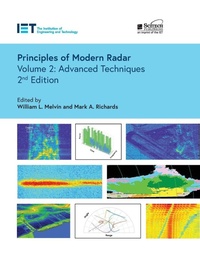
Principles of Modern Radar: Volume 2
Advanced Techniques
2nd Edition
Published on 12. May 2026
Book
Hardback
1090 pages
978-1-83953-383-9 (ISBN)
Description
The second edition of Principles of Modern Radar Volume 2: Advanced Techniques is a comprehensive textbook serving as an important technical reference for practicing radar engineers and graduate students alike. The book covers essential topics in modern radar development, including radar waveform design and processing, radar imaging algorithms, multidimensional adaptive antenna processing techniques, target recognition approaches and methods, distributed radar algorithms, and an introduction to artificial intelligence and machine learning for radar.
The chapters are written by noted experts, and each provides breadth of coverage while maintaining engineering rigor appropriate for the intended audience.
The book focuses on five key areas:
Waveforms and radar operation in spectrum-sharing environments;
Synthetic aperture radar, including spotlight, stripmap, and interferometric operating modes;
Array processing and interference mitigation, with detailed discussion of adaptive digital beamforming, space-time adaptive processing, and MIMO radar;
Post processing considerations, including radar polarimetry and target recognition methods, and multisensor/multitarget tracking algorithms;
Processing methods for distributed radar, as well as introductions to AI/ML radar approaches and cognitive radar.
The popular first edition of Principles of Modern Radar Volume 2: Advanced Techniques has been completely updated and includes the latest developments in radar signal and data processing methods.
The chapters are written by noted experts, and each provides breadth of coverage while maintaining engineering rigor appropriate for the intended audience.
The book focuses on five key areas:
Waveforms and radar operation in spectrum-sharing environments;
Synthetic aperture radar, including spotlight, stripmap, and interferometric operating modes;
Array processing and interference mitigation, with detailed discussion of adaptive digital beamforming, space-time adaptive processing, and MIMO radar;
Post processing considerations, including radar polarimetry and target recognition methods, and multisensor/multitarget tracking algorithms;
Processing methods for distributed radar, as well as introductions to AI/ML radar approaches and cognitive radar.
The popular first edition of Principles of Modern Radar Volume 2: Advanced Techniques has been completely updated and includes the latest developments in radar signal and data processing methods.
More details
Series
Edition
2nd edition
Language
English
Place of publication
Stevenage
United Kingdom
Target group
College/higher education
Professional and scholarly
Product notice
sewn/stitched
Cloth over boards
Dimensions
Height: 278 mm
Width: 219 mm
Thickness: 67 mm
Weight
2370 gr
ISBN-13
978-1-83953-383-9 (9781839533839)
Copyright in bibliographic data and cover images is held by Nielsen Book Services Limited or by the publishers or by their respective licensors: all rights reserved.
Schweitzer Classification
Other editions
Previous edition
Book
10/2012
SciTech Publishing Inc
€184.50
Shipment within 3-4 weeks
Persons
William L. Melvin currently serves as Chief Scientist and Technical Fellow, Sensors Division, at Systems and Technology Research (STR), USA. He served on the USAF Science Advisory Board, the Board on Army Science and Technology, the Air Force Studies Board on Developmental Planning organized through the National Academy of Science, and the White House-DoD American Mid-Band Initiative Team.
Mark A. Richards is an independent consultant with over 35 years' experience in radar signal processing, having recently retired as professor from Georgia Institute of Technology's School of Electrical and Computer Engineering. He was Chief of the Radar Systems Division in the Georgia Tech Research Institute's Sensors and Electromagnetic Applications Laboratory, and for two years Program Manager at DARPA. Dr. Richards is a Fellow of the IEEE, cited "for contributions to radar signal processing education".
Mark A. Richards is an independent consultant with over 35 years' experience in radar signal processing, having recently retired as professor from Georgia Institute of Technology's School of Electrical and Computer Engineering. He was Chief of the Radar Systems Division in the Georgia Tech Research Institute's Sensors and Electromagnetic Applications Laboratory, and for two years Program Manager at DARPA. Dr. Richards is a Fellow of the IEEE, cited "for contributions to radar signal processing education".
Content
Chapter 1: Overview: Advanced Techniques in Modern Radar
Part I: Waveforms and Spectrum
Chapter 2: Advanced Pulse Compression Waveform Modulations and Techniques
Chapter 3: Optimal and Adaptive MIMO Waveform Design
Chapter 4: Radar Applications of Sparse Reconstruction and Compressed Sensing
Chapter 5: Spectrum Sharing Approaches
Part II: Synthetic Aperture Radar
Chapter 6: Spotlight Synthetic Aperture Radar
Chapter 7: Stripmap Synthetic Aperture Radar
Chapter 8: Interferometric Synthetic Aperture Radar
Part III: Array Processing and Interference Mitigation Techniques
Chapter 9: Adaptive Digital Beamforming
Chapter 10: Clutter Suppression Using Space-Time Adaptive Processing
Chapter 11: MIMO Radar
Chapter 12: Electromagnetic Protection
Part IV: Post-Processing Considerations
Chapter 13: Introduction to Radar Polarimetry
Chapter 14: Automatic Target Recognition
Chapter 15: Multi-Sensor Multi-Target Tracking Systems
Part V: Emerging Techniques
Chapter 16: Advanced Processing Methods for Passive Bistatic Radar Systems
Chapter 17: Machine Learning for Radar
Chapter 18: An Introduction to Cognitive Radar
Appendix: Quick Reference Guide
Part I: Waveforms and Spectrum
Chapter 2: Advanced Pulse Compression Waveform Modulations and Techniques
Chapter 3: Optimal and Adaptive MIMO Waveform Design
Chapter 4: Radar Applications of Sparse Reconstruction and Compressed Sensing
Chapter 5: Spectrum Sharing Approaches
Part II: Synthetic Aperture Radar
Chapter 6: Spotlight Synthetic Aperture Radar
Chapter 7: Stripmap Synthetic Aperture Radar
Chapter 8: Interferometric Synthetic Aperture Radar
Part III: Array Processing and Interference Mitigation Techniques
Chapter 9: Adaptive Digital Beamforming
Chapter 10: Clutter Suppression Using Space-Time Adaptive Processing
Chapter 11: MIMO Radar
Chapter 12: Electromagnetic Protection
Part IV: Post-Processing Considerations
Chapter 13: Introduction to Radar Polarimetry
Chapter 14: Automatic Target Recognition
Chapter 15: Multi-Sensor Multi-Target Tracking Systems
Part V: Emerging Techniques
Chapter 16: Advanced Processing Methods for Passive Bistatic Radar Systems
Chapter 17: Machine Learning for Radar
Chapter 18: An Introduction to Cognitive Radar
Appendix: Quick Reference Guide