

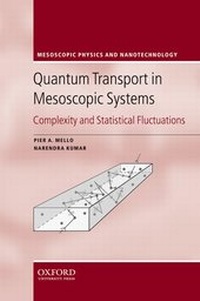
Quantum Transport in Mesoscopic Systems
Complexity and Statistical Fluctuations. A Maximum Entropy Viewpoint
Published on 29. July 2010
Book
Paperback/Softback
418 pages
978-0-19-852583-7 (ISBN)
Description
The aim of this book is to present a statistical theory of wave scattering by complex systems -systems which have a chaotic classical dynamics, as in the case of microwave cavities and quantum dots, or possess quenched randomness, as in the case of disordered conductors-- with emphasis on mesoscopic fluctuations.
The universal character of the statistical behavior of these phenomena is incorporated in a natural way by approaching the problem from a Maximum-Entropy viewpoint -Shannon's information entropy is maximized, subject to the symmetries and constraints that are physically relevant-- within the powerful, non-perturbative Theory of Random Matrices. This is a distinctive feature of the present book that greatly motivated our writing it. Another reason is that it collects in one place the material and notions -derived from the published work of the authors in collaboration with several co-workers, as well as from the work of others-- which are scattered through research journals and textbooks on the subject.
To make the book self-contained, we present in Chapters 2 and 3 the quantum theory of scattering, set in the context of quasi-one-dimensional, multichannel systems, thus related directly to scattering problems in mesoscopic physics. Chapter 4 discusses the linear-response theory of quantum electronic transport, adapted to the context of mesoscopic systems. These chapters, together with Chapter 5 on the Maximum-Entropy Approach and Chapter 8 on weak localization, have been written in a pedagogical style, and can be used as part of a graduate course. Chapters 6 and 7 discuss the problem of electronic transport through classically chaotic cavities and quasi-one-dimensional disordered systems. There are many exercises, most of them worked out in detail, distributed throughout the book. This should help graduate students, their teachers and the research scholars interested generally in the subject of quantum transport through disordered and chaotic systems in their preparation for it, and beyond.
The universal character of the statistical behavior of these phenomena is incorporated in a natural way by approaching the problem from a Maximum-Entropy viewpoint -Shannon's information entropy is maximized, subject to the symmetries and constraints that are physically relevant-- within the powerful, non-perturbative Theory of Random Matrices. This is a distinctive feature of the present book that greatly motivated our writing it. Another reason is that it collects in one place the material and notions -derived from the published work of the authors in collaboration with several co-workers, as well as from the work of others-- which are scattered through research journals and textbooks on the subject.
To make the book self-contained, we present in Chapters 2 and 3 the quantum theory of scattering, set in the context of quasi-one-dimensional, multichannel systems, thus related directly to scattering problems in mesoscopic physics. Chapter 4 discusses the linear-response theory of quantum electronic transport, adapted to the context of mesoscopic systems. These chapters, together with Chapter 5 on the Maximum-Entropy Approach and Chapter 8 on weak localization, have been written in a pedagogical style, and can be used as part of a graduate course. Chapters 6 and 7 discuss the problem of electronic transport through classically chaotic cavities and quasi-one-dimensional disordered systems. There are many exercises, most of them worked out in detail, distributed throughout the book. This should help graduate students, their teachers and the research scholars interested generally in the subject of quantum transport through disordered and chaotic systems in their preparation for it, and beyond.
Reviews / Votes
`Its great strength is that it provides a consistent, systematic introduction to the major ideas of the field and includes a lot of related material that provides important intellectual context.'
Allan MacDonald, University of Texas at Austin `A most important and timely topic. [...] There are other books, but not at the same level of depth.
'
John Spence, Arizona State University
More details
Language
English
Place of publication
Oxford
United Kingdom
Target group
College/higher education
Professional and scholarly
Illustrations
30 b/w line illustrations
Dimensions
Height: 234 mm
Width: 158 mm
Thickness: 21 mm
Weight
583 gr
ISBN-13
978-0-19-852583-7 (9780198525837)
Copyright in bibliographic data and cover images is held by Nielsen Book Services Limited or by the publishers or by their respective licensors: all rights reserved.
Schweitzer Classification
Other editions
Additional editions
Pier A. Mello | Narendra Kumar
Quantum Transport in Mesoscopic Systems
Complexity and Statistical Fluctuations. A Maximum Entropy Viewpoint
Book
05/2004
Oxford University Press
€206.50
Shipment within 15-20 days
Persons
Pier Mello is Distinguished Professor at the Universidad Nacional Autonoma de Mexico (UNAM). He took his B.S. degree in Physics at UNAM in 1962, and his PhD there in 1965. he was a member of the Institute for Advanced Study, Princeton, 1965-67, and has been Full Professor of Physics at the Instituto de Fisica, UNAM, Mexico, since 1974. He was a member of the Wissenschaftkolleg (Institute for Advanced Study) in Berlin, Germany, 1992-93 and became Distinguished Professor at UNAM, Mexico in 1994. He was a Lecturer at the
Les Houches International School on Mesoscopic Quantum Physics in 1994.
Narendra Kumar is Director at the Raman Research Institute, Bangalore. He has been recognised with several awards, including the Shanti Swarup Bhatnagar (SSB) Prize for Physics in 1985 by CSIR, India
the Third World Academy of Sciences (TWAS) Prize for Physics (1992), the C.V. Raman Birth Centenary award (1999-2000), and the Meghnad Saha Medal (2000). He was elected Fellow of the Indian Academy of Sciences, Bangalore (1987), Fellow of the American Physical Society (1994), Fellow of TWAS (1995), Fellow of INSA (1987), and Fellow of the National Academy of Sciences, India (1994).
Les Houches International School on Mesoscopic Quantum Physics in 1994.
Narendra Kumar is Director at the Raman Research Institute, Bangalore. He has been recognised with several awards, including the Shanti Swarup Bhatnagar (SSB) Prize for Physics in 1985 by CSIR, India
the Third World Academy of Sciences (TWAS) Prize for Physics (1992), the C.V. Raman Birth Centenary award (1999-2000), and the Meghnad Saha Medal (2000). He was elected Fellow of the Indian Academy of Sciences, Bangalore (1987), Fellow of the American Physical Society (1994), Fellow of TWAS (1995), Fellow of INSA (1987), and Fellow of the National Academy of Sciences, India (1994).
Content
1. Introduction ; 2. Quantum Mechanical Time Independent Scattering Theory I ; 3. Quantum Mechanical Time Independent Scattering Theory II ; 4. Linear Response Theory of Quantum Electronic Transport ; 5. The Maximum Entropy Approach ; 6. Electronic Transport through Open Chaotic Cavities ; 7. Electronic Transport through Quasi One-Dimensional Disordered Systems ; 8. An Introduction to Localization Theory ; A. The Theorem of Kane-Serota-Lee ; B. The Conductivity Tensor in RPA ; C. The Conductance in Terms of the Transmission Coefficient of the Sample ; D. Evaluation of the Invariant Measure