

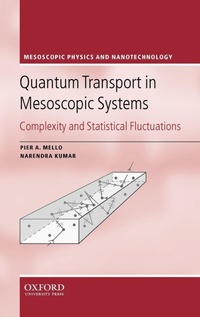
Quantum Transport in Mesoscopic Systems
Complexity and Statistical Fluctuations. A Maximum Entropy Viewpoint
Published on 20. May 2004
Book
Hardback
416 pages
978-0-19-852582-0 (ISBN)
Description
This book presents the statistical theory of complex wave scattering and quantum transport in physical systems which have chaotic classical dynamics, as in the case of microwave cavities and quantum dots, or which possess quenched randomness, as in the case of disordered conductors - with an emphasis on mesoscopic fluctuations. The statistical regularity of the phenomena is revealed in a natural way by adopting a novel maximum-entropy approach. Shannon's information entropy is maximised, subject to the symmetries and constraints which are physically relevant, within the powerful and non-perturbative theory of random matrices; this is a most distinctive feature of the book.
Aiming for a self-contained presentation, the quantum theory of scattering, set in the context of quasi-one-dimensional, multichannel systems, and related directly to scattering problems in mesoscopic physics, is introduced in chapters two and three. The linear-response theory of quantum electronic transport, adapted to the context of mesoscopic systems, is discussed in chapter four. These chapters, together with chapter five on the maximum-entropy approach and chapter eight on weak localization, have been written in a most pedagogical style, suitable for use on graduate courses. In chapters six and seven, the problem of electronic transport through classically chaotic cavities and quasi-one-dimensional disordered systems is discussed. Many exercises are included, most of which are worked through in detail, aiding graduate students, teachers, and research scholars interested in the subject of quantum transport through disordered and chaotic systems.
Aiming for a self-contained presentation, the quantum theory of scattering, set in the context of quasi-one-dimensional, multichannel systems, and related directly to scattering problems in mesoscopic physics, is introduced in chapters two and three. The linear-response theory of quantum electronic transport, adapted to the context of mesoscopic systems, is discussed in chapter four. These chapters, together with chapter five on the maximum-entropy approach and chapter eight on weak localization, have been written in a most pedagogical style, suitable for use on graduate courses. In chapters six and seven, the problem of electronic transport through classically chaotic cavities and quasi-one-dimensional disordered systems is discussed. Many exercises are included, most of which are worked through in detail, aiding graduate students, teachers, and research scholars interested in the subject of quantum transport through disordered and chaotic systems.
Reviews / Votes
Its great strength is that it provides a consistent, systematic introduction to the major ideas of the field and includes a lot of related material that provides important intellectual context. * Allan MacDonald, University of Texas at Austin * ...a most important and timely topic. [...] There are other books, but not at the same level of depth. * John Spence, Arizona State University *More details
Series
Language
English
Place of publication
Oxford
United Kingdom
Target group
Professional and scholarly
Illustrations
numerous line drawings
Dimensions
Height: 240 mm
Width: 161 mm
Thickness: 27 mm
Weight
787 gr
ISBN-13
978-0-19-852582-0 (9780198525820)
Copyright in bibliographic data and cover images is held by Nielsen Book Services Limited or by the publishers or by their respective licensors: all rights reserved.
Schweitzer Classification
Other editions
Additional editions
Pier A. Mello | Narendra Kumar
Quantum Transport in Mesoscopic Systems
Complexity and Statistical Fluctuations. A Maximum Entropy Viewpoint
Book
07/2010
Oxford University Press
€75.64
Shipment within 15-20 days
Persons
Pier A. Mello, Instituto de Fisica, U.N.A.M., Apartado Postal 20-364, Delegacion A. Obregon, 01000 Mexico D.F., Mexico. Tel: +52 55 5622 5142, Fax: +52 55 5622 5015, Email: mello@fisica.unam.mx
Present position: Distinguished Professor of Physics at Instituto de Fisica, U.N.A.M., Mexico
Narendra Kumar, Raman Research Institute, C.V. Raman Avenue, Bangalore 560080, Karnataka State, India. Tel: +91 80 361 1012, Fax: +91 80 361 0492, Email: nkumar@rri.res.in
Present position: Director, Raman Research Institute, Bangalore
Present position: Distinguished Professor of Physics at Instituto de Fisica, U.N.A.M., Mexico
Narendra Kumar, Raman Research Institute, C.V. Raman Avenue, Bangalore 560080, Karnataka State, India. Tel: +91 80 361 1012, Fax: +91 80 361 0492, Email: nkumar@rri.res.in
Present position: Director, Raman Research Institute, Bangalore
Content
1. Introduction ; 2. Quantum Mechanical Time Independent Scattering Theory I ; 3. Quantum Mechanical Time Independent Scattering Theory II ; 4. Linear Response Theory of Quantum Electronic Transport ; 5. The Maximum Entropy Approach ; 6. Electronic Transport through Open Chaotic Cavities ; 7. Electronic Transport through Quasi One-Dimensional Disordered Systems ; 8. An Introduction to Localization Theory ; A. The Theorem of Kane-Serota-Lee ; B. The Conductivity Tensor in RPA ; C. The Conductance in Terms of the Transmission Coefficient of the Sample ; D. Evaluation of the Invariant Measure