

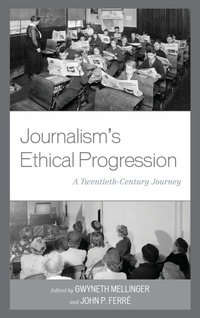
Journalism's Ethical Progression
A Twentieth-Century Journey
Published on 27. November 2019
Book
Hardback
258 pages
978-1-7936-0100-1 (ISBN)
Description
Using case studies and historical analysis, this book traces changes in ways that journalists understood their ethical responsibilities during the pre-internet twentieth century. Each chapter in this book explores a historical development in the evolution of journalists' perceptions of their role as professionals.
Reviews / Votes
This sterling book is a showcase of quality scholarship, with a readability index of ten. Contrary to the anthology genre, every chapter without exception is rigorous and path-breaking. Its cohesion is marvelous, the result of prior collaborations, and the masterpiece essays of introduction and conclusion. Journalism's Ethical Progression: A Twentieth-Century Journey demonstrates its thesis that the ideas and strategies from critical junctures in history enable our understanding of the complicated issues today. -- Clifford G. Christians, University of Illinois at Urbana-Champaign This is an enlightening book that helps illustrate how contemporary concepts of media ethics evolved, from the development of ethics codes through the debate over the professionalization of the media industry. The book chronicles how the profession came to understand its own ideals, particularly within the rise and fall of the corporate, non-partisan press. Authors draw from historic trade news articles, company reports, and journalism society records to document creation of ethical standards and the definition of "journalist." -- Ginny Whitehouse, Eastern Kentucky UniversityMore details
Language
English
Place of publication
United States
Publishing group
Bloomsbury Publishing Plc
Target group
Professional and scholarly
Dimensions
Height: 235 mm
Width: 157 mm
Thickness: 20 mm
Weight
574 gr
ISBN-13
978-1-7936-0100-1 (9781793601001)
Copyright in bibliographic data and cover images is held by Nielsen Book Services Limited or by the publishers or by their respective licensors: all rights reserved.
Schweitzer Classification
Other editions
Additional editions
Journalism's Ethical Progression
A Twentieth-Century Journey
E-Book
11/2019
1st Edition
Lexington Books
€100.99
Available for download
Journalism's Ethical Progression
A Twentieth-Century Journey
E-Book
11/2019
1st Edition
Lexington Books
€100.99
Available for download
Persons
Gwyneth Mellinger is director of the School of Media Arts & Design at James Madison University.
John P. Ferre is professor of communication at the University of Louisville.
John P. Ferre is professor of communication at the University of Louisville.
Content
Introduction: Journalism's Ethical Progression
Gwyneth Mellinger
Chapter 1: The Progressive Era's Social Awakening and the Soul of the News
Ronald R. Rodgers
Chapter 2: A "Failure to Take Itself Seriously": The Canons of Journalism and the Model of Inaction
Ken J. Ward
Chapter 3: The Lippmann-Dewey "Debate": Roles and Responsibilities of Journalists in a Democratic Society
Tim Klein and Elisabeth Fondren
Chapter 4: Francis Biddle and the Jennings Case in 1934-35: A Labor Union, the First Amendment, and Government Oversight
Patrick S. Washburn and Michael S. Sweeney
Chapter 5: Dorothy Day and The Catholic Worker's Legacy of Pacifism
Bailey Dick
Chapter 6: War Correspondents, Women's Interests, and World War II
Carolyn M. Edy
Chapter 7: Conflicts of Interest in Journalism: Debating a Post-Hutchins Ethical Self-Consciousness
Gwyneth Mellinger
Chapter 8: Ethical Duty and the Right to Know: Sam Ragan's Crusades to Provide the Public with Access to Information
Erin K. Coyle
Chapter 9: "Blackenin
Gwyneth Mellinger
Chapter 1: The Progressive Era's Social Awakening and the Soul of the News
Ronald R. Rodgers
Chapter 2: A "Failure to Take Itself Seriously": The Canons of Journalism and the Model of Inaction
Ken J. Ward
Chapter 3: The Lippmann-Dewey "Debate": Roles and Responsibilities of Journalists in a Democratic Society
Tim Klein and Elisabeth Fondren
Chapter 4: Francis Biddle and the Jennings Case in 1934-35: A Labor Union, the First Amendment, and Government Oversight
Patrick S. Washburn and Michael S. Sweeney
Chapter 5: Dorothy Day and The Catholic Worker's Legacy of Pacifism
Bailey Dick
Chapter 6: War Correspondents, Women's Interests, and World War II
Carolyn M. Edy
Chapter 7: Conflicts of Interest in Journalism: Debating a Post-Hutchins Ethical Self-Consciousness
Gwyneth Mellinger
Chapter 8: Ethical Duty and the Right to Know: Sam Ragan's Crusades to Provide the Public with Access to Information
Erin K. Coyle
Chapter 9: "Blackenin