

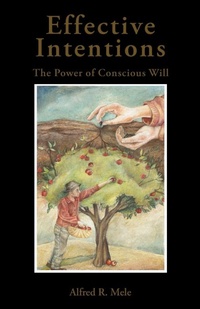
Effective Intentions
The Power of Conscious Will
1st Edition
Published on 11. November 2010
Book
Paperback/Softback
208 pages
978-0-19-976468-6 (ISBN)
Description
Each of the following claims has been defended in the scientific literature on free will and consciousness: your brain routinely decides what you will do before you become conscious of its decision; there is only a 100 millisecond window of opportunity for free will, and all it can do is veto conscious decisions, intentions, or urges; intentions never play a role in producing corresponding actions; and free will is an illusion.
In Effective Intentions Alfred Mele shows that the evidence offered to support these claims is sorely deficient. He also shows that there is strong empirical support for the thesis that some conscious decisions and intentions have a genuine place in causal explanations of corresponding actions. In short, there is weighty evidence of the existence of effective conscious intentions or the power of conscious will. Mele examines the accuracy of subjects' reports about when they first became aware of decisions or intentions in laboratory settings and develops some implications of warranted skepticism about the accuracy of these reports. In addition, he explores such questions as whether we must be conscious of all of our intentions and why scientists disagree about this. Mele's final chapter closes with a discussion of imaginary scientific findings that would warrant bold claims about free will and consciousness of the sort he examines in this book.
In Effective Intentions Alfred Mele shows that the evidence offered to support these claims is sorely deficient. He also shows that there is strong empirical support for the thesis that some conscious decisions and intentions have a genuine place in causal explanations of corresponding actions. In short, there is weighty evidence of the existence of effective conscious intentions or the power of conscious will. Mele examines the accuracy of subjects' reports about when they first became aware of decisions or intentions in laboratory settings and develops some implications of warranted skepticism about the accuracy of these reports. In addition, he explores such questions as whether we must be conscious of all of our intentions and why scientists disagree about this. Mele's final chapter closes with a discussion of imaginary scientific findings that would warrant bold claims about free will and consciousness of the sort he examines in this book.
Reviews / Votes
The discussion is admirably even-handed and judicious, and those looking for an entry into the recent literature on will scepticism are unlikely to find a better place to start. * Tim Bayne, Times Literary Supplement *More details
Language
English
Place of publication
New York
United States
Target group
College/higher education
Philosophers interested in philosophy of mind, consciousness, philosophy of action or free will; academic scientists (neuroscientists and psychologists); graduate and advanced undergraduate students
Dimensions
Height: 216 mm
Width: 140 mm
Thickness: 11 mm
Weight
252 gr
ISBN-13
978-0-19-976468-6 (9780199764686)
Copyright in bibliographic data and cover images is held by Nielsen Book Services Limited or by the publishers or by their respective licensors: all rights reserved.
Schweitzer Classification
Other editions
Additional editions
Book
04/2009
Oxford University Press Inc
€96.80
Shipment within 15-20 days
E-Book
04/2009
1st Edition
OUP eBook
€16.49
Available for download
E-Book
04/2009
1st Edition
OUP eBook
€20.99
Available for download
Person
Alfred R. Mele is William H. and Lucyle T. Werkmeister Professor of Philosophy at Florida State University.
Content
1. Introduction ; 2. Conscious Intentions and Decisions ; 3. Neuroscience and Causes of Action ; 4. Neuroscience and Free Will ; 5. Intentional Actions and the Alleged Illusion of Conscious Will ; 6. Proximal Intentions and Awareness Reports ; 7. The Power of Conscious Will ; 8. Conclusion ; INDEX