

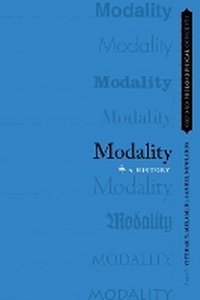
Modality
A History
Published on 3. May 2024
Book
Paperback/Softback
360 pages
978-0-19-008986-3 (ISBN)
Description
Modality: A History provides readers a sweeping study of the history of philosophical work on modal concepts. Everyday discourse is saturated with appeals to what might be the case or to what must be true or to what cannot happen. Possibility, necessity, and impossibility are modal terms, and philosophers have long wondered how to best understand them. This volume traces the history of some of the most prominent and important contributions to our understanding of possibility and necessity over the past two and half millennia of western philosophy, from ancient Greek philosophers through current debates in the 21st century.
Over the course of nine chapters from prominent scholars, this volume traces a history of modal theorizing that begins with extended discussions of Aristotle and the Stoics. Several chapters discuss insights and disagreements among Latin, Arabic, and Jewish medieval scholastics, such as Al-Ghazali, Scotus, and Crescas. Three chapters center on early modern philosophers, whose modal views were deeply shaped by this conceptual inheritance but also departed from it in significant ways: Descartes, Malebranche, Locke, Spinoza, Leibniz, and Hume. Kant and Hegel's modal contributions are presented in their own chapter, and another chapter traces the legacy of Kant's account on early-to-mid 20th century modal views, including Husserl, Heidegger, Russell, and Quine.
The revival of modal metaphysics in the more recent work of Kripke, Marcus, and Lewis has led to a new flourishing of modal theories, including in recent debates among neo-Aristotelians, as the final chapter illustrates. Although modal concepts are interesting and important on their own, theories of modality often intersect with other significant philosophical topics, such as time, freedom, and God. Modal concepts also extend beyond metaphysics. To illustrate the role of modality in other domains, several small-scale studies, or Reflections, are dispersed among these main chapters on modality in cosmology, religion, music, literature, and logic. Readers will learn how a seemingly timeless and changeless cluster of modal concepts have undergone significant revisions and enjoy a rich developmental history.
Over the course of nine chapters from prominent scholars, this volume traces a history of modal theorizing that begins with extended discussions of Aristotle and the Stoics. Several chapters discuss insights and disagreements among Latin, Arabic, and Jewish medieval scholastics, such as Al-Ghazali, Scotus, and Crescas. Three chapters center on early modern philosophers, whose modal views were deeply shaped by this conceptual inheritance but also departed from it in significant ways: Descartes, Malebranche, Locke, Spinoza, Leibniz, and Hume. Kant and Hegel's modal contributions are presented in their own chapter, and another chapter traces the legacy of Kant's account on early-to-mid 20th century modal views, including Husserl, Heidegger, Russell, and Quine.
The revival of modal metaphysics in the more recent work of Kripke, Marcus, and Lewis has led to a new flourishing of modal theories, including in recent debates among neo-Aristotelians, as the final chapter illustrates. Although modal concepts are interesting and important on their own, theories of modality often intersect with other significant philosophical topics, such as time, freedom, and God. Modal concepts also extend beyond metaphysics. To illustrate the role of modality in other domains, several small-scale studies, or Reflections, are dispersed among these main chapters on modality in cosmology, religion, music, literature, and logic. Readers will learn how a seemingly timeless and changeless cluster of modal concepts have undergone significant revisions and enjoy a rich developmental history.
Reviews / Votes
Readers will learn how a seemingly timeless and changeless cluster of modal concepts have undergone significant revisions and enjoy a rich developmental history. * MathSciNet *More details
Series
Language
English
Place of publication
New York
United States
Target group
College/higher education
Product notice
Paperback (trade)
Unsewn / adhesive bound
Dimensions
Height: 201 mm
Width: 145 mm
Thickness: 33 mm
Weight
408 gr
ISBN-13
978-0-19-008986-3 (9780190089863)
Copyright in bibliographic data and cover images is held by Nielsen Book Services Limited or by the publishers or by their respective licensors: all rights reserved.
Schweitzer Classification
Other editions
Additional editions
Book
01/2024
Oxford University Press Inc
€84.32
Shipment within 15-20 days
E-Book
01/2024
OUP eBook
€19.49
Available for download
E-Book
01/2024
OUP eBook
€19.49
Available for download
Persons
Yitzhak Y. Melamed is the Charlotte Bloomberg Professor of Philosophy at Johns Hopkins University. He is the author of Spinoza's Metaphysics: Substance and Thought (Oxford 2013), and Spinoza's Labyrinths (Oxford, forthcoming). His research has been featured in the BBC (The World Tonight), LeMond, Ha'aretz, and Kan Tarbut (Israeli Cultural Radio).
Samuel Newlands is the Carl E Koch Professor of Philosophy and the chair of the Philosophy Department at the University of Notre Dame. He has published dozens of articles on early modern philosophy and has directed large research projects on hope and optimism and the problem of evil. He has also received two NEH fellowships, including to support work on his monograph Reconceiving Spinoza (OUP, 2018) and two new book projects in early modern studies.
Samuel Newlands is the Carl E Koch Professor of Philosophy and the chair of the Philosophy Department at the University of Notre Dame. He has published dozens of articles on early modern philosophy and has directed large research projects on hope and optimism and the problem of evil. He has also received two NEH fellowships, including to support work on his monograph Reconceiving Spinoza (OUP, 2018) and two new book projects in early modern studies.
Content
Acknowledgements
Contributors
Series Editor's Foreword
Introduction
YITZHAK Y. MELAMED & SAMUEL NEWLANDS
1 Aristotle on Modality
MARKO MALINK
2 Modality in Medieval Latin Philosophy
SIMO KNUUTTILA
Reflection: Necessity in the Cosmology of Tommaso Campanella
EMANUELE COSTA
3 Modality and Essence in Early Modern Philosophy: Descartes, Malebranche, and Locke
ANAT SCHECHTMAN
4 Crescas and Spinoza on Modality
YITZHAK Y. MELAMED
5 Leibniz on Modality
SAMUEL NEWLANDS
Reflection: The Infinity of Worlds in Modern Kabbalah.
JONATHAN GARB
6 Hume on Modal Discourse
THOMAS HOLDEN
7 Modality in Kant and Hegel
NICHOLAS STANG
Reflection: Music and Modality
DOMENIICA G. ROMAGNI
8 Modality in 20th Century Philosophy
KRIS McDANIEL
Reflection: Vacuism and the Strangeness of Impossibility.
ROHAN FRENCH
9 Modality and Essence in Contemporary Metaphysics
KATHRIN KOSLICKI
Reflection: Clarice Lispector - Writing of Necessity
PAULA MARCHESINI
Contributors
Series Editor's Foreword
Introduction
YITZHAK Y. MELAMED & SAMUEL NEWLANDS
1 Aristotle on Modality
MARKO MALINK
2 Modality in Medieval Latin Philosophy
SIMO KNUUTTILA
Reflection: Necessity in the Cosmology of Tommaso Campanella
EMANUELE COSTA
3 Modality and Essence in Early Modern Philosophy: Descartes, Malebranche, and Locke
ANAT SCHECHTMAN
4 Crescas and Spinoza on Modality
YITZHAK Y. MELAMED
5 Leibniz on Modality
SAMUEL NEWLANDS
Reflection: The Infinity of Worlds in Modern Kabbalah.
JONATHAN GARB
6 Hume on Modal Discourse
THOMAS HOLDEN
7 Modality in Kant and Hegel
NICHOLAS STANG
Reflection: Music and Modality
DOMENIICA G. ROMAGNI
8 Modality in 20th Century Philosophy
KRIS McDANIEL
Reflection: Vacuism and the Strangeness of Impossibility.
ROHAN FRENCH
9 Modality and Essence in Contemporary Metaphysics
KATHRIN KOSLICKI
Reflection: Clarice Lispector - Writing of Necessity
PAULA MARCHESINI