

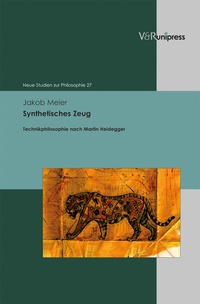
Synthetisches Zeug
Technikphilosophie nach Martin Heidegger
1st Edition
Published on 15. August 2012
Book
Hardback
519 pages
978-3-89971-959-8 (ISBN)
Description
This book concerns a metaphysical definition of artifacts, taken as a key term of the philosophy of technology. Due to the fact that classical determinations are not only insufficient explicating the term but also inapplicable to real artifacts, the work tries to develop a concept of "artifacts" using the thought of truth given by Martin Heidegger. In so far a hermeneutic interpretation of his oeuvre shows us, that truth actually is an object-generating happening. Thats why an analysis of forms of judgments allows the description of factic things. Assuming that there are theoretical judgments concerning technique - wherefore technique is an historically contingent kind of metaphysics - artifacts are given as geometrical universals, meaning terms, without being able to subsume thought-independend individuals, unless artifacts exceptionally are known as subjects of practical philosophy.
More details
Series
Thesis
Doctoral thesis
2011
Universität Cottbus
Language
German
Place of publication
Göttingen
Germany
Illustrations
5 Abbildungen
mit 5 Abbildungen
Dimensions
Height: 24.5 cm
Width: 16.3 cm
Thickness: 3.8 cm
Weight
1020 gr
ISBN-13
978-3-89971-959-8 (9783899719598)
DOI
10.14220/9783899719598
Schweitzer Classification
Other editions
Additional editions
E-Book
08/2012
1st Edition
V&R unipress
€85.00
Available for download
Persons
Author
Dr. Jakob Meier, geboren 1980, studierte an der Universität Halle-Wittenberg Philosophie und Rehabilitationspädagogik und ist seit 2010 Wissenschaftlicher Mitarbeiter an der Universität Cottbus.
Series Editor
Dr. Dr. h.c. Konrad Cramer ist emeritierter ordentlicher Professor der Philosophie in Göttingen und ordentliches Mitglied der Akademie der Wissenschaften zu Göttingen.
Dr. Jürgen Stolzenberg ist Universitätsprofessor für Geschichte der Philosophie an der Martin-Luther-Universität Halle-Wittenberg.
Content
This book concerns a metaphysical definition of artifacts, taken as a key term of the philosophy of technology. Due to the fact that classical determinations are not only insufficient explicating the term but also inapplicable to real artifacts, the work tries to develop a concept of "artifacts" using the thought of truth given by Martin Heidegger. In so far a hermeneutic interpretation of his oeuvre shows us, that truth actually is an object-generating happening. Thats why an analysis of forms of judgments allows the description of factic things. Assuming that there are theoretical judgments concerning technique - wherefore technique is an historically contingent kind of metaphysics - artifacts are given as geometrical universals, meaning terms, without being able to subsume thought-independend individuals, unless artifacts exceptionally are known as subjects of practical philosophy.>