

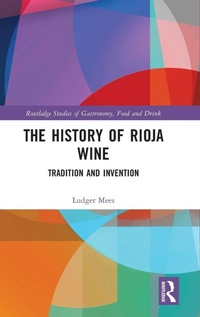
The History of Rioja Wine
Tradition and Invention
1st Edition
Published on 29. July 2022
Book
Hardback
254 pages
978-0-367-61811-7 (ISBN)
Description
This title was a prize winner at the OIV (International Organisation of Vine and Wine) Awards 2023.
The History of Rioja Wine offers an informative, chronological and in-depth account of Rioja wine from the mid-nineteenth century to the present.
This book illuminates the fascinating and largely unknown success story of Rioja wine. Drawing on illustrative sources, the volume traces the economic, social, cultural and political evolution of Rioja wine from the 1850s to the present day, concluding with a reflection on the lesson its appealing success story offers to any lover of history and wine. The book is adorned with historical photographs throughout, the majority previously unpublished.
An ideal companion both for students interested in Spanish history and wine enthusiasts more generally, this volume offers readers the opportunity to uncork the secrets of Rioja's wine.
The History of Rioja Wine offers an informative, chronological and in-depth account of Rioja wine from the mid-nineteenth century to the present.
This book illuminates the fascinating and largely unknown success story of Rioja wine. Drawing on illustrative sources, the volume traces the economic, social, cultural and political evolution of Rioja wine from the 1850s to the present day, concluding with a reflection on the lesson its appealing success story offers to any lover of history and wine. The book is adorned with historical photographs throughout, the majority previously unpublished.
An ideal companion both for students interested in Spanish history and wine enthusiasts more generally, this volume offers readers the opportunity to uncork the secrets of Rioja's wine.
Reviews / Votes
"On the one hand, Mees's new publication is a weaving together of different research strands, a synthesis of his preoccupation with the history of wine-making in the Rioja region. On the other hand, this book is an attempt to achieve something new, something that goes beyond his past research. The chosen secondary title of the book, "Tradition and Innovation", gives a hint at the hinge on which the author's history of Rioja and its wines hangs; it is the oscillation between two poles - one conservative in nature, the other one exploring the new - that explains much of the region's wine-producing story [...] Thanks to Ludger Mees's excellent guidance and this gem of a book we now know more about the history behind Rioja wines, how they came into being and finally reached our palates."-Andreas Hess, excerpt from book review, 'The Grapes of Mirth' in Dublin Review Books.
"Ludger Mees [...] has written a fascinating and multifaceted account of the evolution of Rioja and its wine. Drawing on a wide range of sources (and quoting extensively from key documents that are otherwise hard to access), he shows how a wine once so little valued that it was used make plaster was developed into Wine Spectator's 2013 "best wine in the world." The key word here is "developed," for this was no accident. Indeed, Mees is careful to set his story into the context of the great social and economic changes of the nineteenth century. [The text is a] deeply researched, carefully considered, and illuminating account of wine treated not just as an alcoholic beverage but as a social and economic lens of great value. Little of scholarly value has been written in Spanish or English about the history of Riojan wine, and this book fills a significant gap."
-Graham Harding, excerpt from book review, 'The Social History of Alcohol and Drugs' V37N2.
"Mees has written an excellent history of Rioja wine before the Civil War, making it an essential starting point for historians who want to understand the development of one of Spain's leading wine producing regions. Indirectly, he has also shown why small growers across Spain could not become fine wine producers in this period."
-James Simpson, Universidad Carlos III de Madrid.
More details
Series
Language
English
Place of publication
London
United Kingdom
Publishing group
Taylor & Francis Ltd
Target group
College/higher education
Illustrations
1 s/w Zeichnung, 9 s/w Tabellen, 44 s/w Photographien bzw. Rasterbilder, 45 s/w Abbildungen
9 Tables, black and white; 1 Line drawings, black and white; 44 Halftones, black and white; 45 Illustrations, black and white
Dimensions
Height: 240 mm
Width: 161 mm
Thickness: 18 mm
Weight
552 gr
ISBN-13
978-0-367-61811-7 (9780367618117)
Copyright in bibliographic data and cover images is held by Nielsen Book Services Limited or by the publishers or by their respective licensors: all rights reserved.
Schweitzer Classification
Other editions
Additional editions
Book
05/2024
1st Edition
Routledge
€49.51
Shipment within 15-20 days
E-Book
07/2022
1st Edition
Routledge
€55.49
Available for download
E-Book
07/2022
1st Edition
Routledge
€55.49
Available for download
Person
Ludger Mees completed his PhD in History at the University of Bielefeld, Germany, and was Assistant Professor at the same institution before taking up a lectureship at the University of the Basque Country in 1991. Since 2004 he has been full Professor of Contemporary History at the University of the Basque Country, and between 2004 and 2009 he was also Vice-Chancellor. He is author, co-author or editor of 17 books and about 120 articles and book chapters in the fields of nationalism, social movements, historiography and agrarian history. His recent publications include Una Historia Social del Vino: Rioja, Navarra, Cataluna 1860-1940 and The Basque Contention: Ethnicity, Politics, Violence.
Content
1 An intruder at the royal table; 2 Everything started with a crisis; 3 Taste and status: the invention of the "gourmet" in early bourgeois society; 4 A voice in the wilderness; 5 The Medoc connection: transnational knowledge transfer or industrial espionage?; 6 Conquering the Queen's palate; 7 Thwarted: too modern for the time; 8 Quantity beats quality: the challenge of the phylloxera plague; 9 The comeback: shape and consolidation of a brand; 10 New wine, new conflicts: industrial wineries, small winegrowers and the state; 11 The globalization trap: challenges and opportunities for Rioja wine in the twenty-first century