

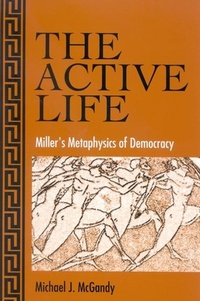
The Active Life
Miller's Metaphysics of Democracy
Published on 15. September 2005
Book
Paperback/Softback
252 pages
978-0-7914-6538-7 (ISBN)
Description
A sustained reflection on philosopher John William Miller and the metaphysical presuppositions and implications of democracy.
The ancient antagonism between the active and the contemplative lives is taken up in this innovative and wide-ranging examination of John William Miller's effort to forge a metaphysics of democracy. The Active Life sheds new light on Miller's actualist philosophy-its scope, its systematic character, and its dialectical form. Michael J. McGandy persuasively sets Miller's actualism in the context of Hannah Arendt's understanding of the active life and skillfully presents actualism as a response to Whitman's challenge to craft a democratic form of metaphysics. McGandy concludes that Miller reveals how the philosophical and the political are inextricably connected, how there is no active life without the contemplative life, and that the contemplative life is founded in the active life.
The ancient antagonism between the active and the contemplative lives is taken up in this innovative and wide-ranging examination of John William Miller's effort to forge a metaphysics of democracy. The Active Life sheds new light on Miller's actualist philosophy-its scope, its systematic character, and its dialectical form. Michael J. McGandy persuasively sets Miller's actualism in the context of Hannah Arendt's understanding of the active life and skillfully presents actualism as a response to Whitman's challenge to craft a democratic form of metaphysics. McGandy concludes that Miller reveals how the philosophical and the political are inextricably connected, how there is no active life without the contemplative life, and that the contemplative life is founded in the active life.
More details
Series
Language
English
Place of publication
Albany, NY
United States
Target group
Professional and scholarly
US School Grade: College Graduate Student and over
Product notice
Paperback (trade)
Dimensions
Height: 228 mm
Width: 164 mm
Thickness: 16 mm
Weight
354 gr
ISBN-13
978-0-7914-6538-7 (9780791465387)
Copyright in bibliographic data and cover images is held by Nielsen Book Services Limited or by the publishers or by their respective licensors: all rights reserved.
Schweitzer Classification
Other editions
Additional editions
E-Book
02/2012
1st Edition
De Gruyter
€36.49
Available for download
Person
Michael J. McGandy is Associate Managing Editor for Norton Professional Books.
Content
Preface
List of Abbreviations
Introduction: The Active and Contemplative Lives
1. A Metaphysics of Democracy?
1.1 Senses of Democracy
1.2 America's Antimetaphysical Tradition
1.3 Rorty's Challenge
1.4 Miller's Antimetaphysical Sympathies
1.5 Revisions of Metaphysics and History
1.6 Reinvigorating Criticism
1.7 Conclusion
2. Action
2.1 The Disclosure of Action
2.2 Dialectic and Definition
2.3 Dialectic and Action
2.4 Action as Constructive
2.5 Conclusion
3. Symbol
3.1 Symbolic Environment
3.2 The Midworld: Signs and Symbols
3.3 The Midworld: Symbols and Artifacts
3.4 Interpretation
3.5 Res Publicae
3.6 Conclusion
4. History
4.1 History as Constitutional
4.2 Fate, Demonry, Nemesis
4.3 Conflict, Revision, Action
4.4 Reflection and Autonomy
4.5 History and Philosophy
4.6 Conclusion
5. Democracy
5.1 The Metaphysics of Morals
5.2 Liberal Democracy
5.3 The State: Universality and Process
5.4 Democracy and Philosophy
5.5 Conclusion
Epilogue: The Scholar and the Citizen
Notes
References
Index
List of Abbreviations
Introduction: The Active and Contemplative Lives
1. A Metaphysics of Democracy?
1.1 Senses of Democracy
1.2 America's Antimetaphysical Tradition
1.3 Rorty's Challenge
1.4 Miller's Antimetaphysical Sympathies
1.5 Revisions of Metaphysics and History
1.6 Reinvigorating Criticism
1.7 Conclusion
2. Action
2.1 The Disclosure of Action
2.2 Dialectic and Definition
2.3 Dialectic and Action
2.4 Action as Constructive
2.5 Conclusion
3. Symbol
3.1 Symbolic Environment
3.2 The Midworld: Signs and Symbols
3.3 The Midworld: Symbols and Artifacts
3.4 Interpretation
3.5 Res Publicae
3.6 Conclusion
4. History
4.1 History as Constitutional
4.2 Fate, Demonry, Nemesis
4.3 Conflict, Revision, Action
4.4 Reflection and Autonomy
4.5 History and Philosophy
4.6 Conclusion
5. Democracy
5.1 The Metaphysics of Morals
5.2 Liberal Democracy
5.3 The State: Universality and Process
5.4 Democracy and Philosophy
5.5 Conclusion
Epilogue: The Scholar and the Citizen
Notes
References
Index