

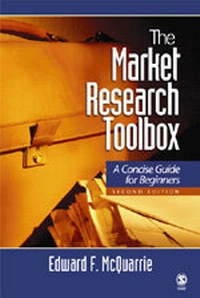
The Market Research Toolbox
A Concise Guide for Beginners
2nd Edition
Published on 25. August 2005
Book
Paperback/Softback
224 pages
978-1-4129-1319-5 (ISBN)
Description
An ideal resource for those who want to conduct market research but have little experience in doing so, The Market Research Toolbox describes how to think of market research in the context of making a business decision. The book begins by defining market research and discussing some of the various types and techniques. It then examines what objectives can be met by doing market research and the expected payoffs. Six traditional market research techniques are covered - secondary research, customer visits, focus groups, surveys, choice modelling and experimentation. The author describes how each technique works along with its costs and uses, tips for success, when and how to use certain techniques and precautions to take while using them. Next, McQuarrie discusses nontraditional types of market research that have evolved in recent years to meet the needs of business-to-business marketers and technology firms. The volume concludes with a chapter on five common business applications that can be addressed by combining several individual research techniques into a research strategy.
New to the Second Edition:
- Chapters 1 and 2 have been extensively revised and updated based on feedback from students.
- Chapter 3 on secondary research includes a new section on Internet research.
- Chapter 6 will be split into two chapters, one to focus on survey research procedures and the other to focus on questionnaire design.
- Chapter 7 will be revised to focus almost exclusively on conjoint analysis, a key tool.
- Chapter 9 will be deleted, and relevant material will be moved to other chapters.
- Chapter 10 will be expanded to include new topics such as forecasting
- An Instructors Resource on CD-ROM will be made available to lecturers adopting the book for course use. It contains PowerPoint slides, case questions, teaching notes for suggested cases that can be linked to the book, and a sample syllabus.
New to the Second Edition:
- Chapters 1 and 2 have been extensively revised and updated based on feedback from students.
- Chapter 3 on secondary research includes a new section on Internet research.
- Chapter 6 will be split into two chapters, one to focus on survey research procedures and the other to focus on questionnaire design.
- Chapter 7 will be revised to focus almost exclusively on conjoint analysis, a key tool.
- Chapter 9 will be deleted, and relevant material will be moved to other chapters.
- Chapter 10 will be expanded to include new topics such as forecasting
- An Instructors Resource on CD-ROM will be made available to lecturers adopting the book for course use. It contains PowerPoint slides, case questions, teaching notes for suggested cases that can be linked to the book, and a sample syllabus.
Reviews / Votes
"McQuarrie presents an overview of market research for a manager and others who seek an understanding of the subject. . . .The choice of tools reflects current trends and includes business-to-business as well as consumer applications. The presentation is comprehensive, concise, and nontechnical." -- W.C. Struning * CHOICE *More details
Edition
2nd Revised edition
Language
English
Place of publication
Thousand Oaks
United States
Target group
College/higher education
Edition type
Revised edition
Dimensions
Height: 229 mm
Width: 152 mm
Weight
312 gr
ISBN-13
978-1-4129-1319-5 (9781412913195)
Copyright in bibliographic data and cover images is held by Nielsen Book Services Limited or by the publishers or by their respective licensors: all rights reserved.
Schweitzer Classification
Other editions
New editions
Book
10/2011
3rd Edition
SAGE Publications Inc
€73.31
Article exhausted; check for reprint
Previous edition
Book
04/1996
1st Edition
SAGE Publications Inc
€53.47
Article exhausted; check for reprint
Person
Edward F. McQuarrie is a professor in the Department of Marketing, Leavey School of Business, Santa Clara University, in California's Silicon Valley. He received his Ph.D. in Social Psychology from the University of Cincinnati in 1985 and a B.A. in Psychology and Literature from The Evergreen State College in 1976. His research interests include market research appropriate to technology products, on the one hand, and advertising strategies that call on rhetoric, narrative, and semiotic resources on the other. He has also written the book Customer Visits: Building a Better Market Focus, co-edited the volume Go Figure! New Directions in Advertising Rhetoric, and published articles in the Journal of Consumer Research, Journal of Advertising, Marketing Theory, Journal of Consumer Psychology, Journal of the Market Research Society, Journal of Advertising Research, and the Journal of Product Innovation Management, among others. For a current list of publications, you can access his profile on scholar.google.com or researchgate.net.
He was Associate Dean for Assessment at the Leavey School of Business, 2001-2010, responsible for the assessment of learning outcomes and the evaluation of teaching. He was Associate Dean for Graduate Studies, 1996-2000, responsible for the MBA and Executive MBA programs. Professor McQuarrie began moderating focus groups in 1980 for Burke Marketing Research. He has consulted for a variety of technology firms and has taught seminars on effective customer visits, managing focus group research, marketing research methods, and similar topics for the Management Roundtable, Hewlett-Packard, Sun Microsystems, Microsoft, Apple Computer, Tektronix, Varian Associates, Cadence Design, and other clients, in England, Germany, and New Zealand as well as the United States.
He was Associate Dean for Assessment at the Leavey School of Business, 2001-2010, responsible for the assessment of learning outcomes and the evaluation of teaching. He was Associate Dean for Graduate Studies, 1996-2000, responsible for the MBA and Executive MBA programs. Professor McQuarrie began moderating focus groups in 1980 for Burke Marketing Research. He has consulted for a variety of technology firms and has taught seminars on effective customer visits, managing focus group research, marketing research methods, and similar topics for the Management Roundtable, Hewlett-Packard, Sun Microsystems, Microsoft, Apple Computer, Tektronix, Varian Associates, Cadence Design, and other clients, in England, Germany, and New Zealand as well as the United States.
Content
Author bio
Preface
Plan of the book
Who should read this book?
1. Nature and Characteristics of Market Research
Distinction #1: exploratory vs. confirmatory research
Distinction #2: marketing intelligence vs. market research
Relationship of business strategy to market research
Technological innovation and market research
Concluding comments
Suggested reading
2. Planning for Market Research
Decision problem to research question
Types of decision problem: the decision cycle
Matching tools to decisions
Effective application of research tools
Summary
Dos and Don'ts
Suggested reading
2A. Financial justification for market research
Part II
3. Secondary Research
Procedure
Steps to be taken by the firm
Steps to be taken for ongoing market intelligence gathering
Examples
Strengths and Weaknesses
Dos and Don'ts
Suggested reading
3A: Search strategies for gathering marketing intelligence
4. Customer visits
Ad hoc visits for marketing intelligence
Programmatic visits for market research
Examples
Cost
Strengths and Weaknesses
Dos and Don'ts
Suggested reading
5. The focus group
Procedure
Cost factors
Examples
Strengths and Weaknesses
Dos and Don'ts
Suggested reading
6. Sampling
Types of samples
Probability sample or non-probability sample?
Why non-probability samples?
Qualitative research and judgment samples
The importance of understanding different types of samples
Estimating the required sample size
Formula for computing sample size
Estimating the variance for a proportion
variance variance
Sampling reminders and caveats
Suggested reading
7. Survey research
Procedure
Conducting the survey yourself
Cost factors
Examples
Strengths and Weaknesses
Dos and Don'ts
Suggested reading
8. Questionnaire design
Procedure
Generating content for questionnaires
Best practices and rules to observe
The questionnaire as a whole
Question phrasing
Answer categories
Suggested reading
9. Choice modeling via conjoint analysis
Designing a conjoint analysis study
Strengths and Weaknesses
Dos and Don'ts
Suggested reading
10. Experimentation
Example #1: crafting direct mail appeals
Example #2: selecting the optimal price
Example #3: selecting a product design
Commentary
Strengths and Weaknesses
Dos and Don'ts
Suggested reading
11. Data analysis
Procedure
Types of data analysis in market research
Managerial perspective on data analysis
Suggested readings
Suggested readings
Part III
12. Combining Research Techniques into Research Strategies
Developing new products
Assessing customer satisfaction
Segmenting a market
Expanding into a market
Developing an advertising campaign
Preface
Plan of the book
Who should read this book?
1. Nature and Characteristics of Market Research
Distinction #1: exploratory vs. confirmatory research
Distinction #2: marketing intelligence vs. market research
Relationship of business strategy to market research
Technological innovation and market research
Concluding comments
Suggested reading
2. Planning for Market Research
Decision problem to research question
Types of decision problem: the decision cycle
Matching tools to decisions
Effective application of research tools
Summary
Dos and Don'ts
Suggested reading
2A. Financial justification for market research
Part II
3. Secondary Research
Procedure
Steps to be taken by the firm
Steps to be taken for ongoing market intelligence gathering
Examples
Strengths and Weaknesses
Dos and Don'ts
Suggested reading
3A: Search strategies for gathering marketing intelligence
4. Customer visits
Ad hoc visits for marketing intelligence
Programmatic visits for market research
Examples
Cost
Strengths and Weaknesses
Dos and Don'ts
Suggested reading
5. The focus group
Procedure
Cost factors
Examples
Strengths and Weaknesses
Dos and Don'ts
Suggested reading
6. Sampling
Types of samples
Probability sample or non-probability sample?
Why non-probability samples?
Qualitative research and judgment samples
The importance of understanding different types of samples
Estimating the required sample size
Formula for computing sample size
Estimating the variance for a proportion
variance variance
Sampling reminders and caveats
Suggested reading
7. Survey research
Procedure
Conducting the survey yourself
Cost factors
Examples
Strengths and Weaknesses
Dos and Don'ts
Suggested reading
8. Questionnaire design
Procedure
Generating content for questionnaires
Best practices and rules to observe
The questionnaire as a whole
Question phrasing
Answer categories
Suggested reading
9. Choice modeling via conjoint analysis
Designing a conjoint analysis study
Strengths and Weaknesses
Dos and Don'ts
Suggested reading
10. Experimentation
Example #1: crafting direct mail appeals
Example #2: selecting the optimal price
Example #3: selecting a product design
Commentary
Strengths and Weaknesses
Dos and Don'ts
Suggested reading
11. Data analysis
Procedure
Types of data analysis in market research
Managerial perspective on data analysis
Suggested readings
Suggested readings
Part III
12. Combining Research Techniques into Research Strategies
Developing new products
Assessing customer satisfaction
Segmenting a market
Expanding into a market
Developing an advertising campaign