

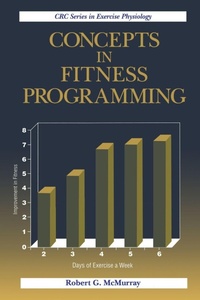
Concepts in Fitness Programming
1st Edition
Published on 23. December 1998
Book
Paperback/Softback
XII, 301 pages
978-0-8493-8714-2 (ISBN)
Description
Concepts in Fitness Programming presents comprehensive material about various aspects of exercise testing and prescription in a simple, straightforward manner. Intended for individuals who design exercise and fitness programs but who lack extensive background in fitness training, this book provides a wealth of knowledge beyond the basic "how to's" of fitness programming. Exercisers require some background in fitness and exercise-related injuries and nutrition. For safety, exerciser and instructor need to know the medical problems that limit exercise capacity or eliminate someone from safely exercising, and how drugs used for medical problems influence exercise. Background in medical terminology and the interrelationships of disease and exercise are useful for understanding exercise literature.
Reviews / Votes
"...excellent work...well written..."--A. H. Goldfarb, University of North Carolina, Greensboro, CHOICE
More details
Language
English
Place of publication
Bosa Roca
United States
Publishing group
Taylor & Francis Inc
Target group
College/higher education
Professional and scholarly
Academic, Professional, and Professional Reference
Illustrations
7 s/w Photographien bzw. Rasterbilder, 75 s/w Tabellen
75 Tables, black and white; 7 Halftones, black and white
Dimensions
Height: 234 mm
Width: 156 mm
Thickness: 17 mm
Weight
480 gr
ISBN-13
978-0-8493-8714-2 (9780849387142)
Schweitzer Classification
Other editions
Additional editions
Robert G. McMurray
Concepts in Fitness Programming
E-Book
06/2019
1st Edition
Routledge
€185.99
Available for download
Robert G. McMurray
Concepts in Fitness Programming
E-Book
06/2019
1st Edition
Routledge
€185.99
Available for download
Robert G. McMurray
Concepts in Fitness Programming
Book
06/2019
1st Edition
Routledge
€264.20
Shipment within 10-20 days
Person
Dr. Robert McMurray is currently Professor of Physical Education, Exercise & Sports Science, Professor of Nutrition, Professor of Physical Therapy, and Director of the Applied Physiology Laboratory at the University of North Carolina at Chapel Hill. Dr. McMurray has been with the university for 20 years. He teaches a number of undergraduate and graduate human physiology, exercise physiology, and sports nutrition courses. Before coming to UNC, he worked as a swimming, soccer and lacrosse coach at Union College in Schenectady, NY, and at State University of New York at Oneonta, NY. He completed his undergraduate education at the State University of New York at Cortland, received his master's degree at Ball State University in Muncie, IN, and his doctorate at Indiana University in Bloomington. In addition, he has completed postdoctoral experiences at the Institute of Environmental Stress in Santa Barbara, CA, and St. Bartholomew's Hospital in London. He has been widely published in the scientific literature, has served as a reviewer for a wide variety of exercise and medical journals, and is presently serving on the Editorial Board of Medicine and Science in Sports and Exercise. He is past president of the Southeast Chapter of the American College of Sports Medicine and is a Fellow in the American College of Sports Medicine.
Content
SECTION I: THE PHYSIOLOGY, Chapter 1 Basic Physiological Concepts, SECTION II: EXERCISE & FITNESS, Chapter 2 Health Risks and Exercise, Chapter 3 Methods of Exercise Testing, Chapter 4 Measurements of Body Composition, Chapter 5 Flexibility, Warm-Up, and Cool-Down Exercises, Chapter 6 Principles of Aerobic Fitness Training, Chapter 7 Strength-Training Techniques, Chapter 8 Low Back Pain and the Effects of an Exercise Program, Chapter 9 Contraindicated Exercise, Chapter 10 Fitness Equipment, Chapter 11 Exercise Leadership and Motivation, Chapter 12 Exercise in Special Populations, Chapter 13 Medications and Exercise, Chapter 14 Care and Prevention of Exercise-Related Injuries, Chapter 15 Civil Liability in Fitness Programming, SECTION IV: LIFESTYLE CONSIDERATIONS, Chapter 16 Cardiovascular Disease: Etiology and Risk Reduction, Chapter 17 Nutrition for Optimal Health and Performance, Chapter 18 Principles of Weight Management, Chapter 19 Stress Management, APPENDICES, Appendix A: Fitness Testing and General Exercise Guidelines, Appendix B: Body Composition, Appendix C: Exercise Circuit, Index