


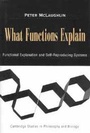
What Functions Explain
Functional Explanation and Self-Reproducing Systems
Published on 16. August 2007
Book
Paperback/Softback
272 pages
978-0-521-03885-0 (ISBN)
Description
This 2001 book offers an examination of functional explanation as it is used in biology and the social sciences, and focuses on the kinds of philosophical presuppositions that such explanations carry with them. It tackles such questions as: why are some things explained functionally while others are not? What do the functional explanations tell us about how these objects are conceptualized? What do we commit ourselves to when we give and take functional explanations in the life sciences and the social sciences? McLaughlin gives a critical review of the debate on functional explanation in the philosophy of science. He discusses the history of the philosophical question of teleology, and provides a comprehensive review of the post-war literature on functional explanation. What Functions Explain provides a sophisticated and detailed Aristotelian analysis of our concept of natural functions, and offers a positive contribution to the ongoing debate on the topic.
Reviews / Votes
'McLaughlin has given us an original and daring account of functional explanation ... [his] fascinating account of organisms as self-maintaining systems is important ...' Acta BiotheoreticaMore details
Series
Language
English
Place of publication
Cambridge
United Kingdom
Target group
Professional and scholarly
Product notice
Paperback (trade)
Illustrations
Worked examples or Exercises
Dimensions
Height: 229 mm
Width: 152 mm
Thickness: 16 mm
Weight
446 gr
ISBN-13
978-0-521-03885-0 (9780521038850)
Copyright in bibliographic data and cover images is held by Nielsen Book Services Limited or by the publishers or by their respective licensors: all rights reserved.
Schweitzer Classification
Other editions
Additional editions
E-Book
01/2005
1st Edition
Cambridge University Press
€44.49
Available for download

Book
12/2000
Cambridge University Press
€122.80
Shipment within 15-20 days
Person
Peter McLaughlin was born in 1963 in Boston, Massachusetts. He was diagnosed with a hole in his heart, called a heart murmur, and a very slow heartbeat. When Peter was 10 years old he underwent heart surgery at Boston Children's Hospital. The doctors repaired the hole in his heart and implanted a pacemaker to keep his heart rate up. That summer the local television station, WGBH, called and asked him to be on the children's program ZOOM, and talk about his surgery and his pacemaker. Peter lived a normal, active life. He graduated from the University of Massachusetts Amherst with a bachelor's degree, and then went on to Boston College to receive his master's degree in social work. At the age of 27 Peter had a massive stroke. He had been right-handed, and was unable to move his right leg or arm. After months of rehabilitation he returned to his childhood home to live with his mother and stepfather. During this time, Peter began drawing with his left hand, sitting for days with a pad of paper and a pencil in front of the window. On Christmas Day, he presented his mother with a pencil drawing of the flowers on the windowsill. Peter entered a watercolor, featuring his good pal Rufus, into an art contest at Topsfield Fair, and out of hundreds of entries, took second place. Peter then began drawing note cards and calendars, which he sold, and eventually began creating the art that became his first children's book.
Content
Acknowledgements; Part I. Functions and Intentions: 1. Introduction; 2. The problem of teleology; 3. Intentions and the functions of artifacts; Part II. The Analysis of Functional Explanation: 4. Basic positions in philosophy of science: Hempel and Nagel; 5. The etiological view; 6. The dispositional view; Part III. Self-Reproducing Systems: 7. Artifacts and organisms; 8. Feedback mechanisms and their beneficiaries; 9. Having a good; 10. What functions explain; Notes; Bibliography; Index.