

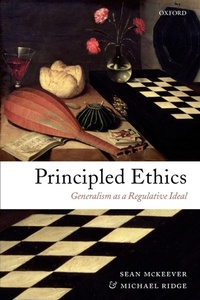
Principled Ethics
Generalism as a Regulative Ideal
Published on 20. April 2006
Book
Paperback/Softback
256 pages
978-0-19-929066-6 (ISBN)
Description
Moral philosophy has long been dominated by the aim of understanding morality and the virtues in terms of principles. However, the underlying assumption that this is the best approach has received almost no defence, and has been attacked by particularists, who argue that the traditional link between morality and principles is little more than an unwarranted prejudice.
In Principled Ethics, Michael Ridge and Sean McKeever meet the particularist challenge head on, and defend a distinctive view they call 'generalism as a regulative ideal'. After cataloguing the wide array of views that have gone under the heading 'particularism' they explain why the main particularist arguments fail to establish their conclusions. The authors' generalism incorporates what is most insightful in particularism (e.g. the possibility that reasons are context-sensitive - 'holism' about reasons) while rejecting every major particularist doctrine. At the same time, they avoid the excesses of hyper-generalist views according to which moral thought is constituted by allegiance to a particular principle or set of principles. Instead, they argue that insofar as moral knowledge and practical wisdom are possible, we both can and should codify all of morality in a manageable set of principles even if we are not yet in possession of those principles. Moral theory is in this sense a work in progress. Nor is the availability of a principled codification of morality an idle curiosity. Ridge and McKeever also argue that principles have an important role to play in guiding the virtuous agent.
In Principled Ethics, Michael Ridge and Sean McKeever meet the particularist challenge head on, and defend a distinctive view they call 'generalism as a regulative ideal'. After cataloguing the wide array of views that have gone under the heading 'particularism' they explain why the main particularist arguments fail to establish their conclusions. The authors' generalism incorporates what is most insightful in particularism (e.g. the possibility that reasons are context-sensitive - 'holism' about reasons) while rejecting every major particularist doctrine. At the same time, they avoid the excesses of hyper-generalist views according to which moral thought is constituted by allegiance to a particular principle or set of principles. Instead, they argue that insofar as moral knowledge and practical wisdom are possible, we both can and should codify all of morality in a manageable set of principles even if we are not yet in possession of those principles. Moral theory is in this sense a work in progress. Nor is the availability of a principled codification of morality an idle curiosity. Ridge and McKeever also argue that principles have an important role to play in guiding the virtuous agent.
Reviews / Votes
clear, honest and engaging...a considerable credit to its two authors. * Jonathan Dancy, Mind Journal * an impressive counterblast to the particularists, and a genuine contribution to the debate * Jonathan Dancy, TLS * Principled Ethics is an excellent work of philosophy...No philosopher working on particularism should ignore McKeever and Ridge's arguments...All in all, Principled Ethics is a highly stimulating read. * Daniel Star, Notre Dame Philosophical Reviews * Despite the attractions of particularism, most philosophers feel that it misses something. McKeever and Ridge turn these vague worries into razor-sharp objections. Then they develop a moderate alternative view of how principles work in morality. For anyone tempted to become a particularist, this book is a powerful deterrent. * Walter Sinnott-Armstrong, Dartmouth College *More details
Language
English
Place of publication
Oxford
United Kingdom
Target group
Professional and scholarly
Dimensions
Height: 234 mm
Width: 156 mm
Thickness: 14 mm
Weight
392 gr
ISBN-13
978-0-19-929066-6 (9780199290666)
Copyright in bibliographic data and cover images is held by Nielsen Book Services Limited or by the publishers or by their respective licensors: all rights reserved.
Schweitzer Classification
Other editions
Additional editions
Book
04/2006
Oxford University Press
€145.47
Shipment within 15-20 days
Persons
Content
1. The many moral particularisms ; 2. Holism about reasons ; 3. Default reasons ; 4. Moral vision ; 5. Constitutive generalism ; 6. From moral knowledge to default principles ; 7. Beyond default principles or trimming the hedges ; 8. Generalism as a regulative ideal ; 9. Principled guidance ; Appendix