

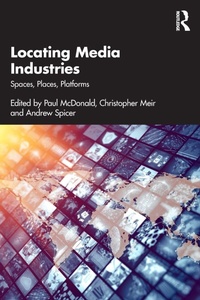
Locating Media Industries
Spaces, Places, Platforms
1st Edition
Will be published approx. on 30. June 2026
Book
Paperback/Softback
230 pages
978-1-032-81169-7 (ISBN)
Description
Examining how media industries actively shape, and are shaped by, attachments to place and movements across geographical spaces, Locating Media Industries illuminates the many spatial dimensions of 'globalised' media.
In an era where music, video and games can be streamed instantly around the world on numerous digital devices, and films and television series are produced across numerous countries, often featuring globetrotting characters in an array of exotic settings, it is easy to forget that media industries retain any attachments to space or place. While globalised production, distribution and consumption systems structure contemporary media industries, this collection seeks to document and analyse the many ways in which questions of space and place still matter to those industries.
Written by leading scholars in the field, this international collection explores how media industries both occupy and generate spaces and places. Here, spatial dynamics are represented by the formation of global production networks, the impacts of virtual production technologies, media engagements with local communities, questions of accessible participation in film festivals, and the franchising of space at media-themed leisure attractions. Several of the book's chapters reflect the increasing dominance of streaming media, which also have complex relationships to place and space, even as they actively seek to obscure and even erase these aspects of the media they distribute and, in some cases, produce.
This volume is essential reading for students and scholars of film, media and/or creative industries.
In an era where music, video and games can be streamed instantly around the world on numerous digital devices, and films and television series are produced across numerous countries, often featuring globetrotting characters in an array of exotic settings, it is easy to forget that media industries retain any attachments to space or place. While globalised production, distribution and consumption systems structure contemporary media industries, this collection seeks to document and analyse the many ways in which questions of space and place still matter to those industries.
Written by leading scholars in the field, this international collection explores how media industries both occupy and generate spaces and places. Here, spatial dynamics are represented by the formation of global production networks, the impacts of virtual production technologies, media engagements with local communities, questions of accessible participation in film festivals, and the franchising of space at media-themed leisure attractions. Several of the book's chapters reflect the increasing dominance of streaming media, which also have complex relationships to place and space, even as they actively seek to obscure and even erase these aspects of the media they distribute and, in some cases, produce.
This volume is essential reading for students and scholars of film, media and/or creative industries.
Reviews / Votes
"Questions of space and place have long fascinated cultural theorists. Locating Media Industries draws on this rich intellectual history to reboot media geography for the platform age. With case studies from across Europe, the Middle East, and Latin America, this essential book explores the nuanced ways in which media institutions 'make and manage' space."- Ramon Lobato, Swinburne University of Technology, author of Netflix Nations
"While the relation between place and media previously have been studied and reflected in different ways, both regarding sites of production, place representation and local colour, this volume brings new and important aspects to the field by looking at how the streaming industries challenge the idea of place and space in media production and as such increase the importance of understanding how 'media industries produce place and space, and how place and space produce media industries'."
- Anne Marit Risum Waade, Professor in Global Media Industries, Aarhus University
More details
Language
English
Place of publication
London
United Kingdom
Publishing group
Taylor & Francis Ltd
Target group
College/higher education
Postgraduate and Undergraduate Advanced
Illustrations
12 s/w Photographien bzw. Rasterbilder, 12 s/w Abbildungen
12 Halftones, black and white; 12 Illustrations, black and white
Dimensions
Height: 234 mm
Width: 156 mm
ISBN-13
978-1-032-81169-7 (9781032811697)
Copyright in bibliographic data and cover images is held by Nielsen Book Services Limited or by the publishers or by their respective licensors: all rights reserved.
Schweitzer Classification
Other editions
Additional editions
Book
approx. 06/2026
1st Edition
Routledge
€191.50
Not yet published
E-Book
approx. 06/2026
1st Edition
Routledge
€55.49
Available for download
E-Book
approx. 06/2026
1st Edition
Routledge
€55.49
Available for download
Persons
Paul McDonald is Professor of Media Industries at King's College London, UK. Recent publications include editing The Routledge Companion to Media Industries (2022), and co-editing Media Industries and Cities: Perspectives, Geopolitics and Transformations (2026), Global Film Policies: New Perspectives (2025), and Digital Media Distribution: Portals, Platforms, Pipelines (2021).
Christopher Meir is Assistant Professor of Communication at the Universidad Carlos III de Madrid, Spain, where he is a member of the TECMERIN research group as well as the University Institute of Spanish Cinema (IUCE). He is the author of Scottish Cinema: Texts and Contexts (2014) and Mass Producing European Cinema: Studiocanal and Its Works (2019).
Andrew Spicer is Professor of Cultural Production at the University of the West of England Bristol, UK. His recent publications include Sean Connery: Acting, Stardom and National Identity (2022); and collaborative works, Go West! 2.5: Bristol's Film and Television Industries (2025; co-authored with Jelena Krivosic); and The Politics of Place: Space and Location in European Screen Industries (2025; co-edited with Ruth Barton and Amy Genders).
Christopher Meir is Assistant Professor of Communication at the Universidad Carlos III de Madrid, Spain, where he is a member of the TECMERIN research group as well as the University Institute of Spanish Cinema (IUCE). He is the author of Scottish Cinema: Texts and Contexts (2014) and Mass Producing European Cinema: Studiocanal and Its Works (2019).
Andrew Spicer is Professor of Cultural Production at the University of the West of England Bristol, UK. His recent publications include Sean Connery: Acting, Stardom and National Identity (2022); and collaborative works, Go West! 2.5: Bristol's Film and Television Industries (2025; co-authored with Jelena Krivosic); and The Politics of Place: Space and Location in European Screen Industries (2025; co-edited with Ruth Barton and Amy Genders).
Content
Platial and Spatial Dynamics of Media Industries Part I: Media Industries and the Production of Space 1. Location as Soft Power in the Media Services Industry: The Case of 'Hollywood East' 2. Virtual Spaces, Digital Assets and the (Re)Production of the Physical: Virtual Production: Digital and Legal Geographies 3. Environment Matters: Localising (Community) Radio to Help Save the Planet 4. Accessibility and Festaphilia: Spatial Dynamics of Disability Film Festivals 5. Shifting Gears: Cars Land, Licensed Immersion, and the Renegotiation of Theme Park Spatial Capital 6. The Balearic Islands on Screen: Representations of Place in La caza: Tramuntana and The Mallorca Files Part II: Space, Place and Streaming 7. Digital Media Industries and the Question of Territoriality: The View from the Middle East 8. Streaming Cultural Authenticity: Netflix Industry Discourse and Global Original Series 9. Netflix's Monumentally Local Auteur Film-Making in Europe: Production, Rhetoric and Regulation 10. Latin American Stories Stream Worldwide: Producing for Global Platforms 11. Streaming Scotland: The Scottish Screen Sector's Journey into the Global Online Drama Production Market