

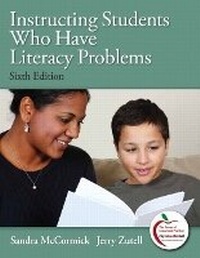
Instructing Students Who Have Literacy Problems
6th Edition
Published on 15. July 2010
Book
Hardback
552 pages
978-0-13-702358-5 (ISBN)
Description
Instructing Students Who Have Literacy Problems has long been valued because it covers both assessment and instructional strategies in a sound, research-based format. It reflects a balanced view of literacy instruction, comprehensively examining both word study and comprehension. It is the definitive research-based book on assessment and instruction of struggling readers. Four complete chapters on formal and informal assessment, plus chapters on instructional interventions, including reading instruction for special populations, allow professors the option of using the book for one inclusive course, or, using it across two courses in those universities where diagnosis and instruction are taught separately.
Many case studies of students, as well as vignettes of teachers in action, illustrate real-world applications of the textbook content. There are practical strategies suggested in the text for elementary and secondary students and for students from a variety of language backgrounds. This valuable book will successfully guide teachers so they can best help students who have reading difficulties - difficulties of all types and at all levels of severity.
Many case studies of students, as well as vignettes of teachers in action, illustrate real-world applications of the textbook content. There are practical strategies suggested in the text for elementary and secondary students and for students from a variety of language backgrounds. This valuable book will successfully guide teachers so they can best help students who have reading difficulties - difficulties of all types and at all levels of severity.
More details
Edition
6th edition
Language
English
Place of publication
United States
Publishing group
Pearson Education (US)
Target group
Professional and scholarly
Dimensions
Height: 254 mm
Width: 203 mm
Weight
1039 gr
ISBN-13
978-0-13-702358-5 (9780137023585)
Copyright in bibliographic data and cover images is held by Nielsen Book Services Limited or by the publishers or by their respective licensors: all rights reserved.
Schweitzer Classification
Other editions
New editions
Sandra McCormick | Jerry Zutell
Instructing Students Who Have Literacy Problems
Pearson New International Edition
Book
08/2013
6th Edition
Pearson Education Limited
€79.99
Shipment within 10-20 days
Previous edition
Sandra McCormick
Instructing Students Who Have Literacy Problems
Book
08/2006
5th Edition
Pearson
€48.27
Article exhausted; check for reprint
Persons
Sandra McCormick, Professor Emerita, The Ohio State University, is the author of five previous editions of this popular text; the graduate-level textbook, Remedial and Clinical Reading Instruction (Merrill); and numerous articles on delayed readers published in Reading Research Quarterly, The Reading Teacher, Journal of Learning Disabilities, Language Arts, and other journals. Dr. McCormick has served on the Board of Directors of the International Reading Association and was coeditor, with Jerry Zutell, of the National Reading Conference Yearbook.
Jerry Zutell is a Professor Emeritus and former Director of the Reading Clinic at The Ohio State University. He is a noted researcher and writer about oral reading fluency, spelling development, and related instructional practices. He is the developer of the Directed Thinking Spelling Activity (DSTA), an innovative student-active cycle of word study instruction. Dr. Zutell is a senior author of Spell It -Write! (Zaner-Bloser, 1998), is the author of the vocabulary series, Word Wisdom (Zaner-Bloser, 2005). and is coauthor, with Timothy Rasinski, of Essential Strategies for Word Study: Effective Methods for Improving Decoding, Spelling, and Vocabulary (Scholastic, 2010).
Jerry Zutell is a Professor Emeritus and former Director of the Reading Clinic at The Ohio State University. He is a noted researcher and writer about oral reading fluency, spelling development, and related instructional practices. He is the developer of the Directed Thinking Spelling Activity (DSTA), an innovative student-active cycle of word study instruction. Dr. Zutell is a senior author of Spell It -Write! (Zaner-Bloser, 1998), is the author of the vocabulary series, Word Wisdom (Zaner-Bloser, 2005). and is coauthor, with Timothy Rasinski, of Essential Strategies for Word Study: Effective Methods for Improving Decoding, Spelling, and Vocabulary (Scholastic, 2010).
Content
Part 1: Foundations of Remedial and Clinical Reading Instruction
Chapter 1: Basic Concepts and Definitions in Reading
Chapter 2: Causes and Correlates of Individual Differences in Reading
Part 2: Assessment
Chapter 3: Assessment for Identification of Reading Problems
Chapter 4: Assessment for Verifying General Reading Levels
Chapter 5 Assessment for Identifying Specific Strengths and Weaknesses Part 1
Chapter 6: Assessment for Identifying Specific Strengths and Weaknesses Part 2
Part 3: Instructional Interventions
Chapter 7: Important Principles of Instruction for Delayed Readers
Chapter 8: Word Recognition and Fluency
Chapter 9: Word Identification
Chapter 10: Knowledge of Word Meanings
Chapter 11: Comprehension of Narrative Text
Chapter 12: Comprehension of Informational Text
Part 4: Reading Instruction for Special Populations
Chapter 13: The Severely Delayed Reader and the Nonreader
Chapter 14: English-Language Learners and Other Learners with Special Needs
References
Index
Chapter 1: Basic Concepts and Definitions in Reading
Chapter 2: Causes and Correlates of Individual Differences in Reading
Part 2: Assessment
Chapter 3: Assessment for Identification of Reading Problems
Chapter 4: Assessment for Verifying General Reading Levels
Chapter 5 Assessment for Identifying Specific Strengths and Weaknesses Part 1
Chapter 6: Assessment for Identifying Specific Strengths and Weaknesses Part 2
Part 3: Instructional Interventions
Chapter 7: Important Principles of Instruction for Delayed Readers
Chapter 8: Word Recognition and Fluency
Chapter 9: Word Identification
Chapter 10: Knowledge of Word Meanings
Chapter 11: Comprehension of Narrative Text
Chapter 12: Comprehension of Informational Text
Part 4: Reading Instruction for Special Populations
Chapter 13: The Severely Delayed Reader and the Nonreader
Chapter 14: English-Language Learners and Other Learners with Special Needs
References
Index