

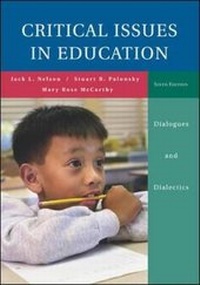
Critical Issues in Education
Dialogues and Dialectics
6th Edition
Published on 4. August 2006
Book
Paperback/Softback
528 pages
978-0-07-313136-8 (ISBN)
Description
"Critical Issues in Education" is designed to be used in courses that examine current, relevant pro and con disputes about schools and schooling. By exploring the major opposing viewpoints on these issues, the text encourages education students to think critically and develop their own viewpoints. The clear writing and dramatic dialectic approach are conducive to dynamic classroom discussions that help students grasp the many sides of these complex issues. Three integrating themes provide a solid framework for examining the eighteen topics covered. Each part begins with a chapter-length introduction that provides background material and organizing themes for the issues that follow. Each issue is then presented from two divergent viewpoints, each one written in advocate language to be as compelling as possible. The book's objective, in addition to informing the reader about the issues, is to develop critical thinking skills within the context of education.
More details
Edition
6th Revised edition
Language
English
Place of publication
London
United States
Publishing group
McGraw-Hill Education - Europe
Target group
College/higher education
Edition type
Revised edition
Dimensions
Height: 231 mm
Width: 162 mm
Thickness: 20 mm
Weight
664 gr
ISBN-13
978-0-07-313136-8 (9780073131368)
Copyright in bibliographic data and cover images is held by Nielsen Book Services Limited or by the publishers or by their respective licensors: all rights reserved.
Schweitzer Classification
Other editions
New editions
Jack Nelson | Stuart Palonsky | Mary Rose McCarthy
Critical Issues in Education: Dialogues and Dialectics
Book
03/2009
7th Edition
McGraw-Hill Professional
€100.27
Article is exhausted; no reprint
Previous edition

Jack L. Nelson | Stuart B. Palonsky | Mary Rose McCarthy
Critical Issues in Education: AND PowerWeb/OLC Card
Dialogues and Dialectics
Book
07/2003
5th Edition
McGraw-Hill Inc.,US
€65.60
Article exhausted; check for reprint
Persons
Jack L. Nelson a professor of education at Rutgers, obtained his doctorate from the University of Southern California. He is experienced teacher in schools at the elementary, secondary, undergraduate, and graduate levels; his university teaching experience includes California State University, Los Angeles; the State University of New York at Buffalo; San Jose State University; and Cambridge University. Nelson has been a visiting scholar at the University of California, Berkeley; Stanford University, University of Colorado; and Curtin University and the University of Sydney in Australia. Critical Issues in Education is his sixteenth book; he has also published about 150 articles and reviews. He is listed in Who's Who in America and Contemporary Authors. Stuart B. Palonsky is professor of education and director of the Honors College at the University of Missouri-Columbia. A former public school teacher in New York and New Jersey, Palonsky earned his doctorate at Michigan State University. His publications include 900 Shows a Year, an ethnographic study of high school teaching from a classroom teacher's perspective. In addition, Palonsky has published numerous articles and reviews in educational and social science journals, and has presented scholarly and professional papers on educational issues at national association conferences.
Content
Foreword by Nel Noddings Preface Chapter 1: Introduction: Critical Issues and Critical Thinking Part One: Whose Interests Should Schools Serve? Theme: Justice and EquityChapter 2: School Choice: Family or Public Funding Chapter 3: Financing Schools: Equity or Disparity Chapter 4: Academic Achievement Gap: Old Remedies or New Chapter 5: Gender Equity: Discrimination or Legitimate Distinctions Chapter 6: Standards-Based Reform: Real Change or Political Smoke Screen Chapter 7: Religion--Church/State: Unification or Separation Chapter 8: Privatization of Schools: Boon or Bane Part Two: What Should Be Taught? Theme: Knowledge Chapter 9: Basic Education: Traditional or Critical Chapter 10: Reading: Phonics or Whole Language Chapter 11: Multicultural Education: Democratic or Divisive Chapter 12: Values/Character Education: Traditional or Liberational Chapter 13: Technological Literacy: Necessary or Excessive Chapter 14: Standardized Testing: Restrict or Expand Part Three: How Should Schools Be Organized and Operated? Theme: School Environment Chapter 15: Instructional Leadership: Teachers or Administrators Chapter 16: Academic Freedom: Teacher Rights or Responsibilities Chapter 17: Teacher Unions: Detrimental or Beneficial to Education Chapter 18: Inclusion and Mainstreaming: Special or Common Education Chapter 19: School Violence: School Treatable or Beyond School Control Index