

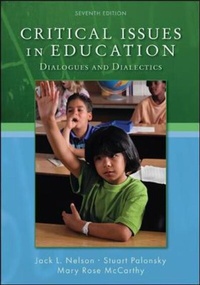
Critical Issues in Education: Dialogues and Dialectics
7th Edition
Published on 16. March 2009
Book
Paperback/Softback
544 pages
978-0-07-337864-0 (ISBN)
Description
Critical Issues in Education is designed to be used in courses that examine current, relevant pro and con disputes about schools and schooling. By exploring the major opposing viewpoints on these issues, the text encourages education students to think critically and develop their own viewpoints. The clear writing and dramatic dialectic approach are conducive to dynamic classroom discussions that help students grasp the many sides of these complex issues. Three integrating themes provide a solid framework for examining the eighteen topics covered. Each part begins with a chapter-length introduction that provides background material and organizing themes for the issues that follow. Each issue is then presented from two divergent viewpoints, each one written in advocate language to be as compelling as possible. The book's objective, in addition to informing the reader about the issues, is to develop critical thinking skills within the context of education.
More details
Edition
7th edition
Language
English
Place of publication
United States
Publishing group
McGraw-Hill Education - Europe
Target group
College/higher education
Dimensions
Height: 231 mm
Width: 163 mm
Thickness: 15 mm
Weight
637 gr
ISBN-13
978-0-07-337864-0 (9780073378640)
Copyright in bibliographic data and cover images is held by Nielsen Book Services Limited or by the publishers or by their respective licensors: all rights reserved.
Schweitzer Classification
Other editions
Previous edition
Mary Rose McCarthy | Jack L. Nelson | Stuart B. Palonsky
Critical Issues in Education
Dialogues and Dialectics
Book
08/2006
6th Edition
McGraw Hill Higher Education
€73.03
Article exhausted; check for reprint
Persons
Jack L. Nelson a professor of education at Rutgers, obtained his doctorate from the University of Southern California. He is experienced teacher in schools at the elementary, secondary, undergraduate, and graduate levels; his university teaching experience includes California State University, Los Angeles; the State University of New York at Buffalo; San Jose State University; and Cambridge University. Nelson has been a visiting scholar at the University of California, Berkeley; Stanford University, University of Colorado; and Curtin University and the University of Sydney in Australia. Critical Issues in Education is his sixteenth book; he has also published about 150 articles and reviews. He is listed in Whos Who in America and Contemporary Authors.
Stuart B. Palonsky is professor of education and director of the Honors College at the University of Missouri-Columbia. A former public school teacher in New York and New Jersey, Palonsky earned his doctorate at Michigan State University. His publications include 900 Shows a Year, an ethnographic study of high school teaching from a classroom teachers perspective. In addition, Palonsky has published numerous articles and reviews in educational and social science journals, and has presented scholarly and professional papers on educational issues at national association conferences.
Stuart B. Palonsky is professor of education and director of the Honors College at the University of Missouri-Columbia. A former public school teacher in New York and New Jersey, Palonsky earned his doctorate at Michigan State University. His publications include 900 Shows a Year, an ethnographic study of high school teaching from a classroom teachers perspective. In addition, Palonsky has published numerous articles and reviews in educational and social science journals, and has presented scholarly and professional papers on educational issues at national association conferences.
Content
Foreword by Nel NoddingsPrefaceChapter 1 Introduction: Critical Issues and Critical ThinkingIntroductionDemocratic Vitality and Educational CriticismThe Political Context of SchoolingA Tradition of School Criticism and ReformPart OneWhose Interests Should Schools Serve? Justice and EquityChapter 2School Choice: Family or Public Financing?Is family choice of schools in the public interest?Position 1: For Family Choice in EducationPosition 2: Against VouchersChapter 3Financing Schools: Equity or Disparity?Is it desirable to equalize educational spending among school districts within a state or across the nation?Position 1: For Justice in Educational FinancePosition 2: Against Centralization in Educational Financing Chapter 4 Gender Equity: Eliminating Discrimination or Accommodating Differences?Is it ever necessary to create schools or classroom settings that separate students by gender? Position 1: Eliminating DiscriminationPosition 2: Accommodating DifferencesChapter 5Standards-Based Reform: Real Change or Political Smoke Screen?Will the standards-based reform movement improve education or discriminate against poor and disadvantaged students?Position 1: Standards-Based Reform Promises Quality Education for All StudentsPosition 2: Standards-Based Reform is a Political Smoke ScreenChapter 6Religion and Public Schools: Unification or Separation?How do schools find a balance between freedom of religious expression and the separation of church and state?Position 1: For Religious Freedom in SchoolsPosition 2: Against Violating the Separation Between Church and StateChapter 7Privatization of Schools: Boon or Bane?What criteria are most suitable for deciding whether schools are better when they are operated as a public or private enterprise?Position 1: Public Schools Should be PrivatizedPosition2: Public Schools Should be PublicChapter 8 Corporations, Commerce and Schools: Competing or Complementing Interests?Does school support become corporate support?Position 1: Businesses are School PartnersPosition 2: Commercializing the SchoolChapter 9New Immigrants and Schools: Unfair Burden or Business-as-usual?Schools should offer free opportunity to all children of new immigrants?Position 1: Schools should offer educational opportunities to all children of new immigrantsPosition 2: Bad Policy Overburdens SchoolsPart TwoWhat Should be Taught? Knowledge and LiteracyChapter 10The Academic Achievement Gap: Old Remedies or New?Are already existing policies and practices reducing the academic achievement gap or are new measures needed?Position 1: For Maintaining Existing ProgramsPosition 2: For Innovative SolutionsChapter 11Values and Character Education: Traditional or Liberational?Which and whose values should public schools teach, and why?Position 1: Teach Traditional ValuesPosition 2: Liberation Through Active Value InquiryChapter 12Multicultural Education: Democratic or Divisive?Should schools emphasize America's cultural diversity or the shared aspects of American culture?Position 1: Multiculturalism: Central to a Democratic EducationPosition 2: Multiculturalism is Divisive and Destructive Chapter 13 Technology and Learning: Enabling or Subverting?What technology deserves significant school attention and who should decide?Position 1: Technology Enables LearningPosition 2: Technology Can Subvert LearningChapter 14Standardized Testing: Restrict or Expand?Should the use of standardized school tests be increased or decreased?Position 1: For Restricting TestingPosition 2: For Expanding TestingPart ThreeHow Should Schools be Organized and Operated? School EnvironmentChapter 15Discipline and Justice: Zero Tolerance or Discretion?What concept of justice should govern school and classroom discipline?Position 1: Zero-Tolerance Disciplinary Policies Provide Justice in Public SchoolsPosition 2: Zero-Tolerance Discipline Policies are Fundamentally UnjustChapter 16Teacher Unions and School Leadership: Detrimental or Beneficial?Should teachers and their unions be given a larger role in running public schools?Position 1: Teachers and Teacher Unions Should Play a Major Role in School LeadershipPosition 2: Teachers and Teacher Unions Should Not Play a Role in School LeadershipChapter 17Academic Freedom: Teacher Rights or ResponsibilitiesHow should the proper balance between teacher freedom and responsibility be determined?Position 1: For Increased Academic FreedomPosition 2: For Teacher ResponsibilityChapter 18 Inclusion and Mainstreaming: Common or Special EducationWhen and why should selected children be provided inclusive or special treatment in schools?Position 1: For Full InclusionPosition 2: Special Programs Help Special StudentsChapter 19Violence in Schools: School Treatable or Beyond School Control?Can schools deal effectively with violent or potentially violent students?Position 1: Schools Can and Should Curb ViolencePosition 2: The Problem of School Violence is Beyond School Control