

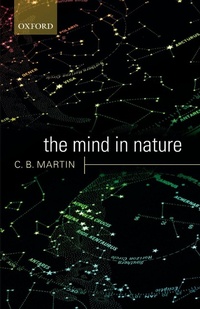
The Mind in Nature
Published on 20. May 2010
Book
Paperback/Softback
242 pages
978-0-19-957568-8 (ISBN)
Description
What are the most fundamental features of the world? Do minds stand outside the natural order? Is a unified picture of mental and physical reality possible? The Mind in Nature provides a staunchly realist account of the world as a unified system incorporating both the mental and the physical. C. B. Martin, an original and influential exponent of 'ontologically serious' metaphysics, echoes Locke's dictum that 'all things that exist are only particulars', and argues that properties are powerful qualities. He also spells out the implications of this view for philosophical conceptions of causation, intentionality, consciousness, and the mind-body problem.
Martin emphasizes the importance of non-conscious 'vegetative' systems, which provide clear examples of intentionality in the form of representational use. The slide from representational use to consciousness involves a change in the material of use, but not the form of representation. A concluding chapter provides an argument for the view that an ontology of particular substances and properties leads ineluctably to monism: the bus we board with Locke takes us directly to the world of Spinoza and Einstein. Along the way, we are led to understand the nature of minds and conscious states of mind in a way that avoids both reductionism (the idea that mental is reducible to the non-mental) and dualism (the idea that mental substances or properties differ dramatically from physical substances and properties).
Martin emphasizes the importance of non-conscious 'vegetative' systems, which provide clear examples of intentionality in the form of representational use. The slide from representational use to consciousness involves a change in the material of use, but not the form of representation. A concluding chapter provides an argument for the view that an ontology of particular substances and properties leads ineluctably to monism: the bus we board with Locke takes us directly to the world of Spinoza and Einstein. Along the way, we are led to understand the nature of minds and conscious states of mind in a way that avoids both reductionism (the idea that mental is reducible to the non-mental) and dualism (the idea that mental substances or properties differ dramatically from physical substances and properties).
Reviews / Votes
Worth reading, as the presently only available survey of Martin's deeply interesting world-view. * Jessica Wilson Mind 119 *More details
Language
English
Place of publication
Oxford
United Kingdom
Target group
College/higher education
Dimensions
Height: 216 mm
Width: 140 mm
Thickness: 13 mm
Weight
310 gr
ISBN-13
978-0-19-957568-8 (9780199575688)
Copyright in bibliographic data and cover images is held by Nielsen Book Services Limited or by the publishers or by their respective licensors: all rights reserved.
Schweitzer Classification
Other editions
Additional editions
Person
C. B. Martin (1924-2008) was Professor of Philosophy at the University of Calgary.
Content
Preface ; 1. Introduction ; 2. Dispositions and Conditionals ; 3. Truthmakers and Disposition Lines: From Quark to Colleague ; 4. Parts and Wholes ; 5. Causality ; 6. The Road to Pythagoreanism and Back ; 7. Linguisticism and Pythagoreanism ; 8. Protolanguage ; 9. Use, Representational Use, and Content ; 10. Emergence, Reduction, and Mental Chauvanism ; 11. Dispositional Systems ; 12. Two Jokes Explained ; 13. Tactile-Motor-Kinaesthetic Perception ; 14. Verbal Imagery ; 15. Mind in Nature: A New View of the Mind ; 16. Warps and Woof of Einstein ; References ; Index