

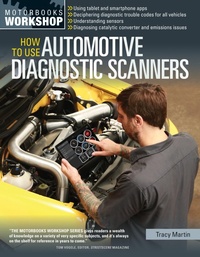
How To Use Automotive Diagnostic Scanners
- Understand OBD-I and OBD-II Systems - Troubleshoot Diagnostic Error Codes for All Vehicles - Select the Right Scan Tools and Code Readers
Published on 3. September 2015
Book
Paperback/Softback
200 pages
978-0-7603-4773-7 (ISBN)
Description
Scan your own codes to save money, fix problems, or get the best performance out of your ride!
Scanning the code to determine why your "check engine" light has come on is frequently more costly than the repair itself! Scanning automotive systems at home can save you money and only requires the ability to plug a phone or tablet into an easily accessible port on the car. With the right dock, it is possible to perform diagnostic checks in your very own garage.
From handheld, dedicated units to software that turns PCs and portable devices into powerful diagnostic scanners, today's auto enthusiasts can access and analyze their vehicle's on-board diagnostic systems. This is great news, and not just for repairs. With the right information, these scanners can be used as low-budget data acquistion systems and dynamometers to maximize your vehicle's performance.
How to Use Automotive Diagnostic Scanners teaches you how to choose the right scanner for your application and how to use it, with a comprehensive list of what each code means. Photos and diagrams help you understand OBD-I and OBD-II systems (including CAN) and the scanners that read the information they record. From catalytic converters and O2 sensors to emissions and automotive detective work, this is the complete reference for keeping your vehicle EPA-compliant and on the road!
Scanning the code to determine why your "check engine" light has come on is frequently more costly than the repair itself! Scanning automotive systems at home can save you money and only requires the ability to plug a phone or tablet into an easily accessible port on the car. With the right dock, it is possible to perform diagnostic checks in your very own garage.
From handheld, dedicated units to software that turns PCs and portable devices into powerful diagnostic scanners, today's auto enthusiasts can access and analyze their vehicle's on-board diagnostic systems. This is great news, and not just for repairs. With the right information, these scanners can be used as low-budget data acquistion systems and dynamometers to maximize your vehicle's performance.
How to Use Automotive Diagnostic Scanners teaches you how to choose the right scanner for your application and how to use it, with a comprehensive list of what each code means. Photos and diagrams help you understand OBD-I and OBD-II systems (including CAN) and the scanners that read the information they record. From catalytic converters and O2 sensors to emissions and automotive detective work, this is the complete reference for keeping your vehicle EPA-compliant and on the road!
Reviews / Votes
"THE MOTORBOOKS WORKSHOP SERIES gives readers a wealth of knowledge on a variety of very specific subjects, and it's always on the shelf for reference in years to come." - Tom Vogele, Editor, Streetscene MagazineMore details
Series
Language
English
Place of publication
United States
Publishing group
Quarto Publishing Group USA Inc
Product notice
Paperback (trade)
Illustrations
200 color photos, 25 diagrams
Dimensions
Height: 269 mm
Width: 206 mm
Thickness: 20 mm
Weight
635 gr
ISBN-13
978-0-7603-4773-7 (9780760347737)
Copyright in bibliographic data and cover images is held by Nielsen Book Services Limited or by the publishers or by their respective licensors: all rights reserved.
Schweitzer Classification
Other editions
Additional editions
Tracy Martin
How To Use Automotive Diagnostic Scanners
E-Book
08/2015
Motorbooks
€29.49
Available for download
Person
TRACY MARTIN writes for Motorcycle Consumer News, RoadBike, Friction Zone, PowerSports, and Dealer News magazines. He is the author of six books, including the Motorbooks titles How to Diagnose and Repair Automotive Electrical Systems (2005), Motorcycle Electrical Systems: Troubleshooting and Repair (2007), How to Tune and Modify Motorcycle Engine Management Systems (2012), and How to Troubleshoot, Repair, and Modify Motorcycle Electrical Systems (2014). Tracy lives in Baltimore, Maryland.
Content
Preface
Chapter 1-On Board Diagnostics, a Brief History
Chapter 2, OBD-II - the On-Board Emissions Monitor Transitions: From OBD-I to OBD-II
Chapter 3 - Catalytic Converters, Oxygen Sensors and Electronic Fuel Delivery
Chapter 4 - Professional Scanners & Code Readers
Chapter 5 Scan Tools
Chapter 6, Automotive Detective Work
Chapter 7 Scanner Operation
Appendix:
Domestic OBD-I and OBD-II Applications
OBD-I Codes
OEM Contact Info for OBD-II
OBD-II Automotive Terms
OBD-II Acronyms
DLC Non-standard Locations
Diagnostic Trouble Codes
Chapter 1-On Board Diagnostics, a Brief History
Chapter 2, OBD-II - the On-Board Emissions Monitor Transitions: From OBD-I to OBD-II
Chapter 3 - Catalytic Converters, Oxygen Sensors and Electronic Fuel Delivery
Chapter 4 - Professional Scanners & Code Readers
Chapter 5 Scan Tools
Chapter 6, Automotive Detective Work
Chapter 7 Scanner Operation
Appendix:
Domestic OBD-I and OBD-II Applications
OBD-I Codes
OEM Contact Info for OBD-II
OBD-II Automotive Terms
OBD-II Acronyms
DLC Non-standard Locations
Diagnostic Trouble Codes