

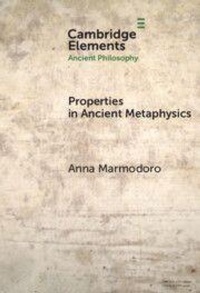
Properties in Ancient Metaphysics
Published on 21. December 2023
Book
Hardback
78 pages
978-1-009-47573-0 (ISBN)
Description
This Element provides an overview of how the ancient thinkers (Anaxagoras, Plato and Aristotle) theorised about properties; such overview puts in relief the inquiries, problems and solutions they were pursuing while engaged in dialogue with each other. It examines alternative philosophical perspectives existing in antiquity concerning the explanation of property qualification, qualitative similarity, compositeness, and oneness. It further argues that although Plato was the first to conceptualise recurring universals, he did not reify them and did not admit them in his ontology; it was Aristotle who did, and developed his metaphysics around them. Aristotle, building on Plato's work, identified the metaphysical phenomenon of the instantiation of properties and developed an account for it. Finally, this Element outlines Aristotle's 'sophisticated' account of the oneness of a substance and argues that it was not hylomorphic.
More details
Series
Language
English
Place of publication
Cambridge
United Kingdom
Product notice
sewn/stitched
Cloth over boards
Illustrations
Worked examples or Exercises
Dimensions
Height: 229 mm
Width: 152 mm
Thickness: 6 mm
Weight
277 gr
ISBN-13
978-1-009-47573-0 (9781009475730)
Copyright in bibliographic data and cover images is held by Nielsen Book Services Limited or by the publishers or by their respective licensors: all rights reserved.
Schweitzer Classification
Other editions
Additional editions
Anna Marmodoro
Properties in Ancient Metaphysics
Book
12/2023
Cambridge University Press
€24.00
Shipment within 15-20 days
Anna Marmodoro
Properties in Ancient Metaphysics
E-Book
12/2023
Cambridge University Press
€20.99
Available for download
Anna Marmodoro
Properties in Ancient Metaphysics
E-Book
11/2023
Cambridge University Press
€20.99
Available for download
Person
Content
1. Introduction; 2. Anaxagoras's opposites; 3. Plato's forms; 4. Aristotle's forms; 5. Conclusion; Bibliography.