

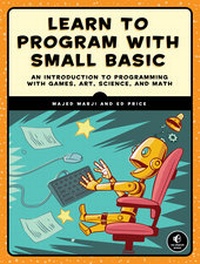
Learn to Program with Small Basic
An Introduction to Programming with Games, Art, Science, and Math
1st Edition
Published on 16. April 2016
Book
Paperback/Softback
XXIV, 320 pages
978-1-59327-702-4 (ISBN)
Description
" Welcome to the Magical World of Programming. What do you want to create today?" - Vijaye Raji, Creator of Small Basic
Small Basic is a free, beginner-friendly programming language created by Microsoft. Inspired by BASIC, which introduced programming to millions of first-time PC owners in the 1970s and 1980s, Small Basic is a modern language that makes coding simple and fun.
Learn to Program with Small Basic introduces you to the empowering world of programming. You'll master the basics with simple activities like displaying messages and drawing colorful pictures, and then work your way up to programming games! Learn how to:
- Program your computer to greet you by name
- Make a game of rock-paper-scissors using If/Else statements
- Create an interactive treasure map using arrays
- Draw intricate geometric patterns with just a few lines of code
- Simplify complex programs by breaking them into bite-sized subroutines
You'll also learn to command a turtle to draw shapes, create magical moving text, solve math problems quickly, help a knight slay a dragon, and more!
Each chapter ends with creative coding challenges so you can take your skills to the next level. Learn to Program with Small Basic is the perfect place to start your computer science journey.
Covers small basic Version 1.X. Windows 7 or higher required.
Small Basic is a free, beginner-friendly programming language created by Microsoft. Inspired by BASIC, which introduced programming to millions of first-time PC owners in the 1970s and 1980s, Small Basic is a modern language that makes coding simple and fun.
Learn to Program with Small Basic introduces you to the empowering world of programming. You'll master the basics with simple activities like displaying messages and drawing colorful pictures, and then work your way up to programming games! Learn how to:
- Program your computer to greet you by name
- Make a game of rock-paper-scissors using If/Else statements
- Create an interactive treasure map using arrays
- Draw intricate geometric patterns with just a few lines of code
- Simplify complex programs by breaking them into bite-sized subroutines
You'll also learn to command a turtle to draw shapes, create magical moving text, solve math problems quickly, help a knight slay a dragon, and more!
Each chapter ends with creative coding challenges so you can take your skills to the next level. Learn to Program with Small Basic is the perfect place to start your computer science journey.
Covers small basic Version 1.X. Windows 7 or higher required.
Reviews / Votes
"A middle school student with no programming experience could pick up this title and quickly begin writing text-based programming. This book is particularly relevant to libraries trying to beef up their STEAM offerings."-School Library Connection
"The book is an excellent resource for any parent or teacher looking to provide a gentle introduction to coding. The ambitious middle schooler might also find it a suitable read to tackle on their own."
-Zen and the Art of Programming
"This book is for anyone who is interested in learning more about the basics of computer programming in a fun and engaging way. I highly recommend Learn to Program with Small Basic and Microsoft's excellent Small Basic programming language."
-Martin Fish, Coding and Robotics teacher
"Learn to Program with Small Basic provides a fun and informative way of delivering the concepts. The use of color coding and visuals enables students to easily follow and gives them the confidence to try coding themselves."
-Susan Nicholson, Computer Science and Robotics teacher
More details
Language
English
Place of publication
San Francisco
Germany
Target group
Children/juvenile
Students, Programmers
Product notice
Unsewn / adhesive bound
Illustrations
komplett in Farbe
Dimensions
Height: 233 mm
Width: 177 mm
Thickness: 25 mm
Weight
665 gr
ISBN-13
978-1-59327-702-4 (9781593277024)
Schweitzer Classification
Other editions
Additional editions
Majed Marji | Ed Price
Learn to Program with Small Basic
An Introduction to Programming with Games, Art, Science, and Math
E-Book
04/2016
No Starch Press
€27.49
Available for download
Persons
Majed Marji is a senior development engineer at General Motors and an adjunct faculty member at Wayne State University in Michigan. He is the author of Learn to Program with Scratch (No Starch Press).
Ed Price is a senior program manager in engineering at Microsoft. He holds an MBA in Technology Management and has been a professor at Bellevue College. He runs customer feedback programs for Azure Development, Visual Studio, and Small Basic.
Ed Price is a senior program manager in engineering at Microsoft. He holds an MBA in Technology Management and has been a professor at Bellevue College. He runs customer feedback programs for Azure Development, Visual Studio, and Small Basic.
Content
Chapter 1: Introducing Small Basic
Chapter 2: Getting Started
Chapter 3: Drawing Basics
Chapter 4: Using Variables
Chapter 5: Drawing Shapes with Turtle Graphics
Chapter 6: Getting User Input
Chapter 7: Empowering Programs with Math
Chapter 8: Making Decisions with If Statements
Chapter 9: Using Decisions to Make Games
Chapter 10: Solving Problems with Subroutines
Chapter 11: Event-Driven Programming
Chapter 12: Building Graphical User Interfaces
Chapter 13: Repeating For Loops
Chapter 14: Creating Conditional While Loops
Chapter 15: Grouping Data in One-Dimensional Arrays
Chapter 16: Storing Data with Associative Arrays
Chapter 17: Expanding to Higher-Dimension Arrays
Chapter 18: Advanced Text Magic
Chapter 19: Receiving File Input and Output
Chapter 2: Getting Started
Chapter 3: Drawing Basics
Chapter 4: Using Variables
Chapter 5: Drawing Shapes with Turtle Graphics
Chapter 6: Getting User Input
Chapter 7: Empowering Programs with Math
Chapter 8: Making Decisions with If Statements
Chapter 9: Using Decisions to Make Games
Chapter 10: Solving Problems with Subroutines
Chapter 11: Event-Driven Programming
Chapter 12: Building Graphical User Interfaces
Chapter 13: Repeating For Loops
Chapter 14: Creating Conditional While Loops
Chapter 15: Grouping Data in One-Dimensional Arrays
Chapter 16: Storing Data with Associative Arrays
Chapter 17: Expanding to Higher-Dimension Arrays
Chapter 18: Advanced Text Magic
Chapter 19: Receiving File Input and Output