

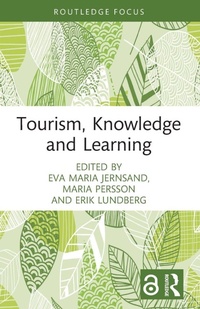
Tourism, Knowledge and Learning
1st Edition
Published on 27. May 2024
Book
Paperback/Softback
122 pages
978-1-032-27564-2 (ISBN)
Description
This book contributes to the understanding of how tourism can be designed to provide conditions for learning. This involves learning for tourists, the tourist industry, public authorities and local communities. We explore how tourism, knowledge and learning can be used as means towards sustainable development through current, new or changed structures, concepts, activities and communication efforts. The book should be seen as both an inspiration for tourism actors (e.g. tourism attractions, policy makers and other industry actors), and a scholarly contribution to further research. A holistic approach distinguishes this book from most existing literature that focuses on separate units of tourism, for instance, personal or community well-being, nature-based tourism, cultural heritage tourism or tourism that is a result of researchers' travels (so-called scientific tourism). The various contributors to the book provide a range of perspectives and experiences, from social sciences with a focus on marketing, innovation management, human geography and environmental law, to arts and humanities with a focus on heritage studies, archaeology and photography, and, finally, to natural sciences with a focus on marine sciences.
The Open Access version of this book, available at www.taylorfrancis.com, has been made available under a Creative Commons Attribution-Non Commercial-No Derivatives 4.0 license
The Open Access version of this book, available at www.taylorfrancis.com, has been made available under a Creative Commons Attribution-Non Commercial-No Derivatives 4.0 license
More details
Series
Language
English
Place of publication
London
United Kingdom
Publishing group
Taylor & Francis Ltd
Target group
College/higher education
Postgraduate and Undergraduate
Illustrations
2 s/w Tabellen, 19 s/w Abbildungen, 2 s/w Zeichnungen, 17 s/w Photographien bzw. Rasterbilder
2 Tables, black and white; 2 Line drawings, black and white; 17 Halftones, black and white; 19 Illustrations, black and white
Dimensions
Height: 216 mm
Width: 140 mm
Thickness: 7 mm
Weight
177 gr
ISBN-13
978-1-032-27564-2 (9781032275642)
Copyright in bibliographic data and cover images is held by Nielsen Book Services Limited or by the publishers or by their respective licensors: all rights reserved.
Schweitzer Classification
Other editions
Additional editions
Eva Maria Jernsand | Maria Persson | Erik Lundberg
Tourism, Knowledge and Learning
Conceptual Development and Case Studies
E-Book
09/2022
1st Edition
Routledge
€0.00
Available for download
Eva Maria Jernsand | Maria Persson | Erik Lundberg
Tourism, Knowledge and Learning
Conceptual Development and Case Studies
E-Book
09/2022
1st Edition
Routledge
€0.00
Available for download
Eva Maria Jernsand | Maria Persson | Erik Lundberg
Tourism, Knowledge and Learning
Conceptual Development and Case Studies
Book
09/2022
1st Edition
Routledge
€76.80
Shipment within 10-20 days
Persons
Eva Maria Jernsand is a researcher in Department of Business Administration, University of Gothenburg, Sweden.
Maria Persson is a researcher in Department of Historical Studies, University of Gothenburg, Sweden.
Erik Lundberg is a researcher and lecturer Department of Business Administration, University of Gothenburg, Sweden.
Maria Persson is a researcher in Department of Historical Studies, University of Gothenburg, Sweden.
Erik Lundberg is a researcher and lecturer Department of Business Administration, University of Gothenburg, Sweden.
Content
1. An introduction - learning and sustainable tourism. 2. Destination development based on knowledge and learning - initiating a UNESCO biosphere reserve (BR) in Bohuslaen. 3. Science tourism - a conceptual development. 4. Learning on guided tours: historical perspective. 5. Experience-based learning through archaeological information panels - using herirtage interpretation. 6. Extended ways of experiencing climate change - from photography to virtual reality in Svalbard. 7. Citizen science as a tourist attraction - an active learning tourist experience. 8. Towards a research agenda on tourism, knowledge and learning.