

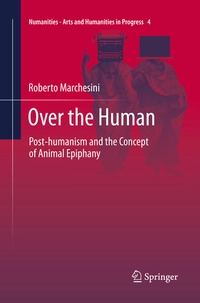
Over the Human
Post-humanism and the Concept of Animal Epiphany
Published on 12. May 2018
Book
Paperback/Softback
VI, 160 pages
978-3-319-87346-6 (ISBN)
Description
This book presents a new way to understand human-animal interactions. Offering a profound discussion of topics such as human identity, our relationship with animals and the environment, and our culture, the author channels the vibrant Italian traditions of humanism, materialism, and speculative philosophy.
The research presents a dialogue between the humanities and the natural sciences. It challenges the separation and oppression of animals with a post-humanism steeped in the traditions of the Italian Renaissance.
Readers discover a vision of the human as a species informed by an intertwining with animals. The human being is not constructed by an onto-poetic process, but rather by close relations with otherness. The human system is increasingly unstable and, therefore, more hybrid.
The argument it presents interests scholars, thinkers, and researchers. It also appeals to anyone who wants to delve intothe deep animal-human bond and its philosophical, cultural, political instances.
The author is a veterinarian, ethologist, and philosopher. He uses cognitive science, zooanthropology, and philosophy to engage in a series of empirical, theoretical, and practice-based engagements with animal life. In the process, he argues that animals are key to human identity and culture at all levels.
The research presents a dialogue between the humanities and the natural sciences. It challenges the separation and oppression of animals with a post-humanism steeped in the traditions of the Italian Renaissance.
Readers discover a vision of the human as a species informed by an intertwining with animals. The human being is not constructed by an onto-poetic process, but rather by close relations with otherness. The human system is increasingly unstable and, therefore, more hybrid.
The argument it presents interests scholars, thinkers, and researchers. It also appeals to anyone who wants to delve intothe deep animal-human bond and its philosophical, cultural, political instances.
The author is a veterinarian, ethologist, and philosopher. He uses cognitive science, zooanthropology, and philosophy to engage in a series of empirical, theoretical, and practice-based engagements with animal life. In the process, he argues that animals are key to human identity and culture at all levels.
More details
Series
Edition
Softcover reprint of the original 1st ed. 2017
Language
English
Place of publication
Cham
Switzerland
Publishing group
Springer International Publishing
Target group
Professional and scholarly
Illustrations
VI, 160 p.
Dimensions
Height: 235 mm
Width: 155 mm
Thickness: 10 mm
Weight
265 gr
ISBN-13
978-3-319-87346-6 (9783319873466)
DOI
10.1007/978-3-319-62581-2
Schweitzer Classification
Other editions
Additional editions
Book
08/2017
Springer
€85.59
Shipment within 10-15 days
Person
Marco Celentano is a Professor of Ethics and Moral Philosophy at the Università degli Studi di Cassino e del Lazio Meridionale (Italy), founder and coordinator of the Post-Graduate School of Philosophy, Ethics and Ethology, and member of the Konrad Lorenz Institute for Evolution and Cognition Research and of the Italian Society of Moral Philosophy. He correlate in His studies different research fields: from ethology of knowledge, evolutionary epistemology to the philosophy of ethology and study of the animal minds and cultures. He also produced monographic studies on authors such as K. Lorenz, F. Nietzsche and Th. Adorno and several papers on the question of animal liberation and the contemporary anti-speciesist ethics. Amongst his publications for the English-speaking audience: From Konrad Lorenz's "phylogenetic apriorism" to the birth of Evolutionary Epistemology. In Andreica, O. - Olteanu, A. (eds.) Readings in Numanities, Springer 2017; Interspecific Cultural Convergences (ICC) and Interspecific Cultural Studies (ICS): From the only human towards a comparative history of animal uses and traditions in Ceccarelli D., Frezza G. (eds), Predicatbility and the Unpredictable, CNR Edizioni 2018; "Both for Ethics and Health. Non-Animal Technologies: an achievable goal", in Journal of Theoretical and Applied Vascular Research, 2 (1), 2017. Roberto Marchesini is Director of Siua (School of Human-Animal Interaction) and the Centro Studi Filosofia Postumanista (Centre Study for Post-human Philosophy), both based in Bologna, Italy. He has been a prominent voice in the development of zooanthropology and posthumanism in Italy and teaches human-animal interactions in courses around the country. He has written and co-written more than 30 books and 100 scientific essays. Amongst his main pubblications for the English-speaking audience: Over the human. Post-humanism and the Concept of Animal Epiphany (Springer 2017), The Philosophical Ethology of Roberto Marchesini (Routledge) and Beyond Anthropocentrism (Mimesis International) Roberto Marchesini runs an ethology blog on the major Italian Newspaper Il Corriere della Sera, and he is also member of the scientific board of Minding Animal International.
Content
1. The Epimethean Condition.- 2. The Promethean Condition.- 3. The Therioanthrophic Being As Our Neighbour.- 4. Overcoming The Human.- 5. Zoomimesis: Embodied Epiphany.- 6. Step To A Philosophical Ethology.- 7. The Posthuman Dimension.