

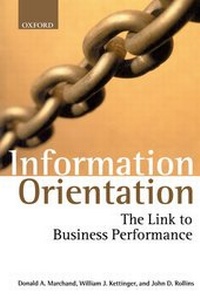
Information Orientation
The Link to Business Performance
Published on 27. June 2002
Book
Paperback/Softback
328 pages
978-0-19-925221-3 (ISBN)
Description
In today's fast-moving, e-commerce economy information is power. For years companies have been investing in IT, expecting to develop their ability to exploit the power of information and achieve better business performance. Frequently, a company's investment has been a cost with no clear payback; a competitive necessity rather than a strategic advantage.
The authors have developed a clear and effective framework for evaluating IT strategies: Information Orientation. Information Orientation does this by determining the degree to which a company implements and realizes the synergies across three information capabilities: information behaviors and values; information management practices; and information technology practices. The book provides a thorough description of the dimensions of each of the capabilities, along with the analytical basis which validates the research finding that a company must integrate all three information capabilities as a precondition for achieving superior business performance.
The book presents the Information Orientation Dashboard as a diagnostic tool to measure and evaluate the strengths and weaknesses of a company's information capabilities. The book also identifies a new trend in the way in which senior managers think about achieving strategic priorities and future indsutry leadership with information.
The book contributes to a new area of management thinking by offering empirically-tested and statistically-validated theories, which will not only be of interest to academics, but will also carry great significance for the practitioner. For academic readers, this book presents a theory with supporting evidence and arguments for changing the way management, and in particular IT researchers, examine the roles of people, information, and IT in decision making and strategy implementation. For company managers, this book provides a new framework and business metric that challenges current mindsets and practices concerning how people, information, and IT can be managed to achieve business results.
The authors have developed a clear and effective framework for evaluating IT strategies: Information Orientation. Information Orientation does this by determining the degree to which a company implements and realizes the synergies across three information capabilities: information behaviors and values; information management practices; and information technology practices. The book provides a thorough description of the dimensions of each of the capabilities, along with the analytical basis which validates the research finding that a company must integrate all three information capabilities as a precondition for achieving superior business performance.
The book presents the Information Orientation Dashboard as a diagnostic tool to measure and evaluate the strengths and weaknesses of a company's information capabilities. The book also identifies a new trend in the way in which senior managers think about achieving strategic priorities and future indsutry leadership with information.
The book contributes to a new area of management thinking by offering empirically-tested and statistically-validated theories, which will not only be of interest to academics, but will also carry great significance for the practitioner. For academic readers, this book presents a theory with supporting evidence and arguments for changing the way management, and in particular IT researchers, examine the roles of people, information, and IT in decision making and strategy implementation. For company managers, this book provides a new framework and business metric that challenges current mindsets and practices concerning how people, information, and IT can be managed to achieve business results.
Reviews / Votes
Vitally important issues that are usefully explored. * Long Range Planning *More details
Language
English
Place of publication
Oxford
United Kingdom
Target group
College/higher education
Professional and scholarly
Illustrations
numerous figures and tables
Dimensions
Height: 235 mm
Width: 158 mm
Thickness: 18 mm
Weight
511 gr
ISBN-13
978-0-19-925221-3 (9780199252213)
Copyright in bibliographic data and cover images is held by Nielsen Book Services Limited or by the publishers or by their respective licensors: all rights reserved.
Schweitzer Classification
Other editions
Additional editions
Donald A. Marchand | William J. Kettinger | John D. Rollins
Information Orientation
The Link to Business Performance
Book
01/2001
Oxford University Press
€90.80
Shipment within 15-20 days
Persons
Donald A. Marchand is Study Director and Professor, Information Management and Strategy, IMD International, Lausanne.
William J. Kettinger is Director, Center for Information Management and Technology Research, Darla Moore School of Business Administration, University of South Carolina.
John D. Rollins is Study Director and Managing Partner, Strategic IT Effectiveness (SITE), Andersen Consulting.
William J. Kettinger is Director, Center for Information Management and Technology Research, Darla Moore School of Business Administration, University of South Carolina.
John D. Rollins is Study Director and Managing Partner, Strategic IT Effectiveness (SITE), Andersen Consulting.
Content
1. Managing People, Information, and Technology to Improve Business Performance ; 2. Evolution of Management Thinking and Practice about People, Information, and IT ; 3. How Senior Managers Assess Information Technology Practices ; 4. How Senior Managers Value Information Management Practices ; 5. What Key Behaviors and Values Lead to Effective Information Use by People in Companies ; 6. Discovering the Link between Information Orientation and Business Performance ; 7. Information Orientation: The New Metric of Effective Information Use ; 8. Developing Information Orientation Maturity in Companies ; 9. Competing for the Future: Industry Leadership Using Information ; Epilogue Transforming Management Practice and Metrics in the Age of Information Capitalism ; Appendix The Study's Research Approach and Statistical Results