

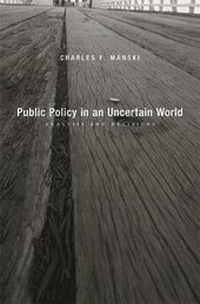
Public Policy in an Uncertain World
Analysis and Decisions
Published on 18. February 2013
Book
Hardback
224 pages
978-0-674-06689-2 (ISBN)
Description
Public policy advocates routinely assert that "research has shown" a particular policy to be desirable. But how reliable is the analysis in the research they invoke? And how does that analysis affect the way policy is made, on issues ranging from vaccination to minimum wage to FDA drug approval? Charles Manski argues here that current policy is based on untrustworthy analysis. By failing to account for uncertainty in an unpredictable world, policy analysis misleads policy makers with expressions of certitude. Public Policy in an Uncertain World critiques the status quo and offers an innovation to improve how policy research is conducted and how policy makers use research.
Consumers of policy analysis, whether civil servants, journalists, or concerned citizens, need to understand research methodology well enough to properly assess reported findings. In the current model, policy researchers base their predictions on strong assumptions. But as Manski demonstrates, strong assumptions lead to less credible predictions than weaker ones. His alternative approach takes account of uncertainty and thereby moves policy analysis away from incredible certitude and toward honest portrayal of partial knowledge. Manski describes analysis of research on such topics as the effect of the death penalty on homicide, of unemployment insurance on job-seeking, and of preschooling on high school graduation. And he uses other real-world scenarios to illustrate the course he recommends, in which policy makers form reasonable decisions based on partial knowledge of outcomes, and journalists evaluate research claims more closely, with a skeptical eye toward expressions of certitude.
Consumers of policy analysis, whether civil servants, journalists, or concerned citizens, need to understand research methodology well enough to properly assess reported findings. In the current model, policy researchers base their predictions on strong assumptions. But as Manski demonstrates, strong assumptions lead to less credible predictions than weaker ones. His alternative approach takes account of uncertainty and thereby moves policy analysis away from incredible certitude and toward honest portrayal of partial knowledge. Manski describes analysis of research on such topics as the effect of the death penalty on homicide, of unemployment insurance on job-seeking, and of preschooling on high school graduation. And he uses other real-world scenarios to illustrate the course he recommends, in which policy makers form reasonable decisions based on partial knowledge of outcomes, and journalists evaluate research claims more closely, with a skeptical eye toward expressions of certitude.
Reviews / Votes
To academic readers steeped in [economics and decision theory], [Manski's] account is likely to be of some interest. It includes many useful and important insights (for example, the distinctions among policies based on the principles of 'maximin,' 'minimax,' and 'adaptive mini-max' regret) that have substantial implications for real-world policy. -- Brian Baird * Science *More details
Language
English
Place of publication
Cambridge, Mass
United States
Target group
Professional and scholarly
US School Grade: College Graduate Student
Illustrations
1 graph, 3 tables
Dimensions
Height: 235 mm
Width: 156 mm
ISBN-13
978-0-674-06689-2 (9780674066892)
Copyright in bibliographic data and cover images is held by Nielsen Book Services Limited or by the publishers or by their respective licensors: all rights reserved.
Schweitzer Classification
Other editions
Additional editions
E-Book
02/2013
1st Edition
Harvard University Press
€66.59
Available for download
Charles F. Manski
Public Policy in an Uncertain World
E-Book
02/2013
1st Edition
Harvard University Press
€44.59
Available for download
Person
Charles F. Manski is Board of Trustees Professor of Economics at Northwestern University.