

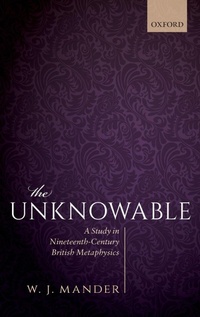
The Unknowable
A Study in Nineteenth-Century British Metaphysics
Published on 19. May 2020
Book
Hardback
328 pages
978-0-19-880953-1 (ISBN)
Description
W. J. Mander presents a history of metaphysics in nineteenth-century Britain. The story focuses on the elaboration of, and differing reactions to, the concept of the unknowable or unconditioned, first developed by Sir William Hamilton in the 1829. The idea of an ultimate but unknowable way that things really are in themselves may be seen as supplying a narrative arc that runs right through the metaphysical systems of the period in question. These thought schemes may be divided into three broad groups which were roughly consecutive in their emergence but also overlapping as they continued to develop. In the first instance there were the doctrines of the agnostics who developed further Hamilton's basic idea that fundamental reality lies for the great part beyond our cognitive reach. These philosophies were followed immediately by those of the empiricists and, in the last third of the century, the idealists: both of these schools of thought--albeit in profoundly different ways--reacted against the epistemic pessimism of the agnostics. Mander offers close textual readings of the main contributions to First Philosophy made by the key philosophers of the period (such as Hamilton, Mansel, Spencer, Mill, and Bradley) as well as some less well known figures (such as Bain, Clifford, Shadworth Hodgson, Ferrier, and John Grote). By presenting, interpreting, criticising, and connecting together their various contrasting ideas, this book explains how the three traditions developed and interacted with one another to comprise the history of metaphysics in Victorian Britain.
Reviews / Votes
W. J. Mander's book is admirably clear and yet compendious, giving the interested reader a fresh sense of both the whole and the parts of Victorian metaphysics. * Dwight Lindley, Newman Studies Journal * W. J. Mander's The Unknowable: A Study in Nineteenth-Century British Metaphysics is a valuable text for scholars of Victorian thought, whether they work in philosophical, metaphysical, or scientific domains. * Andrew Vincent, Victorian Studies *More details
Language
English
Place of publication
Oxford
United Kingdom
Target group
Professional and scholarly
Dimensions
Height: 240 mm
Width: 161 mm
Thickness: 22 mm
Weight
658 gr
ISBN-13
978-0-19-880953-1 (9780198809531)
Copyright in bibliographic data and cover images is held by Nielsen Book Services Limited or by the publishers or by their respective licensors: all rights reserved.
Schweitzer Classification
Other editions
Additional editions
E-Book
05/2020
1st Edition
OUP eBook
€58.99
Available for download
E-Book
05/2020
1st Edition
OUP eBook
€58.99
Available for download
Person
W.J.Mander is Professor of History of Modern Philosophy at Oxford University, where he is a Fellow of Harris Manchester College.
Content
Introduction
Part I: The Unconditioned
1: Sir William Hamilton
2: Henry Longueville Mansel
3: Herbert Spencer
4: Thomas Henry Huxley
Part II: Empiricist Objections
5: John Stuart Mill
6: Alexander Bain and George Croom Robertson
7: Shadworth Hollway Hodgson and William Kingdon Clifford
8: G.H.Lewes and Karl Pearson
Part III: Idealist Objections
9: James Frederick Ferrier
10: John Grote and James Hutchinson Stirling
11: The British Idealists
12: F.H.Bradley
Bibliography
Part I: The Unconditioned
1: Sir William Hamilton
2: Henry Longueville Mansel
3: Herbert Spencer
4: Thomas Henry Huxley
Part II: Empiricist Objections
5: John Stuart Mill
6: Alexander Bain and George Croom Robertson
7: Shadworth Hollway Hodgson and William Kingdon Clifford
8: G.H.Lewes and Karl Pearson
Part III: Idealist Objections
9: James Frederick Ferrier
10: John Grote and James Hutchinson Stirling
11: The British Idealists
12: F.H.Bradley
Bibliography