

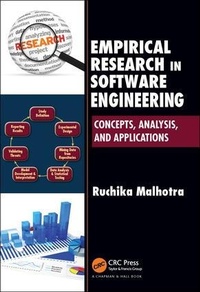
Empirical Research in Software Engineering
Concepts, Analysis, and Applications
1st Edition
Published on 5. October 2015
Book
Hardback
472 pages
978-1-4987-1972-8 (ISBN)
Description
Empirical research has now become an essential component of software engineering yet software practitioners and researchers often lack an understanding of how the empirical procedures and practices are applied in the field. Empirical Research in Software Engineering: Concepts, Analysis, and Applications shows how to implement empirical research processes, procedures, and practices in software engineering.
Written by a leading researcher in empirical software engineering, the book describes the necessary steps to perform replicated and empirical research. It explains how to plan and design experiments, conduct systematic reviews and case studies, and analyze the results produced by the empirical studies.
The book balances empirical research concepts with exercises, examples, and real-life case studies, making it suitable for a course on empirical software engineering. The author discusses the process of developing predictive models, such as defect prediction and change prediction, on data collected from source code repositories. She also covers the application of machine learning techniques in empirical software engineering, includes guidelines for publishing and reporting results, and presents popular software tools for carrying out empirical studies.
Written by a leading researcher in empirical software engineering, the book describes the necessary steps to perform replicated and empirical research. It explains how to plan and design experiments, conduct systematic reviews and case studies, and analyze the results produced by the empirical studies.
The book balances empirical research concepts with exercises, examples, and real-life case studies, making it suitable for a course on empirical software engineering. The author discusses the process of developing predictive models, such as defect prediction and change prediction, on data collected from source code repositories. She also covers the application of machine learning techniques in empirical software engineering, includes guidelines for publishing and reporting results, and presents popular software tools for carrying out empirical studies.
Reviews / Votes
"In this book, Dr. Malhotra uses her breadth of software engineering experience and expertise to give the reader coverage of many aspects of empirical software engineering. She covers the essential techniques and concepts needed for a researcher to get started on empirical software engineering research, including metrics, experimental design, analysis and statistical techniques, threats to the validity of any research findings, and methods and tools for empirical software engineering research. ... The book provides the reader with an introduction and overview of the field and is also backed by references to the literature, allowing the interested reader to follow up on the methods, tools, and concepts described."-From the Foreword by Mark Harman, University College London
More details
Language
English
Place of publication
Oxford
United States
Publishing group
Taylor & Francis Inc
Target group
College/higher education
Illustrations
185 s/w Tabellen, 140 s/w Abbildungen
185 Tables, black and white; 140 Illustrations, black and white
Dimensions
Height: 182 mm
Width: 261 mm
Thickness: 34 mm
Weight
1096 gr
ISBN-13
978-1-4987-1972-8 (9781498719728)
Copyright in bibliographic data and cover images is held by Nielsen Book Services Limited or by the publishers or by their respective licensors: all rights reserved.
Schweitzer Classification
Other editions
Additional editions
E-Book
03/2016
1st Edition
Chapman and Hall
€73.99
Available for download
E-Book
03/2016
Chapman & Hall/CRC
€73.99
Available for download
Person
Ruchika Malhotra is an assistant professor in the Department of Software Engineering at Delhi Technological University (formerly Delhi College of Engineering). She was awarded the prestigious UGC Raman Fellowship for pursuing post-doctoral research in the Department of Computer and Information Science at Indiana University-Purdue University. She received her master's and doctorate degrees in software engineering from the University School of Information Technology of Guru Gobind Singh Indraprastha University. She received the IBM Best Faculty Award in 2013 and has published more than 100 research papers in international journals and conferences. Her research interests include software testing, improving software quality, statistical and adaptive prediction models, software metrics, neural nets modeling, and the definition and validation of software metrics.
Content
Introduction. Systematic Literature Reviews. Software Metrics. Experimental Design. Mining Data from Software Repositories. Data Analysis and Statistical Testing. Model Development and Interpretation. Validity Threats. Reporting Results. Mining Unstructured Data. Demonstrating Empirical Procedures. Tools for Analyzing Data. Appendix. References. Index.