

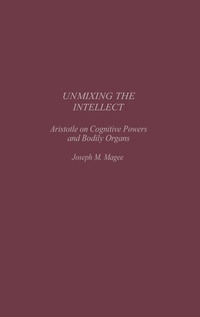
Unmixing the Intellect
Aristotle on Cognitive Powers and Bodily Organs
Published on 30. June 2003
Book
Hardback
184 pages
978-0-313-32377-5 (ISBN)
Description
In recent years the majority of scholarship on Aristotle's philosophy of mind has concentrated on his account of sensation and has generally sought to find in his ancient account insights applicable to contemporary materialistic explanations of mental life. Challenging cognitivist and functionalist interpretations, this volume argues that Aristotle believed the mind to be unmixed, or separate from the body. Through careful textual analysis of De Anima and other key texts, the author shows that the Greek philosopher made a clear distinction between perception-an activity realized in material sense organs-and thinking-a process that cannot occur in any material organ. This innovative interpretation of Aristotle's theory of cognitive activities is a worthy contribution to an ongoing debate.
More details
Language
English
Place of publication
United States
Publishing group
Bloomsbury Publishing Plc
Target group
College/higher education
Dimensions
Height: 240 mm
Width: 161 mm
Thickness: 14 mm
Weight
440 gr
ISBN-13
978-0-313-32377-5 (9780313323775)
Copyright in bibliographic data and cover images is held by Nielsen Book Services Limited or by the publishers or by their respective licensors: all rights reserved.
Schweitzer Classification
Other editions
Additional editions
E-Book
06/2003
1st Edition
Praeger Publishers Inc
€94.99
Available for download
Person
JOSEPH M. MAGEE is Director of Campus Ministry at the Catholic Student Center, Sam Houston State University,
Content
Preface Introduction Aristotle and Contemporary Theories of Mind The Separability of Nous and Cognitivist Functionalism The Similarities between Novc and Sense The Relationship of Sense Powers to Their Organs The Difference between Aisthesis and Nous Bibliography Index