

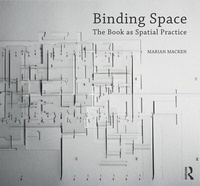
Binding Space: The Book as Spatial Practice
1st Edition
Published on 13. April 2018
Book
Paperback/Softback
186 pages
978-1-4724-8323-2 (ISBN)
Description
Books orient, intrigue, provoke and direct the reader while editing, interpreting, encapsulating, constructing and revealing architectural representation. Binding Space: The Book as Spatial Practice explores the role of the book form within the realm of architectural representation. It proposes the book itself as another three-dimensional, complementary architectural representation with a generational and propositional role within the design process.
Artists' books in particular - that is, a book made as an original work of art, with an artist, designer or architect as author - have certain qualities and characteristics, quite different from the conventional presentation and documentation of architecture. Paginal sequentiality, the structure and objecthood of the book, and the act of reading create possibilities for the book as a site for architectural imagining and discourse. In this way, the form of the book affects how the architectural work is conceived, constructed and read.
In five main sections, Binding Space examines the relationships between the drawing, the building and the book. It proposes thinking through the book as a form of spatial practice, one in which the book is cast as object, outcome, process and tool. Through the book, we read spatial practice anew.
Artists' books in particular - that is, a book made as an original work of art, with an artist, designer or architect as author - have certain qualities and characteristics, quite different from the conventional presentation and documentation of architecture. Paginal sequentiality, the structure and objecthood of the book, and the act of reading create possibilities for the book as a site for architectural imagining and discourse. In this way, the form of the book affects how the architectural work is conceived, constructed and read.
In five main sections, Binding Space examines the relationships between the drawing, the building and the book. It proposes thinking through the book as a form of spatial practice, one in which the book is cast as object, outcome, process and tool. Through the book, we read spatial practice anew.
More details
Series
Language
English
Place of publication
London
United Kingdom
Publishing group
Taylor & Francis Ltd
Target group
College/higher education
Professional and scholarly
Dimensions
Height: 240 mm
Width: 220 mm
Weight
670 gr
ISBN-13
978-1-4724-8323-2 (9781472483232)
Copyright in bibliographic data and cover images is held by Nielsen Book Services Limited or by the publishers or by their respective licensors: all rights reserved.
Schweitzer Classification
Other editions
Additional editions

Marian Macken
Binding Space: The Book as Spatial Practice
E-Book
04/2018
Routledge
€72.49
Available for download

Marian Macken
Binding Space: The Book as Spatial Practice
E-Book
04/2018
1st Edition
Routledge
€72.49
Available for download

Marian Macken
Binding Space: The Book as Spatial Practice
Book
04/2018
1st Edition
Routledge
€215.41
Shipment within 10-20 days
Person
Dr Marian Macken teaches in design and architectural media at the University of Auckland, New Zealand. Marian's research examines histories and theories of spatial representation; temporal aspects of architecture; and the book form, with particular interest in the implications and possibilities for architectural drawing and exhibition as design outcome. Her work has been acquired by various international public collections of artists' books.
Content
Part I Field: the scope of the book.
1. Artists' books: historical context
2 Qualities and characteristics of artists' books
3 Architecture and printed media
4 Recording time, place and memory
Part II Page: the book as cumulation
5 The line within architectural documentation
6 Architectural drawing and the page
Part III Volume: the book as vessel
7 The objecthood of the book
8 The book as folded model
9 The temporality of interiority
Part IV Series: the book as sequence
10 The reproducibility of drawings / buildings / books
11 The book as exhibition
Conclusion
Bibliography
Index
1. Artists' books: historical context
2 Qualities and characteristics of artists' books
3 Architecture and printed media
4 Recording time, place and memory
Part II Page: the book as cumulation
5 The line within architectural documentation
6 Architectural drawing and the page
Part III Volume: the book as vessel
7 The objecthood of the book
8 The book as folded model
9 The temporality of interiority
Part IV Series: the book as sequence
10 The reproducibility of drawings / buildings / books
11 The book as exhibition
Conclusion
Bibliography
Index