

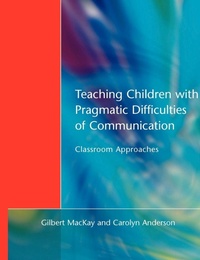
Teaching Children with Pragmatic Difficulties of Communication
Classroom Approaches
1st Edition
Published on 2. June 2000
Book
Paperback/Softback
128 pages
978-1-85346-650-2 (ISBN)
Description
First Published in 2000. In everyday life, 'pragmatic' means 'useful', 'functional' or 'what's right for just now'. In communication, it means just the same. This book has been written for teachers and speech and language therapists (SLTs) working in services for children who have difficulty communicating usefully.
More details
Language
English
Place of publication
London
United Kingdom
Publishing group
Taylor & Francis Ltd
Target group
College/higher education
Professional and scholarly
Academic and Professional Practice & Development
Dimensions
Height: 246 mm
Width: 189 mm
Thickness: 7 mm
Weight
272 gr
ISBN-13
978-1-85346-650-2 (9781853466502)
Copyright in bibliographic data and cover images is held by Nielsen Book Services Limited or by the publishers or by their respective licensors: all rights reserved.
Schweitzer Classification
Other editions
Additional editions
Gilber MacKay | Carolyn Anderson
Teaching Children with Pragmatic Difficulties of Communication
Classroom Approaches
Book
02/2017
1st Edition
Routledge
€185.50
Shipment within 10-20 days
Gilber MacKay | Carolyn Anderson
Teaching Children with Pragmatic Difficulties of Communication
Classroom Approaches
E-Book
12/2013
1st Edition
Routledge
€51.49
Available for download
Gilber MacKay | Carolyn Anderson
Teaching Children with Pragmatic Difficulties of Communication
Classroom Approaches
E-Book
12/2013
1st Edition
Routledge
€51.49
Available for download
Persons
Gilbert MacKay, Carolyn Anderson
Content
Chapter 1 Useful communication, Gilbert MacKay, Carolyn Anderson; Chapter 2 Actions and interactions: the roots of pragmatic communication, Gilbert MacKay; Chapter 3 Pragmatic communication difficulties, Carolyn Anderson; Chapter 4 Two case studies of pragmatic difficulties, Kirsty Gilbert; Chapter 5 Primary-age pupils with pragmatic difficulties, Gilbert MacKay; Chapter 6 It takes two to stammer: interaction factors and stammering, Roberta Lees; Chapter 7 The school as an integrated support system for pupils with pragmatic difficulties, Libby Roberts; Chapter 8 Systems for establishing and maintaining a service, Jennifer Lundie;