

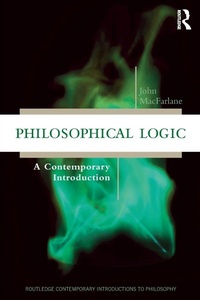
Philosophical Logic
A Contemporary Introduction
1st Edition
Published on 30. November 2020
Book
Paperback/Softback
238 pages
978-1-138-73765-5 (ISBN)
Description
Introductory logic is generally taught as a straightforward technical discipline. In this book, John MacFarlane helps the reader think about the limitations of, presuppositions of, and alternatives to classical first-order predicate logic, making this an ideal introduction to philosophical logic for any student who already has completed an introductory logic course.
The book explores the following questions. Are there quantificational idioms that cannot be expressed with the familiar universal and existential quantifiers? How can logic be extended to capture modal notions like necessity and obligation? Does the material conditional adequately capture the meaning of 'if'-and if not, what are the alternatives? Should logical consequence be understood in terms of models or in terms of proofs? Can one intelligibly question the validity of basic logical principles like Modus Ponens or Double Negation Elimination? Is the fact that classical logic validates the inference from a contradiction to anything a flaw, and if so, how can logic be modified to repair it? How, exactly, is logic related to reasoning? Must classical logic be revised in order to be applied to vague language, and if so how? Each chapter is organized around suggested readings and includes exercises designed to deepen the reader's understanding.
Key Features:
An integrated treatment of the technical and philosophical issues comprising philosophical logic
Designed to serve students taking only one course in logic beyond the introductory level
Provides tools and concepts necessary to understand work in many areas of analytic philosophy
Includes exercises, suggested readings, and suggestions for further exploration in each chapter
The book explores the following questions. Are there quantificational idioms that cannot be expressed with the familiar universal and existential quantifiers? How can logic be extended to capture modal notions like necessity and obligation? Does the material conditional adequately capture the meaning of 'if'-and if not, what are the alternatives? Should logical consequence be understood in terms of models or in terms of proofs? Can one intelligibly question the validity of basic logical principles like Modus Ponens or Double Negation Elimination? Is the fact that classical logic validates the inference from a contradiction to anything a flaw, and if so, how can logic be modified to repair it? How, exactly, is logic related to reasoning? Must classical logic be revised in order to be applied to vague language, and if so how? Each chapter is organized around suggested readings and includes exercises designed to deepen the reader's understanding.
Key Features:
An integrated treatment of the technical and philosophical issues comprising philosophical logic
Designed to serve students taking only one course in logic beyond the introductory level
Provides tools and concepts necessary to understand work in many areas of analytic philosophy
Includes exercises, suggested readings, and suggestions for further exploration in each chapter
Reviews / Votes
"This is the perfect book for coverage of classic debates in mainstream philosophy of logic. It's also the perfect source for exceptionally clear reviews of standard logical machinery (e.g., standard modal machinery, quantifier machinery, higher-order machinery, etc.). Very user-friendly, clear, and accurate on all of the topics that it covers, this is my new required text for classic debates in the philosophy of logic."Jc Beall, University of Notre Dame
"John MacFarlane displays his usual lively and engaging writing style, and is neutral on controversial issues, giving the arguments employed by both sides. It is an excellent overview of some key topics in the field."
Stewart Shapiro, Ohio State University
More details
Series
Language
English
Place of publication
London
United Kingdom
Publishing group
Taylor & Francis Ltd
Target group
College/higher education
Illustrations
8 s/w Abbildungen, 8 s/w Zeichnungen, 4 s/w Tabellen
4 Tables, black and white; 8 Line drawings, black and white; 8 Illustrations, black and white
Dimensions
Height: 229 mm
Width: 152 mm
Thickness: 14 mm
Weight
382 gr
ISBN-13
978-1-138-73765-5 (9781138737655)
Copyright in bibliographic data and cover images is held by Nielsen Book Services Limited or by the publishers or by their respective licensors: all rights reserved.
Schweitzer Classification
Other editions
Additional editions
Book
11/2020
1st Edition
Routledge
€207.80
Shipment within 10-20 days
E-Book
11/2020
1st Edition
Routledge
€52.49
Available for download
E-Book
11/2020
1st Edition
Routledge
€52.49
Available for download
Person
John MacFarlane is Professor of Philosophy and a member of the Group in Logic and the Methodology of Science at the University of California, Berkeley. He is the author of Assessment Sensitivity: Relative Truth and Its Applications (2014).
Content
1. Fundamentals 2. Quantifiers 3. Modal Logic 4. Conditionals 5. Logical Consequence via Models 6. Logical Consequence via Proofs 7. Relevance, Logic, and Reasoning 8. Vagueness and the Sorites Paradox