

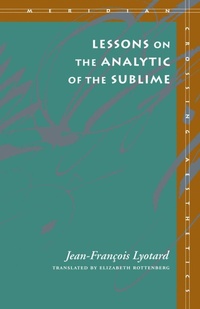
Lessons on the Analytic of the Sublime
Published on 1. March 1994
Book
Hardback
264 pages
978-0-8047-2241-4 (ISBN)
Description
Philosophical aesthetics has seen an amazing revival over the past decade, as a radical questioning of the very grounds of Western epistemology has revealed that some antinomies of aesthetic experience-and in particular of the limits of the aesthetical-can be viewed as a general, yet necessarily open model for human understanding. In this revival, no text in the classical corpus of Western philosophy has been more frequently discussed than the complex paragraphs modestly inserted into Kant's Critique of Judgment as sections 23-29: the Analytic of the Sublime.
This book is a rigorous explication de texte, a close reading of these sections. First, Lyotard reconstitutes, following the letter of Kant's analysis, the philosophical context of his critical writings and of the European Enlightenment. Second, because the analytic of the sublime reveals the inability of aesthetic experience to bridge the separate realms of theoretical and practical reason, Lyotard can connect his reconstitution of Kant's critical project with today's debates about the very conditions-and limits-of presentation in general.
Lyotard enables us to see the sublime as a model for reflexive thinking generally via his concept of the "differend," which emphasizes the inevitability of conflicts and incompatibilities between different notions and "phrases." The Analytic of the Sublime, he points out, tries to argue that human thought is always constituted through a similar incompatibility between different intellectual and affective faculties. These lessons thus highlight the analysis of a "differend of feeling" in Kant's text, which is also the analysis of a "feeling of differend," and connect this feeling with the transport that leads all thought (critical thought included) to its limits.
This book is a rigorous explication de texte, a close reading of these sections. First, Lyotard reconstitutes, following the letter of Kant's analysis, the philosophical context of his critical writings and of the European Enlightenment. Second, because the analytic of the sublime reveals the inability of aesthetic experience to bridge the separate realms of theoretical and practical reason, Lyotard can connect his reconstitution of Kant's critical project with today's debates about the very conditions-and limits-of presentation in general.
Lyotard enables us to see the sublime as a model for reflexive thinking generally via his concept of the "differend," which emphasizes the inevitability of conflicts and incompatibilities between different notions and "phrases." The Analytic of the Sublime, he points out, tries to argue that human thought is always constituted through a similar incompatibility between different intellectual and affective faculties. These lessons thus highlight the analysis of a "differend of feeling" in Kant's text, which is also the analysis of a "feeling of differend," and connect this feeling with the transport that leads all thought (critical thought included) to its limits.
More details
Series
Edition
New edition
Language
English
Place of publication
Palo Alto
United States
Target group
College/higher education
Professional and scholarly
Edition type
New edition
Product notice
Cloth
Dimensions
Height: 218 mm
Width: 145 mm
Thickness: 20 mm
Weight
408 gr
ISBN-13
978-0-8047-2241-4 (9780804722414)
Copyright in bibliographic data and cover images is held by Nielsen Book Services Limited or by the publishers or by their respective licensors: all rights reserved.
Schweitzer Classification