

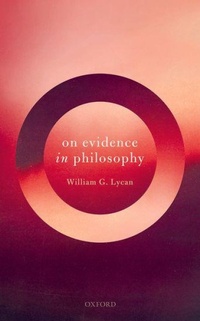
On Evidence in Philosophy
Published on 7. February 2019
Book
Hardback
160 pages
978-0-19-882972-0 (ISBN)
Description
In this book William G. Lycan offers an epistemology of philosophy itself, a partial method for philosophical inquiry. The epistemology features three ultimate sources of justified philosophical belief. First, common sense, in a carefully restricted sense of the term-the sorts of contingent propositions Moore defended against idealists and skeptics. Second, the deliverances of well confirmed science. Third and more fundamentally, intuitions about cases in a carefully specified sense of that term.
The first half of On Evidence in Philosophy expounds a version of Moore's method and applies it to each of several issues. This version is shown to resist all the standard objections to Moore; most of them do not even apply. It is argued, in Chapters 5 and 6, that philosophical method is far less powerful than most have taken it to be. In particular, deductive argument can accomplish very little, and hardly ever is an opposing position refuted except by common sense or by science. The final two chapters defend the evidential status of intuitions and the Goodmanian method of reflective equilibrium; it is argued that philosophy always and everywhere depends on them. The method is then set within a more general explanatory-coherentist epistemology, which is shown to resist standard forms of skepticism.
In sum, William G. Lycan advocates a picture of philosophy as a very wide explanatory reflective equilibrium incorporating common sense, science, and our firmest intuitions on any topic-and nothing more, not ever.
The first half of On Evidence in Philosophy expounds a version of Moore's method and applies it to each of several issues. This version is shown to resist all the standard objections to Moore; most of them do not even apply. It is argued, in Chapters 5 and 6, that philosophical method is far less powerful than most have taken it to be. In particular, deductive argument can accomplish very little, and hardly ever is an opposing position refuted except by common sense or by science. The final two chapters defend the evidential status of intuitions and the Goodmanian method of reflective equilibrium; it is argued that philosophy always and everywhere depends on them. The method is then set within a more general explanatory-coherentist epistemology, which is shown to resist standard forms of skepticism.
In sum, William G. Lycan advocates a picture of philosophy as a very wide explanatory reflective equilibrium incorporating common sense, science, and our firmest intuitions on any topic-and nothing more, not ever.
Reviews / Votes
William G. Lycan has written a short but action-packed book about why philosophical arguments don't establish skeptical or radically revisionary claims concerning the nature of reality or our capacities as knowers and agents. A terrific volume, it is sure to annoy or maybe even infuriate many philosophers who think highly of their own arguments. . . . Here is a philosopher who is deeply reflective, self-critical, and able to impart insights with concision and wit. I recommend the book to all philosophers interested in methodology, skepticism, and knowledge. * Nathan Ballantyne, Notre Dame Philosophical Reviews *More details
Language
English
Place of publication
Oxford
United Kingdom
Target group
Adult education
Product notice
sewn/stitched
Cloth over boards
Dimensions
Height: 223 mm
Width: 147 mm
Thickness: 17 mm
Weight
316 gr
ISBN-13
978-0-19-882972-0 (9780198829720)
Copyright in bibliographic data and cover images is held by Nielsen Book Services Limited or by the publishers or by their respective licensors: all rights reserved.
Schweitzer Classification
Other editions
Additional editions
William G. Lycan
On Evidence in Philosophy
E-Book
01/2019
1st Edition
OUP eBook
€29.49
Available for download
William G. Lycan
On Evidence in Philosophy
E-Book
01/2019
1st Edition
OUP eBook
€33.99
Available for download
Person
William G. Lycan is William Rand Kenan, Jr. Professor of Philosophy Emeritus at the University of North Carolina and currently Distinguished Visiting Professor at the University of Connecticut. He is author of Logical Form in Natural Language (1984), Knowing Who (with Steven Boer, 1986), Consciousness (1987), Judgement and Justification (1988), Modality and Meaning (1994), Consciousness and Experience (1996), Philosophy of Language: A Contemporary Introduction (Routledge 1999), and Real Conditionals (Oxford 2001).
Content
Introduction
1: A Version of Moore's Method
2: Moore against the New Skeptics
3: A Novel Refutation of Eliminative Materialism
4: Free Will and the Burden of Proof
5: The Poverty of Philosophical Method (a Case Study)
6: Philosophical Knowledge
7: The Evidential Status of Intuitions
8: Intuitions and Coherentism
Conclusion
1: A Version of Moore's Method
2: Moore against the New Skeptics
3: A Novel Refutation of Eliminative Materialism
4: Free Will and the Burden of Proof
5: The Poverty of Philosophical Method (a Case Study)
6: Philosophical Knowledge
7: The Evidential Status of Intuitions
8: Intuitions and Coherentism
Conclusion