

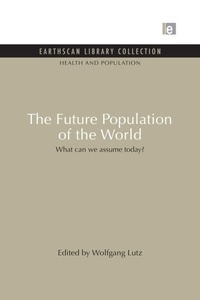
The Future Population of the World
What can we assume today
2nd Edition
Published on 12. April 2013
Book
Paperback/Softback
526 pages
978-0-415-85370-5 (ISBN)
Description
'An excellent basis for thinking about the future of the world's population. Every contributor to the population-environment debate needs to read the demographic sense the book contains and lecturers in population matters around the globe should recommend it to their students'
Applied Geography
'The most authoritative assessment available of the extent to which population is likely to grow'
Development and Cooperation
'Lutz and his colleagues at IIASA have done a masterful job of presenting and explaining the dominant approach to forecasting the world's population and the population of its 12 main regions'
Population and Development Review
'Immensely readable ... highly recommended'
Development and Change
The highly acclaimed The Future Population of the World contains the most authoritative assessment available of the extent to which population is likely to grow over the next 50 to 100 years. The book provides a thorough analysis of all the components of population change and translates these factors into a series of projections for the population of the world's regions.
This revised and updated version incorporates completely new scenario projections based on updating starting values and revised assumptions, plus several methodological improvements. It also contains the best currently available information on global trends in AIDS mortality and the first ever fully probabilistic world population projections.
The projections, given up to 2100, add important additional features to those of the UN and the World Bank: they show the impacts of alternative assumptions for all three components (mortality and migration, as well as fertility); they explicitly take into account possible environmental limits to growth; and, for the first time, they define confidence levels for global populations.
Combining methodological innovation with overviews of the most recent data and literature, this updated edition of The Future Population of the World is sure to conform its reputation as the most comprehensive and essential publication in the field.
Wolfgang Lutz is leader of the Population Project at IIASA and lecturer at the University of Vienna.
Originally published in 1996
Applied Geography
'The most authoritative assessment available of the extent to which population is likely to grow'
Development and Cooperation
'Lutz and his colleagues at IIASA have done a masterful job of presenting and explaining the dominant approach to forecasting the world's population and the population of its 12 main regions'
Population and Development Review
'Immensely readable ... highly recommended'
Development and Change
The highly acclaimed The Future Population of the World contains the most authoritative assessment available of the extent to which population is likely to grow over the next 50 to 100 years. The book provides a thorough analysis of all the components of population change and translates these factors into a series of projections for the population of the world's regions.
This revised and updated version incorporates completely new scenario projections based on updating starting values and revised assumptions, plus several methodological improvements. It also contains the best currently available information on global trends in AIDS mortality and the first ever fully probabilistic world population projections.
The projections, given up to 2100, add important additional features to those of the UN and the World Bank: they show the impacts of alternative assumptions for all three components (mortality and migration, as well as fertility); they explicitly take into account possible environmental limits to growth; and, for the first time, they define confidence levels for global populations.
Combining methodological innovation with overviews of the most recent data and literature, this updated edition of The Future Population of the World is sure to conform its reputation as the most comprehensive and essential publication in the field.
Wolfgang Lutz is leader of the Population Project at IIASA and lecturer at the University of Vienna.
Originally published in 1996
More details
Series
Edition
2nd edition
Language
English
Place of publication
London
United Kingdom
Publishing group
Taylor & Francis Ltd
Target group
College/higher education
Dimensions
Height: 234 mm
Width: 156 mm
Thickness: 29 mm
Weight
793 gr
ISBN-13
978-0-415-85370-5 (9780415853705)
Copyright in bibliographic data and cover images is held by Nielsen Book Services Limited or by the publishers or by their respective licensors: all rights reserved.
Schweitzer Classification
Other editions
Additional editions
E-Book
11/2013
2nd Edition
Routledge
€77.99
Available for download
E-Book
11/2013
2nd Edition
Routledge
€77.99
Available for download
Book
10/2009
2nd Edition
Earthscan Ltd
€215.41
Shipment within 3-4 weeks
Person
Wolfgang Lutz is leader of the Population Project at IIASA and lecturer at the University of Vienna. Originally published in 1996
Content
List of Illustrations
Foreword
Preface
Introduction
Contributors
Part I: Why Another Set of Global Population Projections?
1. Long-range Global Population Projections:
Lessons Learned
Tomas Frejka
2. Alternative Approaches to Population Projection
Wolfgang Lutz, Joshua R Goldstein, Christopher Prinz
Part II: Future Fertility in Developing Countries
3. A Regional Review of Fertility Trends in Developing Countries: 1960 to 1995
John Cleland
4. Reproductive Preferences and Future Fertility in Developing Countries
Charles F West08
5. Population Policies and Family-Planning in Southeast Asia
Mercedes B Conception
6. Fertility in China: Past, Present, Prospects
Grifith Feeney
Part III: Future Mortality in Developing Countries
7. Mortality Trends in Developing Countries: A Survey
Birgitta Bucht
8. Mortality in Sub-Saharan Africa: Trends and Prospects
Michel Garenne
9. Global Trends in AIDS Mortality
John Bongaarts
10. How Many People Can Be Fed on Earth?
Gerhard h' Heilig
Part IV: Future Fertility and Mortality in Industrialized Countries 251
11. Future Reproductive Behavior in Industrialized Countries
Wolfgang Lutz
12. The Future of Mortality at Older Ages in Developed Countries
James W Vaupel and Hans Lundstrom
Part V: The Future of Intercontinental Migration
13. Migration to and from Developing Regions: A Review of Past Trends
Hania Zlotnik
14. Spatial and Economic Factors in Future South-North Migration
Sture 0berg
Part VI: Projections
15. World Population Scenarios for the 21st Century
Wolfgang Lutz, Warren Sanderson, Sergei Scherbov, Anne Goujon
16. Probabilistic Population Projections Based on Expert Opinion
Wolfgang Lutz, Warren Sanderson, Sergei Scherbov
17. Epilogue: Dilemmas in Population Stabilization
Wolfgang Lutz
Appendix Tables
References
Index
Foreword
Preface
Introduction
Contributors
Part I: Why Another Set of Global Population Projections?
1. Long-range Global Population Projections:
Lessons Learned
Tomas Frejka
2. Alternative Approaches to Population Projection
Wolfgang Lutz, Joshua R Goldstein, Christopher Prinz
Part II: Future Fertility in Developing Countries
3. A Regional Review of Fertility Trends in Developing Countries: 1960 to 1995
John Cleland
4. Reproductive Preferences and Future Fertility in Developing Countries
Charles F West08
5. Population Policies and Family-Planning in Southeast Asia
Mercedes B Conception
6. Fertility in China: Past, Present, Prospects
Grifith Feeney
Part III: Future Mortality in Developing Countries
7. Mortality Trends in Developing Countries: A Survey
Birgitta Bucht
8. Mortality in Sub-Saharan Africa: Trends and Prospects
Michel Garenne
9. Global Trends in AIDS Mortality
John Bongaarts
10. How Many People Can Be Fed on Earth?
Gerhard h' Heilig
Part IV: Future Fertility and Mortality in Industrialized Countries 251
11. Future Reproductive Behavior in Industrialized Countries
Wolfgang Lutz
12. The Future of Mortality at Older Ages in Developed Countries
James W Vaupel and Hans Lundstrom
Part V: The Future of Intercontinental Migration
13. Migration to and from Developing Regions: A Review of Past Trends
Hania Zlotnik
14. Spatial and Economic Factors in Future South-North Migration
Sture 0berg
Part VI: Projections
15. World Population Scenarios for the 21st Century
Wolfgang Lutz, Warren Sanderson, Sergei Scherbov, Anne Goujon
16. Probabilistic Population Projections Based on Expert Opinion
Wolfgang Lutz, Warren Sanderson, Sergei Scherbov
17. Epilogue: Dilemmas in Population Stabilization
Wolfgang Lutz
Appendix Tables
References
Index