

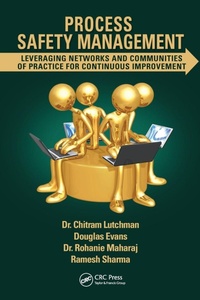
Process Safety Management
Leveraging Networks and Communities of Practice for Continuous Improvement
1st Edition
Will be published approx. on 15. June 2026
Book
Paperback/Softback
244 pages
978-1-041-22100-5 (ISBN)
Description
The continued prevalence of major incidents (most recently the 2010 BP Gulf of Mexico Oil Spill) and preponderance of workplace fatalities and injuries as well as Process Safety Management (PSM) Incidents, globally, begs the question: why do incidents continue to occur in today's technologically advanced era? More importantly, with 80-85 percent of incidents being repeated, the more obvious questions are:
Why do organizations fail to learn from prior incidents internal to the business?
Why do organizations fail to learn from their peers and other same industry players?
Why do organizations fail to learn from the incidents and experiences of other industries?
Process Safety Management: Leveraging Networks and Communities of Practice for Continuous Improvement
provides a road map organizations can use to identify and setup critical networks for preventing catastrophic incidents and for sharing knowledge in an organized manner within the organization to enhance business performance. The book helps organizations establish centers of excellence by activating networks for generating best practices and practical solutions to workplace business, and safety challenges.
The book covers the full range of activation of networks including identifying members, defining goals and objectives, and prioritizing work through leadership and stewardship of networks. It addresses all elements of effective safety management and includes simple, easy-to-follow processes that bring about lasting changes to workplace safety. It also highlights the health and safety needs of both Generation X and Generation Y who currently inherit the workplace but are very different in learning behaviors and experience levels.
In a thin margins business environment characterized by scarce resources, operational discipline and excellence drives stakeholder confidence and corporate performance. Detailing the practical application of tested principles and practices, this book provides a simple path forward for organizations to recognize the benefits of networks and to proactively establish and support them within organizations to generate continuous and sustained improvement in work practices, procedures, and business performance.
Why do organizations fail to learn from prior incidents internal to the business?
Why do organizations fail to learn from their peers and other same industry players?
Why do organizations fail to learn from the incidents and experiences of other industries?
Process Safety Management: Leveraging Networks and Communities of Practice for Continuous Improvement
provides a road map organizations can use to identify and setup critical networks for preventing catastrophic incidents and for sharing knowledge in an organized manner within the organization to enhance business performance. The book helps organizations establish centers of excellence by activating networks for generating best practices and practical solutions to workplace business, and safety challenges.
The book covers the full range of activation of networks including identifying members, defining goals and objectives, and prioritizing work through leadership and stewardship of networks. It addresses all elements of effective safety management and includes simple, easy-to-follow processes that bring about lasting changes to workplace safety. It also highlights the health and safety needs of both Generation X and Generation Y who currently inherit the workplace but are very different in learning behaviors and experience levels.
In a thin margins business environment characterized by scarce resources, operational discipline and excellence drives stakeholder confidence and corporate performance. Detailing the practical application of tested principles and practices, this book provides a simple path forward for organizations to recognize the benefits of networks and to proactively establish and support them within organizations to generate continuous and sustained improvement in work practices, procedures, and business performance.
Reviews / Votes
"... very elegantly present the case that formal and informal social and organizational networks, coupled with shared learning about safety from previous incidents as well as experiences within other industries, are the key to preventing safety issues. ... the most refreshing treatment of safety management that I have ever encountered ... has high value for practitioners, especially senior- and executive-level managers who have responsibility for designing, implementing, and assessing effective safety management approaches."-Dr. Nicole Radziwill in ASQ: Quality Management, April 2014
More details
Language
English
Place of publication
London
United Kingdom
Publishing group
Taylor & Francis Ltd
Target group
Professional and scholarly
Professional Practice & Development
Illustrations
24 s/w Tabellen, 29 s/w Abbildungen
24 Tables, black and white; 29 Illustrations, black and white
Dimensions
Height: 234 mm
Width: 156 mm
Weight
450 gr
ISBN-13
978-1-041-22100-5 (9781041221005)
Copyright in bibliographic data and cover images is held by Nielsen Book Services Limited or by the publishers or by their respective licensors: all rights reserved.
Schweitzer Classification
Other editions
Additional editions
Chitram Lutchman | Douglas Evans | Rohanie Maharaj
Process Safety Management
Leveraging Networks and Communities of Practice for Continuous Improvement
Book
07/2013
1st Edition
CRC Press
€165.90
Shipment within 15-20 days
Chitram Lutchman | Douglas Evans | Rohanie Maharaj
Process Safety Management
Leveraging Networks and Communities of Practice for Continuous Improvement
E-Book
07/2013
1st Edition
CRC Press
€158.99
Available for download

Chitram Lutchman | Douglas Evans | Rohanie Maharaj
Process Safety Management
Leveraging Networks and Communities of Practice for Continuous Improvement
E-Book
07/2013
1st Edition
CRC Press
€158.99
Available for download
Persons
Chitram Lutchman, Douglas Evans, Rohanie Maharaj, Ramesh Sharma
Content
Historical perspective - Review of Operationally Discipline / Excellent Organizations. Elements of an Operationally Excellent Management System. Leadership Behaviors for Operational Discipline and Excellence. Setting the Baseline. Identifying and Prioritizing the Gaps. Networks - Defining Membership. Activating and Tenure Setting for the Network. Network Conference - Training and Chartering. Network Focus and Work Priorities. Defining the Community of Practice. Network Performance Management and Monitoring. Performance Targets and Key Performance Indicators. Sharing Learnings and Best Practices for Sustained Success. Conclusion. References.