

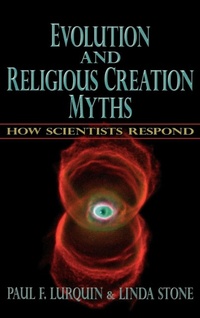
Evolution and Religious Creation Myths
How Scientists Respond
Published on 12. July 2007
Book
Hardback
240 pages
978-0-19-531538-7 (ISBN)
Description
Relying mostly on modern genetic science, this book exposes how various forms of creationism - including intelligent design - fail to provide testable models for the appearance and evolution of life. On the contrary, science has been very successful in the description of the unguided processes that led to the creation of the universe and one of its consequences, the appearance of life forms, including humans.
Reviews / Votes
I strongly recommend the purchase of this reference title for school, public and academic libraries. It is the perfect resource for senior high school students and undergraduates researching the debate between evolution and creationism. * STREAMS *More details
Language
English
Place of publication
New York
United States
Illustrations
8 halftones, 18 line illus.
Dimensions
Height: 235 mm
Width: 157 mm
Thickness: 19 mm
Weight
546 gr
ISBN-13
978-0-19-531538-7 (9780195315387)
Copyright in bibliographic data and cover images is held by Nielsen Book Services Limited or by the publishers or by their respective licensors: all rights reserved.
Schweitzer Classification
Other editions
Additional editions
E-Book
07/2007
1st Edition
OUP eBook
€18.99
Available for download
E-Book
07/2007
1st Edition
OUP eBook
€24.99
Available for download
Persons
Content
Chapter 1.: Creationism and Intelligent Design: The evolution of an idea.
Chapter 2.: What is evolutionary biology and where is it coming from?
Chapter 3.: Creationist purpose and irreducible complexity rebutted
Chapter 4.: The origins and evolution of Homo sapiens
Chapter 5.: The origins of life and the cosmos as evolutionary themes
Chapter 6.: Evolution of the DNA world and the chance events that accompanied it. More about complexity
Chapter 7.: The dangers of creationism
Appendix I: The Brusselator
Appendix II: Experiments for educators
Glossary
Further Reading
Chapter 2.: What is evolutionary biology and where is it coming from?
Chapter 3.: Creationist purpose and irreducible complexity rebutted
Chapter 4.: The origins and evolution of Homo sapiens
Chapter 5.: The origins of life and the cosmos as evolutionary themes
Chapter 6.: Evolution of the DNA world and the chance events that accompanied it. More about complexity
Chapter 7.: The dangers of creationism
Appendix I: The Brusselator
Appendix II: Experiments for educators
Glossary
Further Reading