

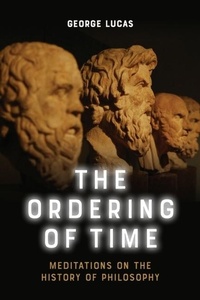
The Ordering of Time
Meditations on the History of Philosophy
Published on 15. September 2020
Book
Hardback
184 pages
978-1-4744-7855-7 (ISBN)
Description
What is the history of philosophy? What exactly is this the history of and how is that history to be understood in relationship to philosophy itself? Can philosophy's history, on any of a number of diverse descriptions, ever be said in its own right to constitute a unique and genuine source of philosophical wisdom or insight?
George Lucas sweeps aside the constraints of traditional methodological and cultural boundaries to reflect broadly on a variety of answers to these questions, as posed by many of the major philosophical figures of the past century. Inviting a re-consideration of the work of scholars as diverse as Alasdair MacIntyre, Leo Strauss, Jacques Derrida, Michel Foucault, Richard Rorty, Hans-Georg Gadamer, Bertrand Russell, Arthur Danto, Martha Nussbaum, Paul Ricoeur, Charles Taylor, Keith Lehrer and Jerome Schneewind, Lucas ranges widely over the history of philosophy itself in search of original, probing answers to these profound and perennial issues.
George Lucas sweeps aside the constraints of traditional methodological and cultural boundaries to reflect broadly on a variety of answers to these questions, as posed by many of the major philosophical figures of the past century. Inviting a re-consideration of the work of scholars as diverse as Alasdair MacIntyre, Leo Strauss, Jacques Derrida, Michel Foucault, Richard Rorty, Hans-Georg Gadamer, Bertrand Russell, Arthur Danto, Martha Nussbaum, Paul Ricoeur, Charles Taylor, Keith Lehrer and Jerome Schneewind, Lucas ranges widely over the history of philosophy itself in search of original, probing answers to these profound and perennial issues.
Reviews / Votes
Full of great insights about the point and mode of philosophy both as history and as normative work helping readers better understand themselves as philosophers in their historical context. Summing Up: Highly recommended. -- A. Jaeger, Benedictine College * CHOICE connect * George Lucas has provided the reader with an engaging invitation to consider the importance of the history of philosophy at a time when philosophers have turned away from the study of the great ideas it contains. This work is fundamental for anyone who wishes to think through what philosophy is. * Donald Phillip Verene, Emory University * An engaging and masterful interpretation of the history of Western philosophy,?The Ordering of Time?is much more than that.? Profoundly ethical, this is a book for our times, troubled as they are by doomful threats such as the COVID-19 pandemic, global economic depression, and climate change. George Lucas shows how to care about the past-its injustice as well as its grandeur and everyday facticity-so that we recover and respect insights that make life worth living and presenting to those who follow after us. * John K. Roth, Edward J. Sexton Professor of Philosophy, Claremont McKenna College *More details
Language
English
Place of publication
Edinburgh
United Kingdom
Target group
Professional and scholarly
Product notice
sewn/stitched
Cloth over boards
Dimensions
Height: 239 mm
Width: 163 mm
Thickness: 18 mm
Weight
454 gr
ISBN-13
978-1-4744-7855-7 (9781474478557)
Copyright in bibliographic data and cover images is held by Nielsen Book Services Limited or by the publishers or by their respective licensors: all rights reserved.
Schweitzer Classification
Other editions
Additional editions
E-Book
09/2020
Edinburgh University Press
€0.00
Available for download
Person
George Lucas is Distinguished Chair of Ethics and Professor Emeritus of Philosophy at The United States Naval Academy. He is General Editor of The Edinburgh Critical Edition of the Complete Works of Alfred North Whitehead.
Content
Preface and Acknowledgements; Introduction: Injustice in the Margins of Time and History; 1. Ordering Time: Thinking with the Presocratics; 2. The Tragical History of Doctor Beneke; 3. Philosophy's Recovery of its History; 4. Three Rival Conceptions of Philosophical Discourse; 5. Art, Philosophy and the Shapes of the Past; 6. A New Methodology for Philosophy; 7. The Critique of Enlightenment and the Question Concerning Metaphysics; 8. Scientific Revolutions and the Search for Covariant Metaphysical Principles; 9. People without a Name; Bibliography; Index.