

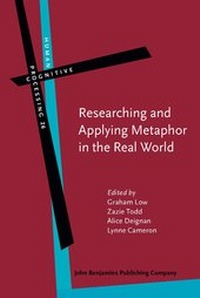
Researching and Applying Metaphor in the Real World
Published on 13. October 2010
Book
Hardback
385 pages
978-90-272-2380-7 (ISBN)
Description
It has become increasingly clear that metaphor needs to be explored in terms of the social and discourse context in which it is used, especially where the aim is to address real-world problems. The notion of 'real world' metaphor research has been developed to describe this important area of investigation. This book starts by describing the nature and scope of real world metaphor research and then illustrates, through 17 detailed, mainly empirically-based studies, the different areas it can apply to, and different methodologies that can be employed. Research problems are explored in areas such as artificial intelligence, language teaching and learning, reconciliation dialogue, university lecture discourse, poetry and wine description. Methods include corpus analysis, experimentation, discourse analysis, cross-cultural analysis and genre analysis. In each case the empirical studies refer back to Gibbs's opening overview of real-world research. The result is an invaluable and cross-referenced collection of papers addressing real-world problems.
More details
Series
Language
English
Place of publication
Amsterdam
Netherlands
Target group
Professional and scholarly
Dimensions
Height: 245 mm
Width: 164 mm
Weight
850 gr
ISBN-13
978-90-272-2380-7 (9789027223807)
Copyright in bibliographic data and cover images is held by Nielsen Book Services Limited or by the publishers or by their respective licensors: all rights reserved.
Schweitzer Classification
Other editions
Additional editions
Graham Low | Zazie Todd | Alice Deignan
Researching and Applying Metaphor in the Real World
E-Book
10/2010
1st Edition
John Benjamins Publishing Company
€118.99
Available for download
Persons
Content
1. Editors' introduction (by Low, Graham); 2. 1. The wonderful, chaotic, creative, heroic, challenging world of Researching and Applying Metaphor: A celebration of the past and some peeks into the future (by Gibbs, Jr., Raymond W.); 3. 1. Metaphor and language learning; 4. 2. Can people be cold and warm?: Developing understanding of figurative meanings of temperature terms in early EFL (by Piquer-Piriz, Ana Maria); 5. 3. Grasping the point: A study of 15-year-old students' comprehension of metaphorical expressions in schoolbooks (by Golden, Anne); 6. 4. "Drugs, traffic, and many other dirty interests": Metaphor and the language learner (by Philip, Gill); 7. 5. The gaps to be filled: The (mis)treatment of the polysemous senses of hand, cool and run in EFL text books (by Chavez, Elisabet Amaya); 8. 6. A cross-cultural study of metaphoric understanding (by Wang, Chongying); 9. 2. Capturing and analysing metaphors; 10. 7. Love, metaphor and responsibility: Some examples from Early Modern and Present-Day English corpora (by Tissari, Heli); 11. 8. A critical look at the desktop metaphor 30 years on (by Terkourafi, Marina); 12. 9. Pragglejaz in practice: Finding metaphorically used words in natural discourse (by Steen, Gerard J.); 13. 10. Mapping principles for conceptual metaphors (by Ahrens, Kathleen); 14. 11. Systematicity in metaphor and the use of invariant mappings (by Wallington, Alan M.); 15. 12. Attitude, style and context: Matching cognitive and aesthetic accounts of poetic interpretation (by Brouwer, Elsbeth C.); 16. 13. A genre approach to imagery in winespeak: Issues and prospects (by Caballero, Rosario); 17. 3. The function of metaphor in discourse; 18. 14. Wot no similes?: The curious absence of simile in university lectures (by Low, Graham); 19. 15. Metaphor marking and metaphor typological and functional ranges in business periodicals (by Skorczynska Sznajder, Hanna); 20. 16. Critical analysis of creative metaphors in political speeches (by Muller, Ralph); 21. 17. Metaphor in physical-and-speech action expressions (by Cameron, Lynne); 22. 18. The evaluative properties of metaphors (by Deignan, Alice); 23. Index of names; 24. Index of terms