


Researching and Applying Metaphor in the Real World
1st Edition
Published on 13. October 2010
XII, 385 pages
978-90-272-8777-9 (ISBN)
Description

It has become increasingly clear that metaphor needs to be explored in terms of the social and discourse context in which it is used, especially where the aim is to address real-world problems. The notion of 'real world' metaphor research has been developed to describe this important area of investigation. This book starts by describing the nature and scope of real world metaphor research and then illustrates, through 17 detailed, mainly empirically-based studies, the different areas it can apply to, and different methodologies that can be employed. Research problems are explored in areas such as artificial intelligence, language teaching and learning, reconciliation dialogue, university lecture discourse, poetry and wine description. Methods include corpus analysis, experimentation, discourse analysis, cross-cultural analysis and genre analysis. In each case the empirical studies refer back to Gibbs's opening overview of real-world research. The result is an invaluable and cross-referenced collection of papers addressing real-world problems.
More details
Other editions
Additional editions
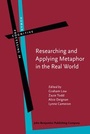
Graham Low | Zazie Todd | Alice Deignan
Researching and Applying Metaphor in the Real World
Book
10/2010
John Benjamins Publishing Co
€100.70
Shipment within 10-15 days
Persons
Content
- Researching and Applying Metaphor in the Real World
- Editorial page
- Title page
- LCC data
- Table of contents
- Editors' introduction
- 1. The wonderful, chaotic, creative, heroic, challenging world of Researching and Applying Metaphor
- 1. Introduction
- 2. The scope of real-world metaphor research
- 3. Ongoing struggles
- 4. Important analytic advances
- 5. Some peeks into the future
- 6. Metaphorical aesthetics
- 7. Conclusion
- References
- Section 1. Metaphor and language learning
- 2. Can people be cold and warm? Developing understanding of figurative meanings of temperature terms in early EFL
- 1. Introduction
- 2. Warm and cold and domain knowledge
- 3. Method
- 4. Conclusions
- Notes
- References
- Appendix
- 3. Grasping the point: A study of 15-year-old students' comprehension of metaphorical expressions in schoolbooks
- 1. Introduction
- 2. Background
- 3. Comprehension research: Focus on methods
- 4. Research questions
- 5. Participants
- 6. Procedure
- 7. Comprehension testing
- 8. Findings
- 9. Variability in expressions
- 10. Results from the sets
- 11. Summary - The variability of the expressions
- 12. Discussion
- 13. General results and remedies
- Notes
- References
- 4. "Drugs, traffic, and many other dirty interests": Metaphor and the language learner
- 1. Introduction
- 2. Metaphor and language learning
- 3. Encoding idiomatic meaning in the L2
- 4. Collocation and conceptualisation
- 5. Encoding L1 concepts in the L2: The creation of opaque metaphor
- 6. Conclusions
- Notes
- References
- 5. The gaps to be filled: Hand, cool and run in EFL text books
- 1. Introduction: Polysemy in the EFL classroom
- 2. Method
- 3. Description of results
- 4. Summary of results
- 5. The presentation and practice of hand, cool and run
- 6. Conclusions
- Acknowledgements
- Notes
- References
- 6. A cross-cultural study of metaphoric understanding
- 1. Introduction
- 2. Experiment 1
- 3. Experiment 2
- 4. General discussion and conclusion
- References
- Appendix
- Section 2. Capturing and analysing metaphors
- 7. Love, metaphor and responsibility: Some examples from Early Modern and Present-Day English corpor
- 1. Introduction
- 2. Examples from the data
- 3. Conclusions
- Notes
- References
- 8. A critical look at the desktop metaphor 30 years on
- 1. Introduction
- 2. The Desktop Metaphor as an interface
- 3. From the command prompt to the virtual desktop
- 4. Summary
- Notes
- References
- 9. Pragglejaz in practice
- 1. Introduction
- 2. Demonstration
- 3. More about demarcating lexical units
- 4. More about contextual meanings and basic meanings
- 5. The role of etymology: Diachronic versus synchronic approaches to meanings
- 6. More about distinctness and similarity
- 7. Concluding remarks
- Acknowledgements
- References
- 10. Mapping principles for conceptual metaphors
- 1. Introduction
- 2. The Conceptual Mapping Model
- 3. Psycholinguistic experiments
- 4. Off-line acceptability ratings of metaphors
- 5. Off-line interpretability ratings on metaphors
- 6. On-line acceptability decision experiment
- 7. On-line interpretability ratings of metaphors
- 8. Discussion and conclusion
- Acknowledgements
- Notes
- References
- 11. Systematicity in metaphor and the use of invariant mappings
- 1. Introduction
- 2. Domains
- 3. Correspondence approaches and map-transcending entities
- 4. Invariant transfers
- 5. Invariant mappings and systematicity
- 6. Conclusion
- Acknowledgements
- Notes
- References
- 12. Attitude, style and context: Matching cognitive and aesthetic accounts of poetic interpretation
- 1. Introduction
- 2. Diagnosing the poetic
- 3. Interpretation in practice: Extending the cognitivist approach
- Acknowledgements
- Notes
- References
- 13. A genre approach to imagery in winespeak
- 1. Introduction
- 2. The research context: The TN genre
- 3. Identifying figurative schemas in TNs
- 4. Classifying the figurative language in the TNs
- 5. Interpreting the figurative language in TNs
- 6. Conclusions
- Notes
- References
- Section 3. The function of metaphor in discourse
- 14. Wot no similes? The curious absence of simile in university lectures
- 1. Introduction
- 2. Simile and metaphorical simile
- 3. Identifying similes in discourse
- 4. What similes do
- 5. Four university lectures
- 6. Findings
- 7. Discussion
- 8. Conclusion
- Notes
- Acknowledgements
- References
- 15. Metaphor marking and metaphor typological and functional ranges in business periodicals
- 1. Introduction
- 2. The framework of study
- 3. Corpus and methodology
- 4. Results
- 5. Conclusions
- References
- 16. Critical analysis of creative metaphors in political speeches
- 1. Introduction
- 2. "Creative" and "creativity"
- 3. Creativity and political speeches
- 4. The gravitational centre of the European Integration
- 5. Metaphor and genres
- 6. Creative mappings
- 7. A critical analysis of creative metaphors
- References
- 17. Metaphor in physical-and-speech action expressions
- Background
- Physical-and-speech action expressions: (1) sit down and talk
- Physical-and-speech action expressions: (2) turn round and say
- Other physical-and-speech action verbs in the focus group data
- Conclusion
- Notes
- References
- Appendix
- 18. The evaluative properties of metaphors
- Introduction
- Mechanisms through which metaphors evaluate
- Analysing metaphors using corpora
- Multiword figurative expressions
- Conclusion
- References
- Index of names
- Index of terms
- The series Human Cognitive Processing
