

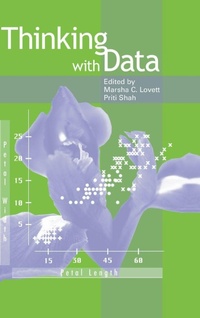
Thinking With Data
1st Edition
Published on 22. May 2007
Book
Hardback
320 pages
978-0-8058-5421-3 (ISBN)
Description
The chapters in Thinking With Data are based on presentations given at the 33rd Carnegie Symposium on Cognition. The Symposium was motivated by the confluence of three emerging trends: (1) the increasing need for people to think effectively with data at work, at school, and in everyday life, (2) the expanding technologies available to support people as they think with data, and (3) the growing scientific interest in understanding how people think with data.
What is thinking with data? It is the set of cognitive processes used to identify, integrate, and communicate the information present in complex numerical, categorical, and graphical data. This book offers a multidisciplinary presentation of recent research on the topic. Contributors represent a variety of disciplines: cognitive and developmental psychology; math, science, and statistics education; and decision science. The methods applied in various chapters similarly reflect a scientific diversity, including qualitative and quantitative analysis, experimentation and classroom observation, computational modeling, and neuroimaging. Throughout the book, research results are presented in a way that connects with both learning theory and instructional application.
The book is organized in three sections:
Part I focuses on the concepts of uncertainty and variation and on how people understand these ideas in a variety of contexts.
Part II focuses on how people work with data to understand its structure and draw conclusions from data either in terms of formal statistical analyses or informal assessments of evidence.
Part III focuses on how people learn from data and how they use data to make decisions in daily and professional life.
What is thinking with data? It is the set of cognitive processes used to identify, integrate, and communicate the information present in complex numerical, categorical, and graphical data. This book offers a multidisciplinary presentation of recent research on the topic. Contributors represent a variety of disciplines: cognitive and developmental psychology; math, science, and statistics education; and decision science. The methods applied in various chapters similarly reflect a scientific diversity, including qualitative and quantitative analysis, experimentation and classroom observation, computational modeling, and neuroimaging. Throughout the book, research results are presented in a way that connects with both learning theory and instructional application.
The book is organized in three sections:
Part I focuses on the concepts of uncertainty and variation and on how people understand these ideas in a variety of contexts.
Part II focuses on how people work with data to understand its structure and draw conclusions from data either in terms of formal statistical analyses or informal assessments of evidence.
Part III focuses on how people learn from data and how they use data to make decisions in daily and professional life.
More details
Series
Language
English
Place of publication
Philadelphia
United States
Publishing group
Taylor & Francis Inc
Target group
College/higher education
Professional and scholarly
Dimensions
Height: 235 mm
Width: 157 mm
Thickness: 31 mm
Weight
854 gr
ISBN-13
978-0-8058-5421-3 (9780805854213)
Copyright in bibliographic data and cover images is held by Nielsen Book Services Limited or by the publishers or by their respective licensors: all rights reserved.
Schweitzer Classification
Other editions
Additional editions
Marsha C. Lovett | Priti Shah
Thinking With Data
Book
05/2007
1st Edition
Psychology Press
€62.00
Shipment within 10-20 days
Marsha C. Lovett | Priti Shah
Thinking With Data
E-Book
05/2007
1st Edition
Psychology Press Ltd
€52.49
Available for download
Marsha C. Lovett | Priti Shah
Thinking With Data
E-Book
05/2007
1st Edition
Psychology Press Ltd
€52.49
Available for download
Persons
Lovett, Marsha C. ; Shah, Priti
Content
Contents: Preface. Part I:Reasoning About Uncertainty and Variation. A. Masnick, D. Klahr, B. Morris, Separating Signal From Noise: Children's Understanding of Error and Variability in Experimental Outcomes. C. Schunn, L. Saner, S. Kirschenbaum, J.G. Trafton, E.B. Littleton, Complex Visual Data Analysis, Uncertainty, and Representation. S. Trickett, J.G. Trafton, L. Saner, C. Schunn,"I Don't Know What's Going on There": The Use of Spatial Transformations to Deal With and Resolve Uncertainty in Complex Visualizations. B. delMas, Y. Liu, Students' Conceptual Understanding of the Standard Deviation. J. Garfield, B. delMas, B. Chance, Using Students' Informal Notions of Variability to Develop an Understanding of Formal Measures of Variability. R. Lehrer, L. Schauble, Contrasting Emerging Conceptions of Distribution in Contexts of Error and Natural Variation. G. Leinhardt, J. Larreamendy-Joerns, Discussion of Part I: Variation in the Meaning and Learning of Variation. Part II:Statistical Reasoning and Data Analysis. K. Dunbar, J. Fugelsang, C. Stein, Do Naive Theories Ever Go Away? Using Brain and Behavior to Understand Changes in Concepts. P. Thompson, Y. Liu, L. Saldanha, Intricacies of Statistical Inference and Teachers' Understandings of Them. K. McNeill, J. Krajcik, Middle School Students' Use of Appropriate and Inappropriate Evidence in Writing Scientific Explanations. C. Konold, Designing a Data Analysis Tool for Learners. M. Lovet, N. Chang, Data-Analysis Skills: What and How Are Students Learning? D.L. Schwartz, D. Sears, J. Chang, Reconsidering Prior Knowledge. K. Koedinger, Discussion of Part II: Statistical Reasoning and Data Analysis. Part III: Learning From and Making Decisions With Data.D. Danks, Causal Learning From Observations and Manipulations. P. Sedlmeier, Statistical Reasoning: Valid Intuitions Put to Use. W.B. de Bruin, J. Downs, B. Fischhoff, Adolescents' Thinking About the Risks of Sexual Behaviors. M. Burrage, M. Epstein, P. Shah, Discussion of Part III: Learning From and Making Decisions About Data.